


The Complete Guide to Unit Owner Insurance
Why Your Condo Needs More Than Just the Master Policy
Title: Protecting Your Condo Lifestyle. Caption: While the master policy protects the building itself, like the one pictured, unit owner insurance secures your personal space and finances within the shared community. Source: PTL Insurance Associates, Inc.; Condo living benefits; Financial security; HO-6 Insurance; Master policy limitations; Importance of personal coverage;
Unit owner insurance is a specialized type of home insurance that protects what your condominium association’s master policy doesn’t cover—your personal belongings, interior upgrades, liability inside your unit, and potentially costly special assessments from the association.
Quick Answer: What Unit Owner Insurance Covers
- Personal Property: Furniture, electronics, clothing, and valuables inside your unit
- Interior Improvements: Kitchen renovations, upgraded flooring, custom fixtures you’ve added
- Personal Liability: Legal protection if someone is injured in your unit or you damage another unit
- Loss Assessment Coverage: Protection against surprise bills from the condo association’s master policy deductible (often $100,000+)
- Additional Living Expenses: Hotel and food costs if your unit becomes uninhabitable after a covered loss
Many condo owners mistakenly believe their association’s master policy covers everything. It doesn’t. The master policy typically covers only the building’s structure and common areas—lobbies, hallways, the roof, and shared amenities. Everything inside your unit, from your couch to your custom backsplash, falls on you to insure. Without your own policy, you’re exposed to significant financial risk from theft, fire, water damage, or lawsuits.
In Florida especially, where hurricanes and flooding pose real threats, understanding the gap between what the association covers and what you’re personally responsible for isn’t optional—it’s essential. The difference between “walls-in” and “bare walls” coverage in your association’s master policy can mean tens of thousands of dollars out of your pocket after a loss.
I’m Niki Perez, and after years in Real Estate Management Services, I’ve seen how critical unit owner insurance is for protecting your investment and avoiding financial surprises. At PTL Insurance Associates, Inc., my husband Erik and I help Miami condo owners steer these exact coverage gaps every day.
Condo Association Insurance vs. Unit Owner Insurance: What’s the Difference?
When you own a condominium unit, you’re part of a unique ownership structure. Unlike a single-family home, your property is intertwined with a larger building and community. This distinction is crucial when it comes to insurance. Your condo association, often legally required to do so, maintains a master insurance policy for the entire property. However, this master policy doesn’t cover everything. That’s where your personal unit owner insurance policy comes in, designed to fill the gaps and protect your individual interests.
The relationship between the master policy and your individual policy can be complex, and understanding it is key to ensuring you have comprehensive coverage. Some master policies might offer “all-in” coverage, which includes fixtures and improvements within units as they were originally built. Others provide “bare walls” coverage, which only protects the structural elements, leaving almost everything inside your unit for you to insure. We recommend reviewing your association’s declaration of co-ownership or condo documents to understand their “standard unit definition” and the specifics of their Condo Association Insurance policy. This will clarify what the association covers and where your responsibilities begin.
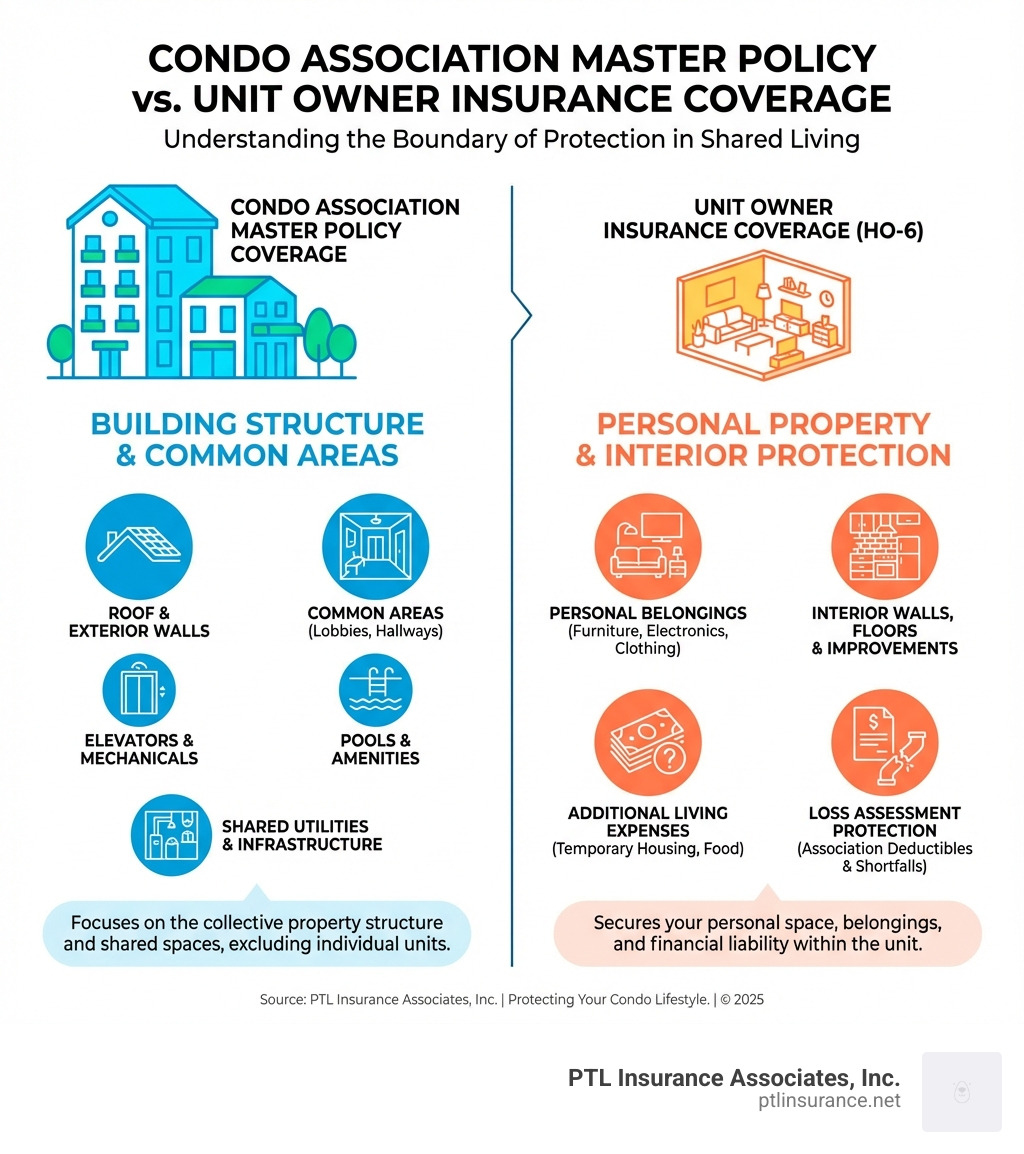
The infographic below clearly illustrates this division of responsibilities, showing what the master policy covers versus what your personal unit owner policy protects.
What the Condo Association’s Master Policy Covers
The condo association’s master policy is primarily responsible for the building itself and its shared components. Think of it as the insurance for everything outside your unit’s “shell” and often the original interior structure. This typically includes:
- Building Exterior and Structure: The foundation, roof, exterior walls, and structural components of the entire building.
- Common Areas: Lobbies, hallways, elevators, stairwells, and shared recreational facilities like pools, gyms, and clubhouses.
- Building Systems: Electrical, plumbing, and HVAC systems that serve multiple units or the common areas.
- Association Liability: Protection for the association if someone is injured in a common area or if damage occurs due to the association’s negligence. This is essentially the Common Area Insurance for the entire complex.
While the master policy is vital, it’s designed to protect the collective interests of the association, not your individual unit’s contents or specific upgrades.
What Your Personal Unit Owner Policy Covers
Your personal unit owner insurance policy, often referred to as an HO-6 policy, is your shield against the risks specific to your individual unit. It complements the master policy by covering what’s inside your four walls and protecting you from personal liability. Here’s what your Condo Insurance Coverage typically includes:
- Your Personal Belongings: This is everything you own inside your unit—furniture, electronics, clothing, kitchenware, and decorations.
- Interior Walls and Finishes: Unlike a house, your condo association typically doesn’t cover your interior walls, flooring, or paint. Your policy steps in here.
- Upgrades and Renovations: Any improvements or betterments you’ve made to your unit, such as new kitchen cabinets, upgraded flooring, or custom bathroom fixtures, are covered by your policy.
- Personal Liability: If a guest is injured in your unit, or if you accidentally cause damage to a neighbor’s unit (e.g., a overflowing bathtub), your personal liability coverage protects you from legal and financial repercussions. This coverage often extends worldwide.
- Additional Living Expenses (ALE): If a covered loss makes your unit uninhabitable, your policy can cover temporary housing, food, and other necessary expenses while repairs are underway.
- Master Policy Deductibles and Loss Assessments: This crucial coverage protects you from potentially large out-of-pocket costs that the association might pass on to unit owners after a claim.
Understanding these distinctions is the first step toward building a robust insurance safety net for your condo in Miami.
A Deep Dive into Your Unit Owner Insurance Coverage
This section details the core protections included in a standard HO6 Condo Insurance policy, ensuring you understand exactly what you’re paying for.
Personal Property Coverage
One of the primary reasons to carry unit owner insurance is to protect your personal belongings. Imagine a fire, theft, or water leak damaging everything you own inside your unit. Your policy provides the financial means to replace these items. This covers everything from your furniture and electronics to your clothing and kitchen gadgets.
When selecting coverage, you’ll often choose between:
- Replacement Cost (RC): This pays to replace your damaged or stolen items with new ones of similar kind and quality, without deduction for depreciation. We generally recommend this option for better protection.
- Actual Cash Value (ACV): This pays the depreciated value of your items, which means you’ll receive less than what it would cost to buy them new.
It’s also important to note that standard policies often have special limits for high-value items like jewelry, furs, art, or collectibles. If you own such items, we can help you schedule them separately on your policy. This means listing them individually with an appraised value to ensure they are fully covered. To accurately determine the amount of coverage you need, we highly recommend creating a detailed Personal Property Inventory. Take photos or videos, keep receipts, and store this inventory securely off-site.
Personal Liability Protection
Accidents happen, and when you own a condo, you could be held responsible for them. Personal liability coverage is a cornerstone of your unit owner insurance policy. It protects you financially if you’re found legally responsible for bodily injury to another person or damage to their property, whether the incident occurs in your unit or even elsewhere in the world.
Consider these scenarios:
- A guest slips and falls on a wet floor in your kitchen, breaking an arm.
- Water from an overflowing sink in your unit leaks into the unit below, causing significant damage.
- Your child accidentally throws a baseball through a neighbor’s window in the common area.
Your liability coverage would step in to cover legal defense costs, medical payments to the injured party, and property damage expenses, up to your policy limits. While your condo association has HOA General Liability Insurance for common areas, it doesn’t cover incidents that happen within your private unit. We typically recommend a liability limit of at least $1 million, and often higher, depending on your assets and risk profile.
Improvements and Betterments
One of the joys of condo ownership is customizing your space. Whether you’ve installed new kitchen cabinets, upgraded your bathroom fixtures, or laid down beautiful new flooring, these are considered “improvements and betterments.” These are alterations or additions made to your individual unit that improve its value or functionality beyond the original builder-grade finishes.
The crucial point here is that the condo association’s master policy usually covers the unit as it was originally built, or “bare walls,” meaning it does not cover these upgrades. If a fire or water leak damages your custom kitchen, the master policy might only cover the cost of replacing the original, basic fixtures. Your unit owner insurance policy, especially if you have All In Coverage Condo, is designed to cover the cost of repairing or replacing these valuable improvements. It’s essential to keep records and documentation of all your renovations and upgrades to ensure they are accurately reflected in your policy’s coverage amount.
Loss Assessment and Deductible Coverage
This is arguably one of the most critical,, coverages for condo owners. Your condo association’s master policy will have a deductible, just like your personal policy. These deductibles can be substantial, often ranging from $25,000 to over $100,000, and in some cases, even higher. If a major incident, like a fire or hurricane, impacts common areas or multiple units, and the association files a claim, the master policy’s deductible must be paid.
When the association is faced with a large deductible or if the damage exceeds the master policy’s limits, they can pass a “loss assessment” to individual unit owners to cover the shortfall. This means you could receive a bill for thousands of dollars as your share of the association’s deductible or uninsured losses. Your unit owner insurance policy’s loss assessment coverage is designed to protect you from this financial shock. It pays your portion of these assessments, up to your policy limits. Without this coverage, you could be left with a hefty, unexpected expense.
Customizing Your Policy for Unique Risks and Valuables
A basic policy is a great start, but tailoring your coverage with endorsements ensures you’re protected against specific threats, especially in a place like Florida.
Protecting Your Unit from Water Damage
Water damage is consistently one of the most frequent and costly types of claims in home insurance. In a condo, a burst pipe in your unit, an overflowing appliance, or even a leak from an upstairs neighbor’s unit can cause significant damage to your property and belongings. Your unit owner insurance policy typically covers accidental and sudden water damage from sources like burst pipes or appliance leaks originating within your unit.
However, it’s crucial to understand the limitations:
- Sewer Backup & Overland Water: Standard policies often exclude damage from sewer backups or “overland water” (water that flows over the ground, like from heavy rain or snowmelt). These require special endorsements to be covered.
- Flood Damage: Damage from rising water, such as a storm surge or river overflow, is almost always excluded from standard property policies. For this, you need a separate flood insurance policy. Given our location, protecting your condo in Condo Insurance Miami Florida from water damage is paramount.
Common Optional Coverages for your unit owner insurance
Beyond the core coverages, several optional endorsements can significantly improve your unit owner insurance protection:
- Earthquake Endorsement: While less common in Florida than other regions, it’s an optional coverage for those concerned, covering damage from seismic activity.
- Identity Theft Protection: This endorsement can provide financial assistance and resources to help you recover from identity theft, covering legal fees, lost wages, and other expenses.
- Unit Contingency Coverage: This can provide additional protection if the master policy’s coverage is insufficient to fully rebuild your unit to its original condition after a major loss.
- Loss of Use / Additional Living Expenses (ALE): As mentioned earlier, this covers temporary living costs if your unit becomes uninhabitable due to a covered peril. We often refer to this as the “hotel bill” coverage.
For a more detailed look at these and other options, consult our Condo Insurance Coverage Guide.
Special Considerations for Florida Condo Owners
Living in Florida brings unique joys and unique risks. Our beautiful coastline and tropical climate mean we must be particularly mindful of hurricane season and flood zones. When it comes to Condo Insurance Florida, these are non-negotiable considerations:
- Hurricane Deductibles: Unlike standard deductibles, hurricane deductibles are typically a percentage of your unit’s insured value (e.g., 2% or 5%). This means a $200,000 unit with a 5% hurricane deductible would mean you pay the first $10,000 out of pocket for hurricane-related damage.
- Windstorm Coverage: This is often a separate component of your policy or provided by a state-backed insurer, covering damage specifically caused by wind from named storms.
- Flood Zones and Regulations: Many areas in Miami and across Florida are in designated flood zones. Standard unit owner insurance policies do not cover flood damage. We strongly advise obtaining a separate flood insurance policy through the National Flood Insurance Program (NFIP) or a private insurer. The NFIP offers policies like the Residential Condominium Building Association Policy (RCBAP) for associations and the Dwelling Form for unit owners, which can cover your personal property and interior finishes from flood damage.
- Building Code Compliance: After a major storm, local building codes may require repairs or rebuilding to higher standards. Your policy should include coverage for increased costs due to ordinance or law to ensure you can comply.
Navigating Premiums, Quotes, and Policy Reviews
Securing the right policy at the right price requires understanding what influences costs and what information you’ll need to provide.
Factors That Influence Your unit owner insurance Premium
Several elements contribute to the cost of your unit owner insurance premium. Understanding these can help you find ways to save and ensure you’re getting a fair rate:
- Property Location: Your condo’s location in Miami, including its specific zip code and proximity to the coast, significantly impacts rates, especially due to hurricane and flood risks.
- Building Age and Construction: Newer buildings with modern construction materials and updated systems often have lower premiums.
- Claims History: Both your personal claims history and the claims history of your condominium association can affect your rates.
- Coverage Limits: Higher coverage amounts for personal property, liability, and loss assessment will naturally lead to higher premiums.
- Deductible Amount: Choosing a higher deductible (the amount you pay out-of-pocket before insurance kicks in) can lower your premium, but ensure it’s an amount you can comfortably afford in an emergency.
- Value of Personal Property: The total value of your belongings directly influences your personal property coverage costs.
- Safety Features: Features like alarm systems, sprinkler systems, and gated communities can sometimes qualify you for discounts.
For a deeper dive into how these factors play out, check out our insights on Condo Insurance Rates.
Information Needed for an Accurate Quote
To provide you with the most accurate and competitive quote for your unit owner insurance, we’ll need some key pieces of information. Having these ready will streamline the process:
- Personal Details: Your full name, contact information, and date of birth.
- Property Address: The full address of your condominium unit.
- Building Construction Type: Details on how the building is constructed (e.g., concrete block, frame).
- Year Built: The year your condominium building was constructed.
- Desired Coverage Amounts: Estimates for your personal property value, liability limits, and loss assessment coverage.
- Copy of Condo Declarations/Bylaws: This helps us understand the specifics of your association’s master policy, including their deductible and “standard unit definition.”
- Information on Safety Features: Details about any alarm systems, sprinkler systems, gated community access, or other protective measures.
- Claims History: Any past insurance claims you’ve made.
Reviewing and Renewing Your Policy Annually
Your unit owner insurance isn’t a “set it and forget it” kind of purchase. We strongly recommend reviewing and renewing your policy annually. Many things can change over a year that could impact your coverage needs:
- Life Changes: Have you made significant renovations or added valuable new items like electronics, art, or jewelry? These changes need to be reflected in your policy.
- Master Policy Changes: Your condo association’s master policy can change. Deductibles might increase, or coverage limits might be adjusted. We can help you understand how these changes might create new gaps in your protection.
- Ensuring No Coverage Gaps: An annual review is the perfect opportunity to ensure your policy continues to align with your needs and that there are no unforeseen gaps between your policy and the association’s.
Working with an independent broker like us at PTL Insurance Associates, Inc. means you have a partner dedicated to staying on top of these changes and finding the best coverage for you, year after year.
Frequently Asked Questions about Unit Owner Insurance
Do I really need unit owner insurance if my condo association has a master policy?
Yes, absolutely. This is one of the most common misconceptions among condo owners. While your condo association’s master policy covers the building’s structure and common areas, it does not cover your personal belongings, your interior unit finishes and improvements, or your personal liability for incidents that occur within your unit. Furthermore, if the master policy faces a large deductible or a claim exceeds its limits, the association can levy a “loss assessment” against unit owners, which you would be responsible for paying out-of-pocket without your own unit owner insurance coverage. Your policy is essential to protect your personal assets and financial well-being.
How much loss assessment coverage should I get?
To determine the appropriate amount of loss assessment coverage, we recommend reviewing your condo association’s master policy, specifically noting their deductible amount. A good starting point for your own policy is coverage that at least matches the master policy deductible, as this is a common amount you could be assessed. However, depending on the building’s financial health and potential risks, you might consider higher limits. An experienced agent can review your building’s specific situation and provide a custom recommendation based on our Condo Insurance Limits Ultimate Guide.
Is flood damage covered by a standard unit owner insurance policy?
No, a standard unit owner insurance policy explicitly excludes flood damage, which is defined as damage from rising water. This includes events like storm surge, river overflow, or heavy rainfall causing water to accumulate and enter your unit from the ground up. To protect your condo from flood damage, especially crucial in coastal areas like Miami Beach, you need a separate flood insurance policy, typically obtained through the National Flood Insurance Program (NFIP) or a private flood insurer. We strongly advise all Florida condo owners to assess their flood risk and consider purchasing this vital coverage.
Conclusion: Secure Your Condo and Your Peace of Mind
Navigating the complexities of condominium ownership requires more than just understanding your property lines; it demands a clear grasp of your insurance responsibilities. As we’ve explored, unit owner insurance is not just an option—it’s an essential safeguard for your finances, your personal property, and your liability where the master policy stops. It bridges the critical gaps that exist between what your condo association covers and what you, as an individual owner, are responsible for.
The value of having a personalized policy cannot be overstated, especially in a dynamic environment like Miami, Florida, with its unique risks. At PTL Insurance Associates, Inc., we pride ourselves on providing personalized guidance and tailoring coverage options to fit your unique needs. With over 35 years of experience, we understand these complexities and are here to help you steer clear of unexpected financial burdens.
Don’t leave your investment to chance. Let us help you secure the peace of mind that comes with knowing you’re fully protected.

