


Common Area Insurance: Essential for 2025 Protection
Why Common Area Insurance is Your Community’s Financial Lifeline
Title: Shared Community Spaces in a Modern HOA Complex
Caption: Well-maintained common areas like pools, clubhouses, and landscaped grounds are vital assets for any HOA or condominium community.
Source: PTL Insurance Associates, Inc.
Common area insurance is the master policy that protects the shared spaces and assets of a homeowners association (HOA) or condominium from property damage and liability claims. With over 53% of U.S. owner-occupied homes governed by an HOA, this coverage is a critical financial safeguard for millions.
This essential policy covers property damage to facilities like clubhouses and pools, provides liability protection for injuries in common spaces, and helps with legal defense costs. It is a legal requirement for HOA boards and condominium associations in most states.
Imagine a fallen tree damages your community clubhouse, or someone slips on a wet pool deck and sues. Without proper insurance, these incidents could trigger special assessments costing each homeowner thousands. While your individual HO-6 policy protects your unit’s interior, the HOA’s master policy safeguards the shared investments that make your community valuable.
At PTL Insurance, we specialize in helping HOAs and property owners steer these complex coverage needs to protect their shared investments and peace of mind.
Defining Common Areas and Shared Spaces
To understand common area insurance, you must first know what constitutes a “common area” in an HOA or condominium community. This distinction is key to understanding insurance responsibilities.
What Constitutes a “Common Area”?
A common area is any part of the community shared and used by all residents. These spaces belong to the community as a whole and are the HOA’s responsibility to maintain and insure.
Common examples include:
- Amenities: Clubhouses, pools, community gyms, and playgrounds.
- Building Infrastructure: Lobbies, hallways, elevators, and rooftops.
- Grounds: Parking lots, landscaped areas, and walkways.
The HOA’s master policy, often called condo association insurance or apartment complex insurance, is responsible for insuring these collective spaces.
Common Areas vs. Limited Common Elements
A critical distinction exists between common areas and “limited common elements.” While common areas are for everyone, limited common elements are shared spaces designated for the exclusive use of specific homeowners.
For example, a community swimming pool is a common area. However, a balcony or patio attached to your unit is a limited common element—it’s part of the building’s structure, but only you use it. Other examples include assigned parking spaces or shared walls between units.
This distinction affects insurance responsibility. The HOA’s master policy generally covers the structural integrity of both common areas and limited common elements. However, responsibility for non-structural aspects, like the surface of a patio, may fall to the homeowner. Your HOA’s governing documents (CC&Rs and bylaws) will define unit-specific responsibility, clarifying who pays for what. It is crucial to read these documents carefully.
The Essentials of Common Area Insurance
Common area insurance is the master policy held by an HOA or condominium association to protect its collective assets and shield it from financial loss. This coverage is not just recommended; it’s often a legal requirement and is fundamental to the community’s financial stability. It covers property damage to shared structures from perils like fire or storms and provides liability protection against lawsuits from injuries in common areas. Without it, a single major incident could force the HOA to levy large special assessments on all homeowners.
Key Types of Coverage for HOAs
A comprehensive community association insurance program includes several layers of protection:
- Property Insurance: The core coverage for physical assets like clubhouses, roofs, and shared equipment against perils such as fire, wind, and vandalism.
- General Liability Insurance: Protects against claims of bodily injury or property damage occurring on common grounds, covering legal fees, medical costs, and settlements.
- Directors & Officers (D&O) Insurance: A crucial policy that protects board members from personal liability for alleged wrongful acts or mismanagement.
- Fidelity/Crime Insurance: Safeguards the association’s funds (dues, reserves) from theft or embezzlement by board members, managers, or employees.
- Umbrella/Excess Liability: Provides an extra layer of liability protection above the limits of other policies, which is vital for catastrophic events or large lawsuits.
- Workers’ Compensation: Legally required if the HOA employs staff, this covers medical expenses and lost wages for work-related injuries.
Why Directors & Officers (D&O) Insurance is Essential
D&O insurance is vital for any HOA board. Volunteers on the board make important decisions about finances, maintenance, and rules, which can sometimes lead to legal challenges. D&O protects these individuals from personal liability if they are sued for actions taken in their official capacity.
This coverage addresses lawsuits related to:
- Alleged breach of fiduciary duty or mismanagement of funds.
- Negligence in maintaining common areas.
- Improper enforcement of rules or discriminatory practices.
Without D&O insurance, board members’ personal assets could be at risk. This protection is essential for attracting and retaining qualified, dedicated leaders to serve the community without fear of personal financial ruin.
Master Policy vs. Individual Policy: Bridging the Coverage Gap
A common source of confusion for homeowners is understanding where the HOA’s master policy ends and their personal coverage begins. Misunderstanding this relationship can lead to costly coverage gaps.
The Role of the HOA’s Master Policy
The HOA’s master policy, or common area insurance, is the primary protection for the community’s structure and shared elements. The extent of coverage depends on the policy type:
- Bare walls coverage: The most basic form, covering the building’s exterior, framing, and common areas, but stopping at the drywall of your unit.
- Single entity coverage: Covers everything in a bare walls policy, plus the original fixtures inside your unit (e.g., standard cabinets, flooring). It does not cover owner upgrades.
- All-in coverage: The most comprehensive option, covering the building, common areas, original fixtures, and any improvements or additions made by unit owners.
Regardless of the type, the master policy always covers liability for incidents in shared spaces.
Your Individual Homeowner’s (HO-6) Policy
An HO-6 policy, or “walls-in” coverage, is designed to protect what the master policy doesn’t. Key coverages include:
- Personal Property: Your furniture, electronics, clothing, and other belongings.
- Unit Interiors: Depending on the master policy, this can include everything from paint and flooring to cabinets and fixtures.
- Improvements and Betterments: Covers the value of any upgrades you’ve made to your unit, like a renovated kitchen or updated bathroom.
- Personal Liability: Protects you if someone is injured inside your unit or if you cause damage to a neighbor’s property (e.g., a washing machine leak).
As the infographic below illustrates, understanding how these policies interact is key to ensuring you are fully protected.
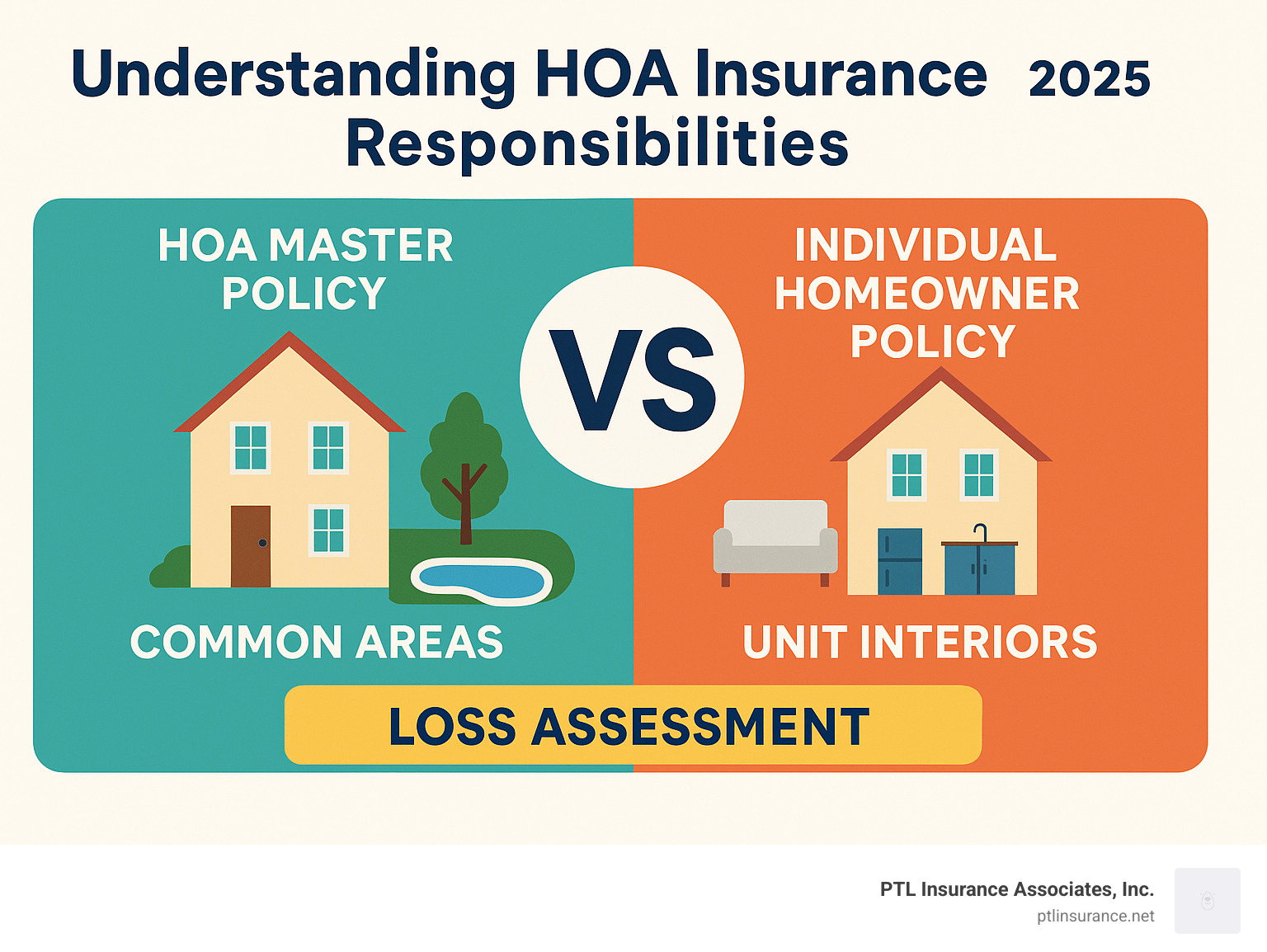
Title: HOA vs. Homeowner Insurance Responsibilities
Caption: Visual guide to what is covered by the HOA master policy versus individual homeowner policies, and where loss assessment fits in.
Source: PTL Insurance Associates, Inc.
Loss Assessment Coverage: Your Financial Safety Net
Even with a strong master policy, an HOA may need to issue a special assessment to cover costs that exceed policy limits or fall within a large deductible. Loss assessment coverage, an endorsement on your HO-6 policy, is designed to cover your share of these assessments. It protects you from unexpected bills for:
- Major property claims that exceed the master policy’s limit.
- Deductible shortfalls where the HOA assesses owners to cover a high deductible.
- Liability claims that surpass the association’s liability coverage.
We recommend carrying a substantial amount of loss assessment coverage, as these assessments can be financially devastating.
Financial & Legal Responsibilities for HOAs
The HOA board holds significant financial and legal duties, acting as the guardian of the community’s assets and well-being.
Who Obtains and Pays for the Insurance?
The HOA’s Board of Directors, often with a property manager’s help, is responsible for securing and maintaining common area insurance. The cost is paid by homeowners through regular homeowner dues, a portion of which is allocated for insurance premiums. In case of a major event where insurance payouts are insufficient, the board may need to levy special assessments—one-time charges to homeowners to cover the shortfall.
Legal Obligations and Governing Documents
Maintaining proper insurance is a legal duty. State laws often mandate specific types and amounts of coverage for common areas. Additionally, an HOA’s own governing documents (CC&Rs and Bylaws) legally bind the board to specific insurance requirements. Finally, mortgage lenders like Fannie Mae have their own insurance standards that must be met for buyers to secure financing, directly impacting property values.
Factors That Influence Insurance Costs
The cost of common area insurance is influenced by several factors:
- Location: Proximity to risks like hurricanes (e.g., Miami), floods, or high crime rates.
- Building Construction & Age: Newer, well-maintained buildings with superior construction often receive better rates.
- Claims History: A history of frequent claims leads to higher premiums.
- Amenities: Pools, gyms, and playgrounds increase liability risk and costs.
- Property Value & Deductible: Higher property values require more coverage, while a higher deductible can lower premiums but increase out-of-pocket costs for the HOA after a claim.
Potential Consequences of Inadequate Common Area Insurance
Cutting corners on coverage can be catastrophic. The risks include:
- Financial Ruin: A major uninsured loss could bankrupt the association.
- Massive Special Assessments: Homeowners could face huge, unexpected bills.
- Lawsuits: The board and association could be sued for negligence.
- Decreased Property Values: Underinsured communities are less attractive to buyers and lenders, making it difficult to sell units.
- Personal Liability: In extreme cases, homeowners could be held personally liable for judgments against the HOA.
A Homeowner’s Guide to HOA Insurance
As a homeowner in an HOA, you are a stakeholder with the right to know how your shared assets are protected. Being proactive is key to safeguarding your investment.
How to Verify Your HOA Has Adequate Coverage
- Request Documents: Ask the board or property manager for the master policy, certificate of insurance, and governing documents (CC&Rs).
- Review the Certificate of Insurance: This one-page summary provides key details like policy limits and deductibles.
- Assess Policy Limits: Question whether the property coverage is enough to rebuild shared amenities and if liability limits are sufficient for a major lawsuit.
- Attend Board Meetings: Use these meetings to ask questions about insurance renewals, claims, and coverage levels.
- Get a Professional Opinion: If you have concerns, an independent insurance professional can review the policy for potential gaps.
What to Do if Your Board Claims Insurance Isn’t Needed
A board that dismisses the need for common area insurance is a major red flag. In this situation:
- Cite Governing Documents: Your CC&Rs and bylaws almost certainly require the HOA to maintain insurance.
- Reference State Law: Most states legally mandate property and liability insurance for HOAs.
- Organize with Neighbors: A group of concerned residents has a stronger voice than an individual.
- Seek Legal Counsel: If the board remains non-compliant, an attorney specializing in HOA law can advise on your legal options.
The cost of insurance is minimal compared to the financial devastation of an uninsured loss.
What is the Best Way to Handle a Claim Involving a Common Area?
- Notify the HOA Board Immediately: Report any damage or liability incident to your board or property manager promptly. They are responsible for filing the claim.
- Document Everything: Take photos/videos of the damage or incident. Note the date, time, and any witnesses.
- Contact Your Own Insurer: If the incident affects your unit or results in a special assessment, notify your personal HO-6 insurance provider.
- Understand the Deductible: If repair costs are below the master policy’s deductible, the HOA will likely assess homeowners to cover the cost. This is where your loss assessment coverage is vital.
- File a Loss Assessment Claim: When you receive an official assessment notice from the HOA, file a claim under your policy’s loss assessment coverage. The notice triggers your ability to file this claim.
Infographic: Understanding HOA Insurance Responsibilities
Title: HOA vs. Homeowner Insurance Responsibilities
Caption: Visual guide to what is covered by the HOA master policy versus individual homeowner policies, and where loss assessment fits in.
Source: PTL Insurance Associates, Inc.
Conclusion: Securing Your Community’s Future
Common area insurance is not just an expense; it’s the financial foundation that secures your community’s strength and stability. It protects the shared investments of every homeowner, from the pool and clubhouse to the building’s very structure.
Understanding the interplay between the HOA’s master policy, your individual HO-6 policy, and crucial loss assessment coverage is essential for complete protection. Proactive management by the board and shared responsibility from informed homeowners are key to achieving financial security. Proper coverage ensures that a major disaster doesn’t lead to devastating special assessments or decreased property values.
Robust common area insurance provides peace of mind, allowing residents to enjoy their community and board members to serve without fear of personal liability. It’s the cornerstone of smart risk management for any shared community.
At PTL Insurance Associates, Inc., we have over 35 years of experience helping Miami communities steer complex insurance needs. As independent brokers, we work for you to find custom solutions. We’ve seen how the right coverage prevents minor incidents from becoming community-wide financial disasters.
For a comprehensive review of your HOA’s master policy or your personal condo insurance, ensure you’re fully protected with a custom commercial property insurance plan. Protecting your shared investment is our priority.

