


Condo Association Insurance: Crucial Guide 2025
What is Condo Association Insurance and Why is it Crucial?
Condo association insurance is a specialized business insurance policy that protects condominium communities from financial losses related to common areas, building structures, and liability claims. This master policy is paid for through association fees and serves as the financial backbone protecting your community’s shared assets.
Here’s what condo association insurance typically covers:
- Building structure – Roof, exterior walls, foundations, and structural elements
- Common areas – Lobbies, hallways, elevators, pools, gyms, and recreational facilities
- General liability – Protection against lawsuits from injuries in shared spaces
- Association property – Equipment, landscaping, walkways, and parking areas
- Legal defense costs – Coverage for lawsuits against the association
What it doesn’t cover:
- Individual unit interiors and personal belongings (requires separate HO-6 policy)
- Personal liability for individual unit owners
- Unit improvements or betterments made by owners
The Foundation of Community Protection
Every condominium association, cooperative, and planned unit development needs this protection. As one industry expert noted, “Directors, officers, trustees, employees, or even volunteers for a community homeowners association can be held personally liable for decisions and actions made on behalf of their association.”
The board of directors has a fiduciary duty to protect the community’s assets through proper risk management. Without adequate insurance, a single lawsuit or major property damage could result in devastating special assessments for all unit owners.
Why Your Community Can’t Afford to Be Without It
The financial impact of being uninsured can be catastrophic. A slip-and-fall accident in the lobby, storm damage to the roof, or a discrimination lawsuit against the board could cost hundreds of thousands of dollars. Many mortgage lenders actually require proof of adequate association insurance before approving unit purchases, making it essential for maintaining property values.
Research from the Community Associations Institute shows that condo association insurance is a significant budget item for associations, but it’s far less expensive than the potential costs of being uninsured. The 2004 and 2005 hurricane seasons alone resulted in over $100 billion in insurable losses, highlighting the importance of proper coverage.
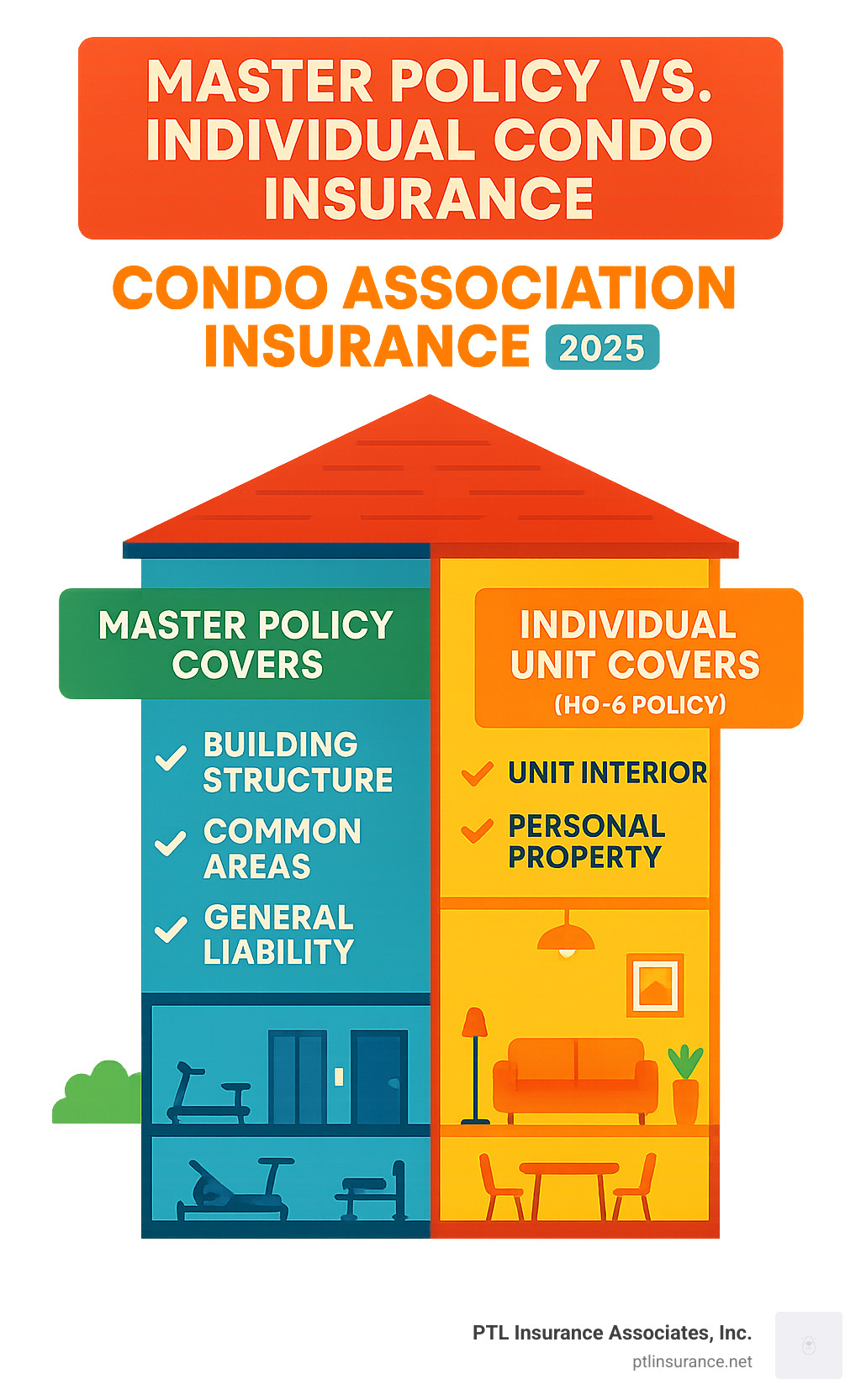
The infographic below illustrates where the master policy stops and individual HO-6 coverage begins, so your board and unit owners can see at a glance who is responsible for what.
Understanding Your Condo Association Insurance Policy
Think of your condo association insurance policy as the protective umbrella that covers everything your community shares. This comprehensive master policy combines property coverage with liability protection, creating a safety net specifically designed for the unique challenges of condominium living.
At its heart, your policy protects two main areas: the physical structures everyone uses and the legal risks that come with managing a community. The property coverage takes care of buildings, common areas, and shared amenities, while liability protection shields your association from lawsuits and accidents that could happen anywhere on the property.
Your policy also includes medical payments coverage for those minor accidents that don’t necessarily lead to lawsuits, legal defense coverage when more serious issues arise, and equipment breakdown coverage for when that temperamental elevator finally gives up. It’s like having a comprehensive safety net that catches problems before they become financial disasters.
What Does a Typical Condo Association Insurance Policy Cover?

Your condo association insurance follows a simple rule: it covers everything “from the walls out.” Basically, if it’s something the whole community uses or benefits from, it’s likely covered by your master policy.
The building structure itself is the foundation of your coverage. Your policy protects the roofs and exterior walls, foundations and structural supports, and windows and doors in shared spaces. If your building has balconies and patios that belong to the association, those are covered too.
Common areas are where your policy really shines. The lobbies and entrance halls where residents and guests first enter, the hallways and stairwells everyone uses daily, and those sometimes-troublesome elevators and escalators are all protected. Your policy also covers practical spaces like laundry rooms and storage areas and mail rooms and package areas.
Many communities love their recreational facilities, and your insurance loves protecting them. Swimming pools and spas like the one pictured above are covered, along with fitness centers and gyms, clubhouses and meeting rooms, tennis courts and sports facilities, and playgrounds and picnic areas where families gather.
The outdoor areas that make your community attractive are protected too. Landscaping and gardens, walkways and sidewalks, parking lots and garages, fencing and gates, and outdoor lighting and signage all fall under your policy’s protection.
Behind the scenes, your mechanical systems keep everything running smoothly. HVAC systems serving common areas, electrical systems and panels, plumbing in common areas, fire safety systems, and security systems and cameras are all covered by your Commercial Property Insurance.
The Different Types of Master Insurance Policies
Not all condo association insurance policies cover the same things, and understanding the differences can save you from unpleasant surprises. There are three main types of master policies, each drawing the line between association and individual responsibility in different places.
Bare walls coverage (also called “studs-in”) is the most basic option. It protects your building’s structure and common areas but stops at the drywall of individual units. Think of it as covering everything up to the point where you’d hang a picture frame. Unit owners handle interior walls and flooring, kitchen cabinets and appliances, bathroom fixtures, and all interior improvements.
Single entity coverage steps up the protection by including some interior elements that were originally installed by the developer. This covers standard flooring materials, basic kitchen appliances, standard bathroom fixtures, and interior paint and wallpaper as they were when the building was first completed.
All-in coverage (sometimes called “all-inclusive”) is the most comprehensive option. It covers everything in the building, including improvements and betterments made by individual unit owners. This means upgraded flooring and fixtures, custom kitchen installations, bathroom renovations, and any improvements made at unit owner expense are all covered by the master policy.
The type of coverage your association carries isn’t usually a choice made by the current board. It’s typically specified in your governing documents, including bylaws and Covenants, Conditions & Restrictions (CC&Rs). Understanding which type you have is crucial because it directly affects what individual unit owners need to protect with their own HO-6 Insurance and helps prevent coverage gaps that could leave someone holding the bill.
Master Policy vs. Individual HO-6: A Tale of Two Coverages
This section will clarify one of the most common points of confusion for condo owners and board members.
Picture this: you’re sitting in a condo board meeting, and someone asks, “So what exactly does our insurance cover?” Half the room thinks it covers everything, while the other half isn’t sure if they need their own policy. Sound familiar?
The truth is, understanding where condo association insurance ends and individual coverage begins is one of the biggest headaches for condo communities. Here’s the simple way to think about it: your association’s master policy is like a protective shell around your entire building and shared spaces, while your individual HO-6 insurance protects everything inside your personal unit.
Think of it as an invisible line drawn at your front door. Everything outside that line – the hallways, pool, roof, and building structure – falls under the master policy. Everything inside your unit is your responsibility to insure separately.
What the Master Policy Doesn’t Cover
Even the most comprehensive condo association insurance policy has significant gaps that can leave unit owners financially vulnerable. Your master policy won’t help if a pipe bursts in your kitchen and ruins your hardwood floors, or if your laptop gets stolen from your unit.
Personal belongings are never covered by the association’s policy. That means your furniture, electronics, clothing, and other personal items need protection through your own condo insurance policy. The same goes for valuable items like jewelry, artwork, and collectibles.
Unit improvements and betterments represent another major gap. If you’ve upgraded your flooring, installed custom kitchen cabinets, or renovated your bathroom beyond the builder’s original specifications, the master policy typically won’t cover these improvements. This is true even if you spent thousands making your unit beautiful.
Personal liability is perhaps the most overlooked gap. If someone gets injured in your unit, or if you accidentally cause water damage to your neighbor’s condo, your association’s policy won’t protect you. You need your own liability coverage for these situations.
The master policy also doesn’t cover additional living expenses if your unit becomes uninhabitable. Hotel costs, temporary housing, and increased food expenses while your unit is being repaired all fall on your shoulders without individual coverage.
Comparing Master Policy vs. Individual HO-6 Insurance
| Feature | Condo Association Master Policy | Individual HO-6 Policy |
|---|---|---|
| Who Pays | Condo Association (via owner dues) | Individual Unit Owner |
| Covers | Common areas, building structure, association liability | Personal property, unit interior, personal liability |
| Example | A fire damages the building’s roof. | A pipe bursts inside your unit, damaging your floors and furniture. |
| Purpose | Protects the collective assets of the community. | Protects your personal assets and living space. |
| Deductible | Paid by association (may be assessed to owners) | Paid by individual unit owner |
| Liability Coverage | Covers association’s legal liability | Covers personal liability of unit owner |
| Loss Assessment | Not applicable | Covers special assessments due to master policy deductibles |
Here’s where it gets interesting: even when the master policy covers something, you might still need individual coverage. For example, if the association’s policy has a $25,000 deductible and storm damage affects the building, the association might pass that deductible cost to unit owners through a special assessment. A good HO-6 policy includes loss assessment coverage to protect you from these unexpected expenses.
The bottom line? Both types of insurance work together to create complete protection for your condo community. The master policy protects the collective investment everyone shares, while individual policies protect your personal stake in that investment. Neither one alone provides complete coverage – you need both to sleep soundly at night.
Key Cost Factors and Essential Additional Coverages
The cost of condo association insurance varies significantly based on numerous factors. Understanding these can help your board make informed decisions about coverage and potentially reduce premiums.
What Factors Influence the Cost of Condo Association Insurance?
Location-Based Factors:
- Hurricane and windstorm exposure (especially relevant in Miami)
- Flood zone designation
- Crime rates in the area
- Proximity to fire stations and emergency services
Property Characteristics:
- Age of the building and construction materials
- Total property value and replacement cost
- Number of units and building height
- Condition and maintenance history
Safety and Security Features:
- Fire alarm and sprinkler systems
- Security systems and cameras
- Gated access and security personnel
- Swimming pool safety features
Claims History:
- Previous insurance claims over 3-5 years
- Type and severity of past losses
- Steps taken to prevent future claims
Coverage Selections:
- Policy limits and deductibles chosen
- Additional coverages selected
- Type of master policy (bare walls vs. all-in)
In Miami’s challenging insurance market, these factors can significantly impact premiums. Properties in hurricane-prone areas or older buildings may face higher costs, but proper risk management can help mitigate these expenses.
Additional Coverages Your Association Should Consider

Beyond basic condo association insurance, several additional coverages can provide crucial protection:
Directors & Officers (D&O) Insurance:
Protects board members from personal liability for management decisions. As one expert noted, “A million dollars coverage is probably the bare bones minimum. Three million, or even five million, can be obtained for a modestly higher premium.” This coverage is essential because board members can be held personally liable for:
- Alleged mismanagement of funds
- Discrimination claims
- Breach of fiduciary duty
- Employment-related lawsuits
Employee Dishonesty/Fidelity Bonds:
Protects against theft by employees or board members. This coverage addresses scenarios like:
- Embezzlement of association funds
- Theft of association property
- Fraudulent financial transactions
- Misappropriation of reserve funds
Cyber Liability Insurance:
Increasingly important as associations collect more personal data and conduct business online. This covers:
- Data breach response costs
- Credit monitoring for affected residents
- Legal defense for privacy violations
- System restoration costs
Equipment Breakdown Coverage:
Covers mechanical and electrical failures not caused by normal wear and tear:
- HVAC system failures
- Elevator breakdowns
- Pool equipment malfunctions
- Electrical system failures
Ordinance or Law Coverage:
Pays for upgrades required by current building codes when rebuilding after a loss:
- ADA compliance improvements
- Updated fire safety systems
- Current electrical code requirements
- Environmental remediation
Workers’ Compensation:
Required if your association has employees:
- Maintenance staff injuries
- Management company employees
- Temporary workers and contractors
Umbrella Insurance:
Provides additional liability coverage beyond primary policy limits:
- Protection against large lawsuits
- Coverage for catastrophic events
- Additional defense costs
Securing the Right Protection for Your Community
Navigating the complexities of condo association insurance can feel overwhelming, but it’s one of the most important responsibilities your board will handle. Think of it as building a financial safety net that protects everyone in your community from unexpected disasters and costly lawsuits.
The good news? You don’t have to figure this out alone. Working with experienced professionals who understand the unique challenges facing condominium communities – especially in Miami’s ever-changing insurance landscape – makes all the difference.
Here’s how to approach securing the right coverage for your community:
Start early and stay organized. Industry experts recommend beginning your insurance renewal process 90-120 days before your current policy expires. This might seem excessive, but it gives you the breathing room to gather necessary documentation, obtain competitive quotes, and review coverage options without the pressure of a looming deadline.
Know your risks inside and out. Every community is different, and your insurance needs should reflect that. Conduct a comprehensive risk assessment that identifies all potential exposures, reviews your governing documents for specific insurance requirements, and considers any future changes your community might be planning.
Keep detailed records. Maintain accurate documentation including loss histories for the past 3-5 years, current property appraisals, and records of all risk mitigation efforts you’ve implemented. These details can significantly impact your premiums and claims processing.
Review coverage annually. As one expert advised, “Review your association’s insurance policies at least annually and take action if needed.” Your community evolves over time – new facilities, updated payment systems, or changes in common areas may require coverage adjustments.
Work with qualified professionals. Look for agents with relevant industry certifications like CPCU, ARM, CIC, or CIRMS. These designations indicate specialized knowledge in community association insurance and can make a real difference in the quality of advice you receive.
Ready to Protect Your Community’s Future?
At PTL Insurance Associates, Inc., we’ve been helping Miami condominium associations steer these challenges for over 35 years. As an independent insurance broker, we work for you – not the insurance companies – which means we can shop multiple carriers to find the best coverage at competitive rates.
Our expertise in condo association insurance goes beyond just finding policies. We provide comprehensive policy reviews, identify coverage gaps, advocate for you during claims, and offer ongoing risk management guidance. We even provide board education to help you understand your coverage and make informed decisions.
Whether you’re dealing with hurricane exposure, aging infrastructure, or complex liability issues, we have the knowledge and market access to protect your community effectively. We understand that every association has unique needs, and we take the time to create customized solutions that fit your specific situation and budget.
Don’t let insurance complexities keep you up at night. Our personalized approach means you’ll have a dedicated team that knows your community and is always available to answer questions or help with claims.
Contact us today to discuss your association’s insurance needs and find how proper coverage can provide peace of mind for your entire community. Learn more about our commercial property insurance solutions and see how we can help secure your community’s financial future.

