


All in coverage condo: Secure 2025 Protection
The Hidden Layers of Condo Insurance
{title=”Condo Building Exterior” caption=”Understanding condo insurance starts with knowing the difference between the master policy and your personal policy.” source=”PTL Insurance Associates”}
All in coverage condo insurance represents the most comprehensive type of master policy your condominium association can purchase. Here’s what you need to know:
Quick Answer for All-In Coverage:
- What it covers: Original fixtures, appliances, flooring, drywall, plumbing, and wiring inside your unit
- What it excludes: Personal belongings, upgrades/remodels, and liability protection
- Your role: Still need an HO-6 policy for personal property and liability
- Cost impact: Typically included in HOA fees, may reduce your personal insurance needs
Condo ownership has unique insurance challenges. Unlike single-family homes, condos split ownership between you and the association, creating two layers of insurance that must work together.
Your condo association carries a master policy that covers shared areas and potentially parts of your unit. Meanwhile, you need your own HO-6 policy to fill the gaps. The type of master policy your association chooses—whether it’s “bare walls,” “single entity,” or “all-in”—dramatically affects what you need to cover personally.
With the national average for condo insurance at $625 per year, understanding these layers protects your investment and prevents paying for duplicate coverage.
I’m Niki Perez with PTL Insurance Associates. I’ve helped countless Miami condo owners steer all in coverage condo policies. My experience shows how costly coverage gaps are when owners don’t understand the relationship between master and personal policies.
What is All-In Coverage Condo Insurance?
Think of all in coverage condo insurance as your association’s premium protection plan. It’s the most comprehensive master policy your condo association can purchase, going far beyond basic coverage to protect not just the building’s bones, but many of the interior elements that make your unit livable.
This isn’t insurance you buy yourself – your condo association’s board makes this decision, and you pay for it through your monthly HOA fees. The beauty of all-in coverage lies in its scope: if disaster strikes, you won’t be left wondering whether your kitchen cabinets or bathroom fixtures are covered.
Defining “All-In” or “All-Inclusive” Coverage
All-in coverage (sometimes called “all-inclusive” coverage) represents the gold standard of condo master policies. Unlike basic policies that only cover common areas and the building’s structure, this comprehensive approach extends protection deep into your individual unit.
Here’s the key distinction: an all-in master policy covers everything in your unit that was there when it was originally built. Think of it as covering anything you couldn’t pack up and take with you if you moved. Your kitchen cabinets? Covered. The bathroom vanity? Covered. The hardwood floors that came with the unit? Also covered.
Your condo association’s board of directors chooses this type of policy and pays for it through the HOA fees you contribute monthly. While this typically means higher HOA fees compared to basic coverage options, it also means greater peace of mind for everyone in the building.
The trade-off is worth understanding: you get more comprehensive coverage, but you also have less control over the policy details since the association makes those decisions for everyone.
What an All-In Coverage Condo Policy Includes
An all in coverage condo policy casts a wide protective net over your unit’s original components. The goal is simple: restore your unit to its original condition if covered damage occurs.
Original fixtures form the backbone of this coverage. Your light fixtures, ceiling fans, bathroom sinks, and toilets are all protected. If a pipe bursts and damages these elements, the master policy steps in to replace them.
Built-in appliances that came standard with your unit typically fall under coverage too. This usually includes your dishwasher, built-in oven, and sometimes even the refrigerator if it was part of the original package.
Drywall and flooring protection means the interior walls and original flooring materials in your unit are covered. Whether it’s the carpet that was installed during construction or the tile in your bathroom, the master policy has you covered.
Wiring and plumbing systems that serve your unit are also protected. This includes the electrical wiring behind your walls and the plumbing that brings water to your faucets and carries waste away.
Beyond your unit, the policy naturally covers common areas like lobbies, hallways, fitness centers, and pools. The building structure itself – exterior walls, roof, foundation – receives comprehensive protection too.
This extensive coverage works together to create a safety net that protects the substantial investment your association has made in the building and its original components. For a deeper dive into how these policies function, our Condo Master Insurance Policy guide offers additional insights.
What an All-In Coverage Condo Policy Excludes
Despite its comprehensive name, all in coverage condo insurance has important boundaries. Understanding these exclusions helps you make smart decisions about your personal HO-6 policy and avoid unpleasant surprises during claim time.
Personal belongings represent the biggest exclusion. Your furniture, electronics, clothing, jewelry, and artwork aren’t covered by the master policy. If a fire damages your unit, the association’s policy might repair the drywall and replace the original light fixtures, but your expensive television and designer sofa are on you.
Unit owner improvements and remodels create another significant gap. That gorgeous kitchen renovation with custom cabinets? Not covered. The luxury vinyl plank flooring you installed to replace the original carpet? Also not covered. The master policy only protects original fixtures and finishes, not your personal upgrades.
Personal liability incidents fall outside the master policy’s scope. If someone slips and falls in your unit, or if you accidentally flood your neighbor’s condo, you’ll need your own liability coverage to protect you.
Special assessments can still hit your wallet even with comprehensive master coverage. While your personal HO-6 policy can include loss assessment coverage to help, the master policy itself doesn’t prevent assessments when coverage falls short or deductibles are high.
Additional living expenses aren’t covered either. If your unit becomes unlivable due to a covered damage, you’ll need your own policy to pay for temporary housing, restaurant meals, and other extra costs.
Like most insurance policies, all-in coverage typically excludes floods, earthquakes, and normal wear and tear unless specific endorsements are purchased.
These exclusions highlight why even the most comprehensive master policy can’t eliminate your need for personal condo insurance. Our Condo Insurance Coverage guide can help you understand how to fill these important gaps.
All-In vs. Other Master Policies: A Clear Comparison
Understanding your condo’s master policy isn’t just insurance jargon—it’s the key to knowing what you’re responsible for protecting. Your association’s master policy is the foundation, and your personal HO-6 policy fills in the gaps. The type of foundation they choose dramatically changes how big those gaps are.
While all in coverage condo policies offer the most comprehensive protection, they’re just one of three main options your association might choose. Let’s break down how they compare so you can make smart decisions about your personal coverage.
Bare Walls Coverage Explained
Bare walls coverage is exactly what it sounds like—and it’s as minimal as master policies get. Picture your condo stripped down to its basic structure. That’s essentially what this policy covers.
Under bare walls coverage, the association’s insurance protects the building’s bones: the exterior walls, roof, foundation, and shared spaces like lobbies and gyms. But once you cross your unit’s threshold, you’re largely on your own. Everything from the drywall inward becomes your responsibility to insure.
This means you’ll need robust dwelling coverage on your HO-6 policy to protect your drywall and interior finishes, all flooring and carpeting, every cabinet and countertop, built-in appliances, and plumbing and electrical fixtures. If you’ve made any upgrades, those are yours to cover too.
The upside? Your HOA fees might be lower since the association is buying less comprehensive coverage. The downside? You’ll likely pay more for your personal policy and need to be extra careful about having adequate dwelling coverage limits.
Single Entity Coverage Explained
Single entity coverage strikes a middle ground many associations find appealing. It’s the “Goldilocks” option—not too basic, not too comprehensive, but often just right for many condo communities.
This type of master policy covers the building structure and common areas, just like bare walls coverage. But it also protects the original fixtures, installations, and appliances that came with your unit when it was first built or sold.
So if your kitchen came with standard oak cabinets, basic laminate countertops, and a builder-grade dishwasher, the single entity policy would cover replacing these with similar quality items if they’re damaged. The same goes for your original flooring and fixtures.
But here’s the big catch: single entity coverage only covers things as they were originally installed. Those gorgeous granite countertops you installed? Or the hardwood floors you put in to replace the builder’s carpet? The master policy will only pay to restore your unit to its original condition, not your upgraded version.
This means you’ll still need dwelling coverage on your HO-6 policy, but primarily to protect your improvements and betterments.
All-In vs. Bare Walls vs. Single Entity
The differences between these three master policy types create a domino effect that impacts your personal insurance needs and costs. Understanding these distinctions helps you avoid both coverage gaps and overpaying for duplicate protection.
Here’s how the three stack up against each other:
| Coverage Area | Bare Walls | Single Entity | All-In |
|---|---|---|---|
| Building Structure | Covered | Covered | Covered |
| Common Areas | Covered | Covered | Covered |
| Original Fixtures | Your responsibility | Covered | Covered |
| Original Appliances | Your responsibility | Covered | Covered |
| Original Flooring | Your responsibility | Covered | Covered |
| Your Upgrades | Your responsibility | Your responsibility | Often covered |
| Personal Belongings | Your responsibility | Your responsibility | Your responsibility |
The financial impact is significant. With bare walls, your HO-6 dwelling coverage might be $50,000-$100,000+. With single entity, it could be $20,000-$40,000 for improvements. With all in coverage condo policies, you may only need $5,000-$15,000 for the deductible and small gaps.
Even the most comprehensive all-in master policy still leaves you responsible for your personal belongings, liability protection, and additional living expenses if you can’t stay in your unit after a loss. That’s why every condo owner needs an HO-6 policy, regardless of their association’s master coverage.
Your Personal HO-6 Policy: Bridging the Gaps
Even with the most comprehensive all in coverage condo master policy, you are not fully protected without your own personal insurance. A personal HO-6 policy is essential to fill the critical gaps left by the association’s coverage. As the infographic below illustrates, these two policies are designed to work in tandem: the master policy protects the building and its original components, while your HO-6 policy protects your personal interests, from your belongings to your liability.
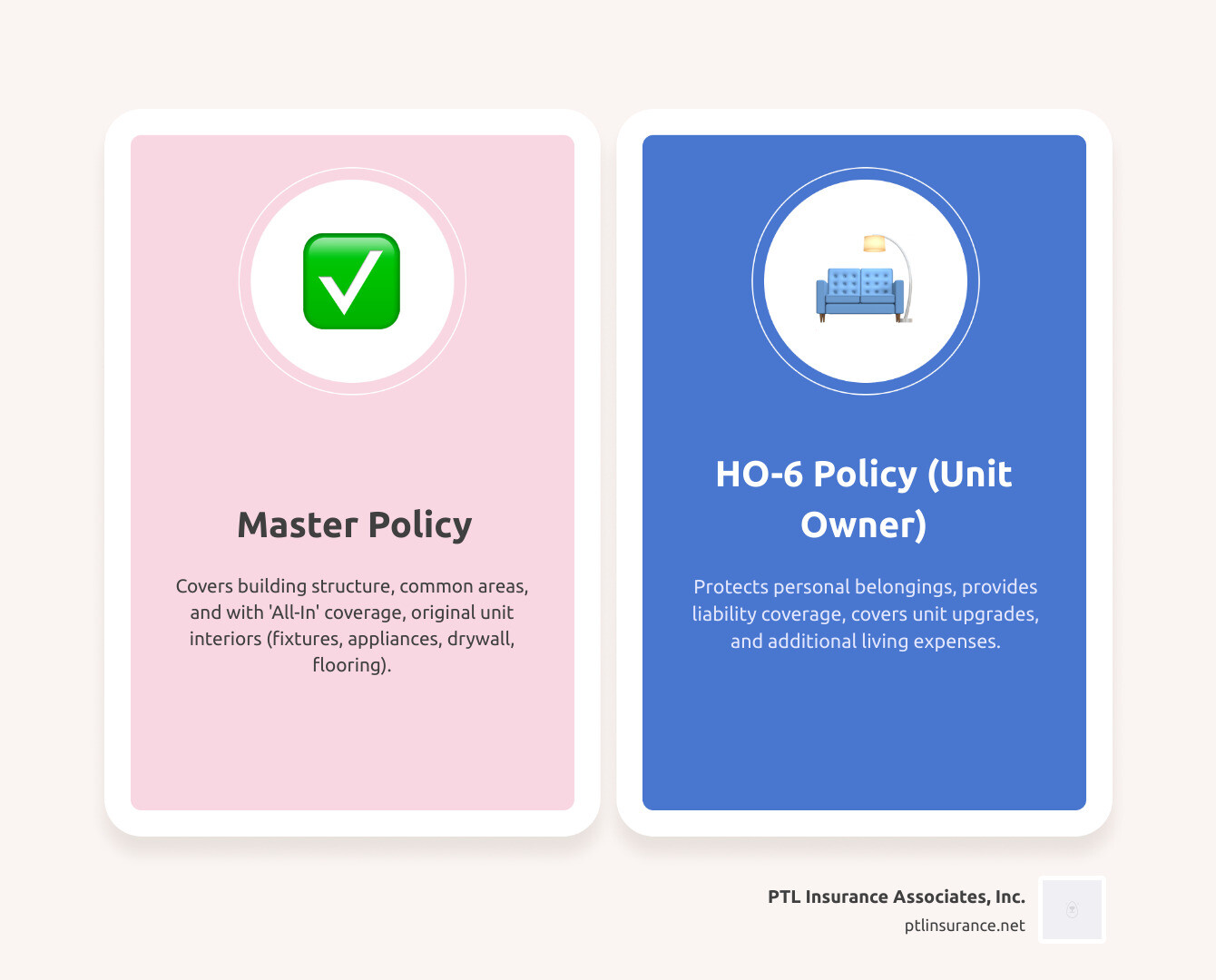
{title=”Two Layers of Condo Insurance” caption=”A master policy covers the building, while an HO-6 policy protects your personal interests.” source=”PTL Insurance Associates”}
Why You Still Need an HO-6 Policy
Your HO-6 policy serves as your personal insurance shield, protecting aspects of condo ownership that no master policy will ever cover. Even with all in coverage condo protection from your association, several crucial areas remain your responsibility.
Personal property protection stands as the most important reason to carry your own policy. Your furniture, electronics, clothing, jewelry, and other valuables need coverage that only your individual policy provides. Whether it’s a fire, theft, or water damage, the master policy won’t replace your belongings – that’s entirely on you.
Liability coverage becomes critical when someone gets hurt in your unit or when you accidentally cause damage elsewhere in the building. Imagine your washing machine overflows and floods the unit below yours. The master policy won’t cover your personal responsibility for that damage. Your HO-6 liability protection handles these situations, covering legal expenses and damages up to your policy limits.
Loss of use coverage pays for additional living expenses when your unit becomes uninhabitable due to a covered loss. This includes hotel costs, restaurant meals, and other necessary expenses while repairs are being made. The master policy doesn’t provide this personal benefit.
Guest medical payments offer a small cushion if someone gets injured in your unit, regardless of who’s at fault. It’s a goodwill coverage that can prevent minor incidents from becoming major lawsuits.
For a deeper dive into how these policies work, check out our comprehensive guide on HO6 Condo Insurance.
How All-In Coverage Affects Your HO-6 Needs
Having an all in coverage condo master policy doesn’t eliminate your need for personal insurance, but it does change what you need to emphasize. It’s like having a strong foundation – you still need to build the right structure on top of it.
Lower dwelling coverage needs represent the most obvious benefit. Since the master policy covers your unit’s original walls, flooring, and fixtures, your HO-6 dwelling coverage can focus primarily on covering the master policy deductible and any upgrades you’ve made. Many condo owners with all-in master policies can get by with dwelling coverage of $10,000 to $25,000, rather than the $50,000 or more needed with bare walls coverage.
Personal property limits become more critical because this is where your real financial exposure lies. Take time to inventory your belongings and calculate their replacement cost. Many people underestimate the value of their possessions – clothing, electronics, furniture, and household items add up quickly.
Loss assessment coverage remains important regardless of master policy type. If your association faces a major expense that exceeds the master policy limits or if there’s a large deductible, owners get assessed for their share. This coverage helps protect you from unexpected bills.
Master policy deductible coverage can save you thousands. Many associations have deductibles of $5,000 to $25,000 or more. If damage originates in your unit, you might be responsible for that entire deductible. Your HO-6 can be structured to help cover this expense.
Our Condo Insurance Coverage Guide provides more detailed guidance on tailoring your coverage to work with your master policy.
Benefits and Drawbacks of an All-In Master Policy
Living in a building with all in coverage condo master insurance comes with clear advantages, but it’s not perfect for everyone. Understanding both sides helps you make informed decisions about your personal coverage needs.
The peace of mind factor ranks as the biggest benefit. When damage occurs to your unit’s original components, you know the association’s policy will handle repairs. There’s less finger-pointing about who covers what, and claims for original fixtures tend to move more smoothly.
Potentially lower HO-6 premiums can result from needing less dwelling coverage on your personal policy. However, don’t expect dramatic savings – your personal property and liability needs remain the same.
Uniformity in repairs means all units get restored with similar quality materials and workmanship, which helps maintain property values throughout the building.
On the flip side, higher HOA fees typically accompany more comprehensive master policies. You’re paying for this extensive coverage through your monthly fees, whether you personally need all of it or not.
Less control over repairs can frustrate owners who prefer specific contractors or materials. When the master policy handles repairs, the association makes those decisions, not you.
Your upgrades still aren’t covered represents a significant limitation. If you’ve invested in custom renovations, granite countertops, or hardwood floors, the master policy only restores your unit to its original builder-grade condition. Your HO-6 must cover the difference in value.
The bottom line? Even with the most comprehensive master policy, your personal HO-6 remains essential. It’s not about whether you need it – it’s about making sure you have the right coverage amounts and types to work seamlessly with your building’s master protection.
How to Verify Your Association’s Coverage and Secure Your Unit
Understanding your association’s master policy isn’t just helpful – it’s absolutely essential for protecting your investment. Too many condo owners make assumptions about their coverage, only to find costly gaps when disaster strikes. The good news? Getting this information is easier than you might think, and it’s your right as a unit owner.
Finding Your Master Policy Details
Your condo association’s master policy details should never be a mystery. As a unit owner, you’re entitled to know exactly what coverage you’re paying for through your HOA fees.
Start with your HOA board or property management company. They’re legally required to provide you with a copy of the master insurance policy declarations page and the full policy document. Don’t be shy about asking – this is standard practice and shows you’re a responsible owner who takes protection seriously.
Your condo’s governing documents hold crucial clues too. The bylaws, Covenants, Conditions, and Restrictions (CC&Rs) often specify exactly what type of master insurance policy the association must carry. You can usually get these documents from your HOA, or sometimes find them online through local land records offices.
When you’re reviewing these documents, focus on finding the policy type first. Look for terms like “bare walls,” “single entity,” or “all in coverage condo” language. Next, note the coverage limits – this tells you the maximum amount the master policy will pay for a loss. Pay special attention to the deductibles, because if a claim starts in your unit, you might be responsible for covering that amount.
Don’t skip over the exclusions section, even though it might seem boring. These exclusions can reveal significant gaps that your personal policy needs to fill. For additional guidance on what to look for, this resource on condo association insurance considerations provides helpful insights.
Assessing Your Coverage Needs
Once you understand your association’s master policy, you can accurately determine what your personal HO-6 policy needs to cover. This step requires honest self-assessment and careful documentation.
Take inventory of everything you own. Walk through your condo and create a detailed list of your belongings – furniture, electronics, clothing, jewelry, artwork, everything. Take photos or videos as you go, and keep receipts when possible. This inventory helps you choose the right personal property coverage limit and decide between replacement cost and actual cash value coverage.
Document any upgrades you’ve made beyond the original builder specifications. That custom kitchen with granite countertops? The hardwood floors you installed over the original carpet? The renovated master bathroom? These improvements need coverage through your HO-6 policy, especially if your master policy only covers original fixtures and finishes.
Consider your lifestyle when determining liability coverage. Do you frequently host dinner parties? Own pets? Have a teenager who invites friends over? These factors influence how much personal liability protection you need. While most policies start at $100,000, we often recommend $500,000 to $1,000,000 for solid protection – it’s surprisingly affordable for the peace of mind it provides.
Calculate your potential responsibility for the master policy deductible. Many condo bylaws make unit owners responsible for the master policy deductible if a loss originates in their unit. Make sure your HO-6 policy can handle this amount, often through loss assessment coverage.
Working with an Insurance Professional
Navigating condo insurance complexities doesn’t have to be a solo journey. Working with an experienced independent insurance broker can save you money, time, and future headaches.
An expert review makes all the difference. At PTL Insurance Associates, we’ve spent over 35 years helping Miami condo owners understand the relationship between master policies and personal coverage. We can spot potential gaps or overlaps that might not be obvious, ensuring you have seamless protection without paying for duplicate coverage.
Every condo owner’s situation is unique, and your insurance should reflect that. Based on your association’s master policy details and your personal assessment, we customize an HO-6 policy that fits your exact needs. This means you’re not overpaying for coverage the master policy already provides, and you’re not left vulnerable to unexpected out-of-pocket expenses.
Clear communication is essential, especially in Miami’s diverse community. For our Spanish-speaking clients, we provide comprehensive guidance through our Seguro de Condominio services, ensuring everyone understands their coverage options completely.
The goal is creating a perfect partnership between your association’s master policy and your personal HO-6 coverage. When these two policies work together properly, you can enjoy your condo with confidence, knowing you’re fully protected from life’s unexpected surprises.
Conclusion: Ensure Your Condo is Protected, Inside and Out
Protecting your condo investment doesn’t have to feel overwhelming once you understand the pieces of the puzzle. All in coverage condo insurance represents the most comprehensive master policy your association can choose, but it’s just the foundation of your protection strategy.
The relationship between your association’s master policy and your personal HO-6 coverage is like a dance – they need to work together seamlessly. Even with the most robust all-in master policy covering your unit’s original fixtures and built-in elements, you still need your own policy to protect what matters most to you personally.
Think of it this way: the master policy takes care of the bones of your unit, while your HO-6 policy protects the heart – your belongings, your liability, and your financial security. Neither one alone provides complete protection, but together they create a safety net that lets you sleep soundly at night.
Being proactive about your coverage means taking those important steps we’ve outlined. Request your association’s master policy documents, understand what type of coverage you have, and work with an experienced professional to fill any gaps. Don’t wait for a water leak or fire to find you’re not as protected as you thought.
At PTL Insurance Associates, we’ve spent over 35 years helping Miami condo owners steer these complexities. We’ve seen how proper planning prevents devastating financial surprises, and we’ve helped countless families recover from losses because they had the right coverage in place.
Your condo is more than just a place to live – it’s your investment, your sanctuary, and often your largest asset. It deserves protection that’s as unique as you are. That’s why we invite you to take the next step toward complete peace of mind with a personalized Condo Insurance review.
Let us help you ensure your condo is truly protected, inside and out. Because when it comes to your home and your financial security, good enough simply isn’t good enough.

