


Condo insurance coverage limits: Secure 2025 Guide
Why Your Condo Insurance Numbers Matter
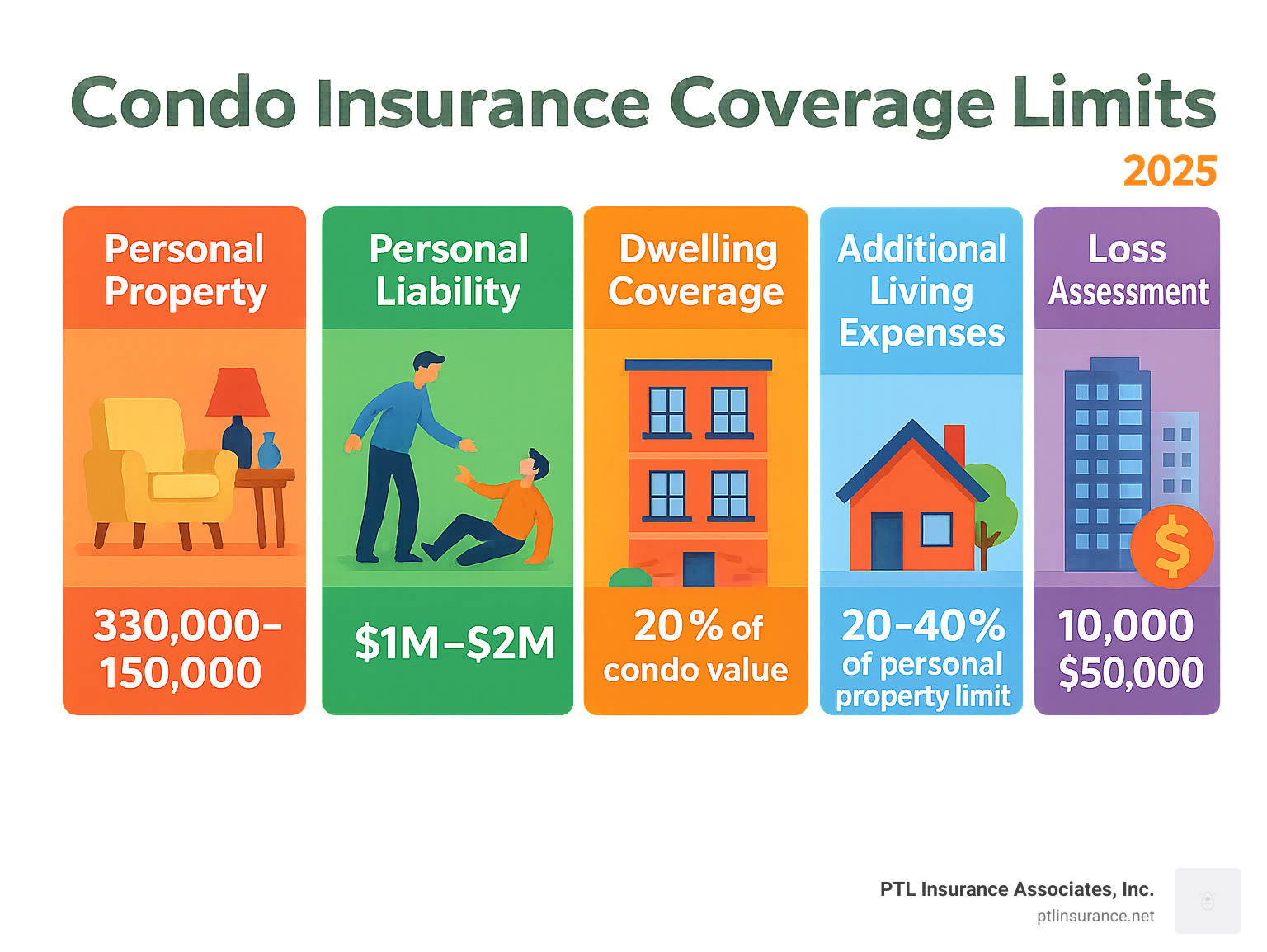
Getting your condo insurance coverage limits right, like the ones detailed in the policy document shown above, is the difference between financial security and devastating out-of-pocket costs. These limits are the maximum amounts your insurer will pay for a claim. Typical limits include:
- Personal Property: $30,000 – $150,000+
- Personal Liability: $1M – $2M (recommended)
- Dwelling Coverage: ~20% of condo’s value
- Additional Living Expenses: 20-40% of personal property limit
- Loss Assessment: $10,000 – $50,000+
While condo living offers convenience, it creates unique insurance challenges. Condo owners must steer a two-policy system where individual coverage fills the gaps left by the association’s master policy.
In Miami’s high-stakes market, with soaring property values and weather risks, inadequate coverage can be a financial disaster. Many owners find too late that their limits are too low to cover their belongings or a massive special assessment from the association.
Most condo owners are underinsured because they don’t understand how to calculate the coverage they truly need. I’m Niki Perez, and at PTL Insurance, I help condo owners steer the complexities of condo insurance coverage limits to ensure their investments are properly protected. My experience has shown that the right limits provide peace of mind, while inadequate ones can devastate finances.
Understanding the Two-Policy System: Master Policy vs. Your HO-6
To be properly protected, condo owners need two different insurance policies. When you buy a condominium, you own your unit individually while sharing collective ownership of the building. This unique structure requires a two-part insurance solution that directly impacts your condo insurance coverage limits.
Your condo association has a master policy for the building and shared spaces, while you need an individual HO-6 policy for everything that is yours. Think of it as the master policy protecting the “we” and your HO-6 Insurance protecting the “me.”
Many owners mistakenly assume the master policy covers everything, creating coverage gaps that can be financially devastating. Your association is responsible for the Condo Master Insurance Policy, but not all master policies are the same. Understanding which type your association has is crucial for setting your own coverage limits.
| Master Policy Type | What the Master Policy Covers | What Your HO-6 Must Cover |
|---|---|---|
| Bare Walls-In | Building structure, common areas, nothing inside your unit walls | Interior walls, all fixtures, flooring, cabinets, appliances, personal belongings, liability |
| Single Entity | Building structure, common areas, original fixtures and appliances in your unit | Improvements beyond original specs, personal belongings, liability |
| All-Inclusive | Building structure, common areas, original fixtures, and any improvements you’ve made | Personal belongings, liability, additional living expenses |
The master policy type dictates how much individual coverage you need, so reviewing your association’s policy documents is the essential first step.
What Your Condo Association’s Master Policy Covers
Funded by your association dues, the master policy protects the entire building and shared spaces.
- Common areas: This includes hallways, lobbies, elevators, the roof, pools, and fitness centers. The master policy’s liability coverage typically handles claims for injuries in these spaces.
- Building structure: This covers exterior walls, the foundation, and the building’s overall framework. For more details, see our guide on Condo Association Insurance.
- Shared amenities: Clubhouse furniture, pool equipment, and landscaping fall under this protection.
- Association liability: This protects the association from lawsuits related to common area incidents. The Small Business Administration recommends adequate coverage to protect all members from financial exposure.
What the master policy usually doesn’t cover is your unit’s interior or your personal belongings. That’s where your HO-6 policy is essential.
What Your Individual HO-6 Policy Must Cover
Your HO-6 policy is your personal financial protection, covering what the master policy doesn’t.
- Personal belongings: Your furniture, electronics, clothing, and other possessions are not covered by the master policy. Your HO-6 covers their replacement if damaged.
- Interior structure: With a “bare walls-in” master policy, you are responsible for insuring interior walls, flooring, cabinets, and fixtures, which can cost tens of thousands to replace.
- Unit improvements: Renovations like an upgraded kitchen or bathroom are typically not covered by the master policy beyond original builder specs. Your HO-6 protects these investments.
- Personal liability: This is crucial. If a guest is hurt in your unit or you cause damage to neighboring units, this coverage handles medical bills, legal fees, and property damage claims.
- Additional living expenses: This pays for hotels, meals, and other costs if your unit becomes uninhabitable after a covered loss.
Understanding these areas helps you set appropriate Condo Insurance Coverage limits and eliminate dangerous gaps between your policy and the association’s master policy.
A Deep Dive into Condo Insurance Coverage Limits
Understanding your individual condo insurance coverage limits is about protecting your financial future. Each coverage type serves a different purpose, from protecting your unit’s structure to shielding your personal assets. The infographic below provides a visual breakdown of these key coverages and their typical ranges. Now, let’s dive into the details of each one.
Dwelling Coverage (Coverage A)
Dwelling coverage protects the parts of your unit you’re responsible for, which varies based on your association’s master policy. With a “bare walls-in” master policy, you’ll need coverage for interior walls, fixtures like cabinets, flooring, and built-in appliances.
A good starting point for Miami condo owners is 20% of your condo’s appraised value. For a $600,000 condo, that’s about $120,000 in dwelling coverage. Some lenders use a square footage calculation, often around $100 per square foot. However, with Miami’s high construction costs, getting a contractor’s estimate provides the most accurate figure. Our Homeowners Insurance Miami Condo page offers more local guidance.
Personal Property Coverage (Contents)
This coverage protects everything you own inside your unit, from furniture and electronics to clothing and kitchenware. Most people seriously underestimate their needs here.
When choosing condo insurance coverage limits, you’ll see two valuation methods:
- Replacement cost coverage pays to replace items with new ones of similar quality.
- Actual cash value pays what items were worth at the time of loss, minus depreciation.
Always choose replacement cost. While it costs slightly more, it ensures you can fully replace your belongings. Policy limits range from $30,000 to $100,000 or more, but don’t guess. Create a home inventory to see how quickly the value of your possessions adds up.
High-value items like jewelry or art have special sub-limits. A $5,000 ring might only be covered for $1,500 unless you add a specific rider or endorsement.
Personal Liability Coverage
Personal liability is your financial safety net if you’re legally responsible for someone’s injury or property damage, such as a guest slipping in your unit or a dishwasher leak flooding a neighbor. Standard limits of $100,000 to $500,000 are often insufficient in today’s litigious environment.
We strongly recommend $1 million to $2 million in liability coverage as the new minimum. The cost to increase this coverage is surprisingly small for the enormous protection it provides. For more on this, see our Condo Insurance Miami page.
Additional Living Expenses (ALE)
If a covered event like a fire or major leak makes your condo uninhabitable, ALE (or Loss of Use) covers the extra costs of living elsewhere. This includes temporary housing, increased restaurant meals, and relocation costs.
ALE limits are typically 20-40% of your personal property coverage. If you have $75,000 in personal property coverage, your ALE limit might be $15,000 to $30,000. Ensure this is enough to cover temporary living costs in Miami’s expensive market.
How to Calculate Your Ideal Coverage Limits
Setting your condo insurance coverage limits doesn’t have to be a guessing game. Following a clear process ensures you get the protection you need. Here is our proven four-step method to take the guesswork out of your coverage decisions.
Step 1: Review Your Association’s Master Policy
Start by understanding the protection you already have. Request a copy of the master policy from your HOA and identify its type: “bare walls-in,” “single entity,” or “all-inclusive.” This determines how much of your unit’s interior you are responsible for insuring.
Pay close attention to the master policy deductibles, especially for water damage, which can be as high as $500,000. Associations often pass these costs to unit owners via special assessments. Clarify exactly where the master policy’s coverage ends and your responsibility begins.
Step 2: Create a Detailed Home Inventory
Most owners underestimate the value of their belongings. A home inventory is the only way to accurately set your personal property condo insurance coverage limits. Systematically go through each room and document everything you own, from furniture to clothing.
- Document with photos or video, paying special attention to electronics and valuables.
- Use a method that works for you: a detailed spreadsheet, a home inventory app, or a simple video walkthrough.
- Store your inventory safely in the cloud or a safe deposit box.
Update your inventory annually. Once you tally the replacement cost of your items, you’ll have a target number for your personal property coverage. Most people find they need more than they initially thought.
Step 3: Determine Your Personal Liability Needs
Liability coverage protects your financial future from lawsuits. Start by considering your total net worth—savings, investments, and other assets. These could be at risk if a lawsuit exceeds your coverage limits.
Condo living presents unique risks, like water damage spreading to neighboring units, which can lead to six-figure claims. Given that medical and legal fees have skyrocketed, $1 million to $2 million is the new standard for liability coverage. The premium increase for this level of protection is modest compared to the financial security it provides.
Step 4: Evaluate Special Coverages for Your Condo Insurance Coverage Limits
Several specialized coverages are crucial for condo owners, especially in Florida.
- Loss Assessment Coverage: This is vital. It pays your share of special assessments when your association has a large claim that exceeds its master policy limits or has a high deductible.
- Improvements & Betterments Coverage: This protects your investment in upgrades like renovated kitchens or new flooring, which the master policy may not cover.
- Water Damage/Sewer Backup: Standard policies often exclude damage from backed-up sewers or drains, a common issue in multi-unit buildings. This endorsement is a smart addition.
- Flood & Hurricane Coverage: A standard condo policy does not cover rising floodwater. Florida residents must evaluate separate flood insurance and ensure their policy adequately addresses hurricane risks. Our Condo Insurance Florida page has more specific guidance.
Special Coverages and Factors That Affect Your Condo Insurance Coverage Limits
Beyond the basics, several specialized coverages are essential shields against the unique risks of condo living. These aren’t just add-ons; they can prevent financial disaster.
Loss Assessment Coverage: The Unsung Hero
Imagine your building’s roof repair costs $2 million, but the master policy only covers $1.5 million. The $500,000 shortfall is passed to unit owners as a special assessment. Loss assessment coverage protects you from these costs, which arise from shared damages exceeding master policy limits or from high deductibles.
If your 50-unit building faces a $500,000 shortfall, your share could be $10,000. Without this coverage, that bill comes out of your pocket. This protection is especially critical for older buildings with higher risks of major claims. Typical limits range from $10,000 to $50,000+, but you should consider your building’s age and the master policy’s deductibles when choosing your limit.
Improvements & Betterments Coverage
Your renovated kitchen, upgraded bathroom, and custom flooring are investments that deserve protection. The master policy typically only covers original, builder-grade finishes. Improvements and betterments coverage ensures you can rebuild to your current standards, not the original ones. This coverage is about protecting your investments and can often be set up to 100% of your personal property limit. For more details, visit our HO6 Condo Insurance page.
Deductibles and Market Conditions
It’s important to understand both your policy deductible and the master policy deductible interaction. Your personal deductible might be $1,000, but if the master policy has a $100,000 deductible that is passed on to owners, you could face a large special assessment. This is where robust loss assessment coverage is vital to your condo insurance coverage limits strategy.
The current hard market impact has led insurers to raise deductibles and tighten coverage. This shift affects your Condo Insurance Rates and makes working with an experienced professional more important than ever. With over 35 years in Miami, PTL Insurance Associates can steer these conditions to find you the right protection.
Frequently Asked Questions about Condo Insurance Limits
At PTL Insurance Associates, we’ve answered thousands of questions from condo owners over our 35 years in the Miami market. Here are answers to some of the most common ones.
How much does condo insurance typically cost in Florida?
Most clients pay between $400 to $800 annually, though Florida’s coastal location and hurricane risk can push costs higher than the national average. Key factors influencing your premium include:
- Location: A condo in downtown Miami or on the beach, like those we cover with Condo Insurance Miami Beach, will cost more to insure.
- Coverage Choices: Higher condo insurance coverage limits increase premiums, but skimping can be costly after a loss.
- Building Age & Condition: Newer buildings with safety features like sprinklers often qualify for discounts.
- Claims History & Deductible: Your personal history and chosen deductible also affect the final price.
For a full breakdown, see our Condo Insurance Cost guide.
Is condo insurance required in Florida?
While Florida law doesn’t mandate condo insurance, it’s practically unavoidable. Your mortgage lender will almost certainly require an HO-6 policy to protect their investment. Even if you own your condo outright, your association’s bylaws likely require minimum condo insurance coverage limits for liability and personal property.
Most associations require at least $100,000 in personal liability coverage to protect the community from underinsured owners. Going without coverage would likely violate your mortgage and HOA rules, creating a huge financial risk. For more on legal requirements, see this resource on What Florida Law Requires for Condo Insurance Coverage.
What is the difference between replacement cost and actual cash value?
This distinction is critical for your financial recovery. Let’s use a quick example.
- Replacement Cost Value (RCV) pays to replace your damaged items with new, similar ones. If your three-year-old laptop is destroyed, RCV gives you enough money to buy a comparable new one.
- Actual Cash Value (ACV) pays the replacement cost minus depreciation. That same laptop might only get you half its original value, not enough to buy a new one.
We always recommend RCV for personal property. The premium is slightly higher, but it ensures you can get back to where you were before the loss without paying large sums out of pocket. The difference is most significant for items that depreciate quickly, like electronics.
Conclusion: Secure Your Condo with the Right Protection
Getting your condo insurance coverage limits right is about protecting your largest financial asset and your peace of mind. We’ve covered the key steps: understanding the two-policy system, creating a home inventory, calculating your liability needs, and evaluating special coverages.
Your condo is your investment and your retreat. In Miami, with high property values and unique weather risks, having adequate condo insurance coverage limits is essential, not optional. Many owners find coverage gaps only after filing a claim—a costly lesson. Proactive risk management means taking action now.
At PTL Insurance Associates, we’ve spent over 35 years helping Miami condo owners steer these challenges. We know how the right coverage provides security and how inadequate limits can devastate finances. Our expertise is in translating complex policies into real-world protection that fits your unique situation.
Cookie-cutter insurance doesn’t work for condos. You deserve a personalized policy that reflects your risks, possessions, and financial goals.
Get a personalized quote for your condo insurance today and let us help you get those important numbers right.

