


Navigating the Tides: Your Guide to Miami Beach Flood Risks
Why Miami Beach Flood Risk Demands Your Attention
Title: Miami Beach Flood Risk; Caption: High tides and heavy rains frequently impact the streets of Miami Beach; Source: PTL Insurance Associates
As shown in the header image above, the reality of a Miami Beach flood is a constant presence and one of the most pressing challenges facing property owners in this coastal community. Here’s what you need to know right now:
Quick Facts About Miami Beach Flooding:
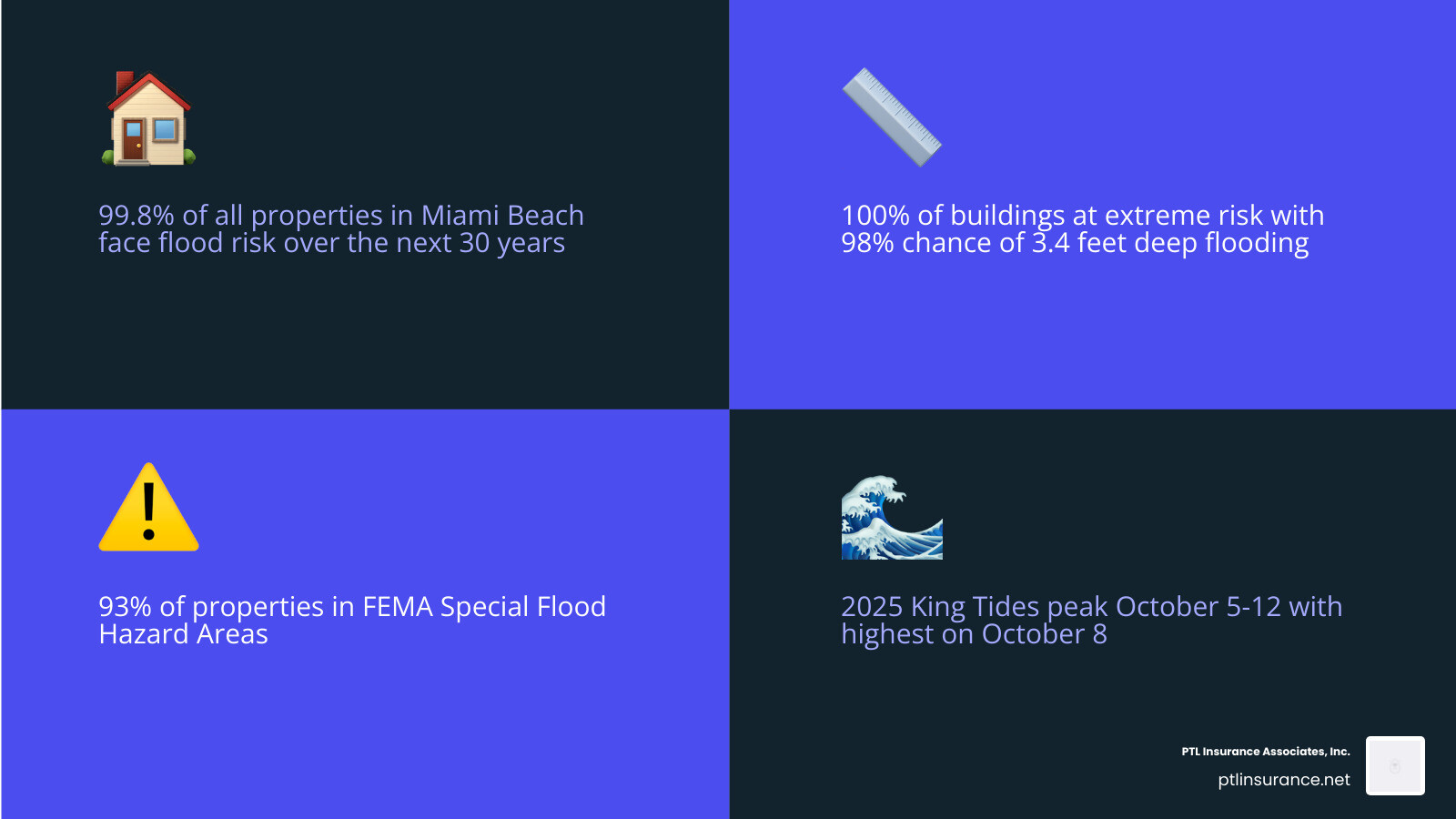
- 99.8% of all properties in Miami Beach (9,543 properties) face flood risk over the next 30 years
- 100% of buildings are at extreme risk, with an average 98% chance of experiencing a flood about 3.4 feet deep
- 93% of properties sit in a FEMA Special Flood Hazard Area, requiring flood insurance for mortgaged properties
- 2025 King Tides peak October 5-12, with the highest tide on October 8
- A 1-in-100 year flood could impact 9,460 properties today—rising to 9,512 properties in 30 years
Miami Beach sits at an extremely low elevation near sea level, surrounded by the Atlantic Ocean and Biscaye Bay. This geography creates serious drainage challenges. Heavy rainfall, high tides, and storm surge regularly overwhelm the city’s infrastructure. The porous limestone bedrock beneath the island allows groundwater to rise during king tides, causing flooding even on sunny days.
The numbers tell a stark story. Buildings in Miami Beach average a 98% chance of flooding over a 30-year mortgage period. Hurricane Wilma in 2005 impacted 5,936 properties. By 2050, sea levels are projected to rise between 6 and 34 inches above 1992 levels, dramatically increasing flood frequency and depth.
But understanding your risk is the first step toward protection. Whether you own a home, business, or both, knowing which flood zone you’re in, what mitigation options exist, and how to secure proper insurance coverage can make the difference between manageable disruption and financial disaster.
I’m Niki Perez, and after years in real estate management services and now working alongside my husband at PTL Insurance, I’ve helped countless Miami Beach property owners navigate the complex intersection of Miami Beach flood risk and insurance protection. This guide will walk you through everything you need to understand your exposure, protect your property, and ensure you have the right coverage in place.
Miami Beach flood terms to learn:
Understanding the Miami Beach Flood Risk
When we talk about an “extreme risk level,” we aren’t being hyperbolic. According to the Miami Beach Flood Map and Climate Risk Report, 99.8% of all properties in our city are at risk of flooding over the next 30 years. This means that if you own a home or a condo in Miami Beach, the question isn’t if you will face water issues, but when and how often.
The data shows that 100% of buildings in Miami Beach are currently at an extreme risk level. On average, these buildings have a 98% chance of experiencing a flood approximately 3.4 feet deep within the span of a typical 30-year mortgage. This is why understanding coastal flood risk is vital for every resident. Even a “1-in-100 year” event—which sounds rare—could affect nearly 9,500 properties today. In 30 years, that number is expected to climb even higher as environmental conditions shift.

Primary Causes of a Miami Beach Flood
Why is our beautiful island so prone to water? It’s a combination of nature and urban development.
- Porous Limestone: Our city is built on top of porous limestone bedrock. Think of it like a giant, hard sponge. Even if we build sea walls, the water can simply push up through the ground from underneath.
- High Groundwater: Because we are so low, the groundwater table is very close to the surface. There isn’t much room for the earth to “soak up” extra water.
- Rain Bombs: Scientists and city officials often refer to “extreme rain events” or “rain bombs.” These are intense downpours where several inches of rain fall in a very short window, overwhelming the city’s ability to drain it.
- Tidal Outfalls: Most of our drainage pipes use gravity to move water into the bay or ocean. During high tides, the water level in the bay is higher than the pipes, essentially “blocking” the exit and causing water to back up onto the streets.
- Impervious Surfaces: In a dense city like ours, concrete and asphalt are everywhere. This prevents rain from soaking into the ground, forcing it to run off into the streets.
For a deeper dive into the mechanics of our local drainage, you can explore the city’s resource on Why Extreme Rain Events Cause Flooding.
Historical Flooding and Hurricane Impacts
We have a long history of battling the elements. Historical floods have left a lasting mark on our infrastructure and insurance rates.
Hurricane Wilma in October 2005 was particularly devastating, impacting 5,936 properties across the island. More recently, Hurricane Irma in 2017 caused significant storm surge, though the impact was less widespread than Wilma. These events contribute to the “repetitive loss” statistics that FEMA tracks. Currently, there are over 122,000 repetitive loss properties nationwide, and many of our local census tracts have more than half of their buildings at significant risk from storm surge and surface flooding.
2025 King Tide Dates and Climate Projections
“Sunny day flooding” is a unique Miami Beach phenomenon caused by King Tides—the highest astronomical tides of the year. In 2025, we need to be particularly vigilant during the following windows:
- September 8–11
- September 21–23
- October 5–12 (Peak expected on October 8)
- October 19–23
- November 3–9
- December 4–5
These tides are exacerbated by sea level rise. According to the Unified Sea Level Rise Projections, we could see the ocean rise 6 to 10 inches by 2030 and up to 34 inches by 2060. This isn’t just about water; it’s about heat, too. By 2050, Miami Beach is projected to experience about 89 days per year over 92.3°F, up from just 7 days in the 1990s. This combination of heat and rising water makes South Florida flood insurance a non-negotiable part of property ownership.
FEMA Zones and Property Protection
Understanding your FEMA flood zone is critical for both safety and your wallet. Currently, 93% of Miami Beach properties are in a FEMA Special Flood Hazard Area (SFHA). The data visualized in the infographic below highlights the sheer scale of the challenge, with nearly all properties facing significant risk over the coming decades.
- Zone VE: Coastal high hazard areas with risks from storm waves. These have at least a 1-in-4 chance of flooding over a 30-year mortgage.
- Zone AE/AH/AO: Areas with a 1% annual chance of shallow flooding (1-3 feet).
- Zone X: Moderate-to-low risk areas. Interestingly, over 20% of NFIP claims come from Zone X, proving that “low risk” does not mean “no risk.”
You can check your specific address at the FEMA Map Service Center. If you have a federally backed mortgage in an SFHA, you are required to carry NFIP coverage.
Pro Tip: Don’t wait for a storm to brew. There is a standard 30-day waiting period for new flood insurance policies to take effect. However, there is some good news: Miami-Dade County’s Community Rating System (CRS) recently improved to Class 3, which provides a 25% to 35% discount on flood insurance premiums for many residents.
How to Mitigate a Miami Beach Flood at Home
We always tell our clients at PTL Insurance that insurance is the last line of defense—physical mitigation is the first.
- Elevation Certificates: This document verifies your home’s elevation relative to the base flood level. It’s essential for getting accurate insurance quotes.
- PPA Grants: The City of Miami Beach offers the Private Property Adaptation (PPA) grant. This program can provide up to $20,000 in funding ($2,500 for assessment and $17,500 in reimbursable funds) to help you elevate your home, install flood barriers, or add green infrastructure.
- Backflow Valves: These prevent sewer water from backing up into your home during a flood.
- Flood-Resistant Materials: If you’re remodeling, use materials like tile instead of carpet and water-resistant drywall.
For more tailored advice, check out our Flood Insurance Miami Guide.
City Resilience and Infrastructure Projects
The City of Miami Beach is a global leader in climate adaptation. Currently, there are 85 flood risk reduction projects in the works, protecting over 1,600 properties.
One of the most visible efforts is the West Avenue Improvements project. With a budget exceeding $100 million, this project aims to eliminate chronic flooding by installing massive stormwater drainage systems, water lines, and new pump stations. While the construction has caused short-term disruptions for local businesses, the goal is to keep the roads dry and walkable for decades to come.
The city’s Sea Level Rise Vulnerability Assessment also guides the elevation of roadways and the increasing of seawall heights. These projects are vital because 42 out of our 48 stormwater pump stations are currently considered highly vulnerable to rising seas.
Resident Resources and Safety Protocols
The city provides several tools to help us stay dry. One of the newest innovations is the sandless sandbag. These bags are prefilled with silica gel beads that expand when they contact water.
- Activation: Spray them with a hose or soak them in a tub for 3-4 minutes.
- Usage: Stack them at door thresholds to block water.
- Disposal: After use, they can be disposed of in your regular residential bin (unless they touched contaminated floodwater).
We also recommend using the Miami Beach Gov App to report flooding and signing up for MBALERT by texting “MBALERT” to 888777. During flood events, the city often activates a parking relief program, allowing residents to move their cars to city garages to avoid salt-water damage. For more on protecting your vehicle, see our Car Insurance Miami Beach Guide.
Safety Before, During, and After a Flood
- Before: Develop a plan by June 1st (the start of hurricane season). Clear your storm drains of debris and prepare your emergency kit.
- During: Never walk or drive through floodwater. Just six inches of moving water can knock you off your feet. Turn off your power and gas if your home is threatened by rising water.
- After: Dispose of damaged materials properly. If you live in a condo, ensure the association is checking the building’s drainage systems. For more on this, read our guide on Condo Insurance Miami Beach.
Frequently Asked Questions about Miami Beach Flooding
When are the highest King Tides expected in 2025?
The highest tides are predicted for October 5–12, with the peak occurring on October 8, 2025. Residents in low-lying areas should prepare for potential street flooding during these windows.
How do I activate and use sandless sandbags?
Soak the bags in water for 3-4 minutes until fully saturated; they will expand significantly. Once full, stack them tightly at door thresholds or garage entries to prevent water intrusion.
Does my standard homeowners insurance cover flood damage?
No, standard homeowners insurance policies almost never cover flood damage. You must purchase a separate flood insurance policy through the National Flood Insurance Program (NFIP) or a private insurance carrier to be protected.
Conclusion
Living in Miami Beach means embracing the beauty of the Atlantic while respecting its power. At PTL Insurance Associates, Inc., we’ve spent over 35 years helping our neighbors protect what matters most. As an independent broker based right here in Miami, we don’t believe in one-size-fits-all solutions. We offer personalized service and tailored coverage options that account for the unique Miami Beach flood risks your specific property faces.
From understanding FEMA’s latest maps to navigating the 30-day waiting period, we are here to ensure your resilience strategy is airtight. Don’t wait for the next King Tide or tropical system to check your coverage.
Protect your home with comprehensive insurance solutions by contacting us today. Let us help you navigate the tides so you can get back to enjoying our sun-kissed island with peace of mind.

