

NFIP: Your Ultimate 2025 Flood Protection
Why Understanding Flood Insurance Could Save Your Home and Business

The image above paints a stark picture of the devastation floods can cause. Flooding is America’s most common and costly natural disaster, yet a dangerous myth persists: that standard homeowners insurance has you covered. It doesn’t. Whether from a hurricane storm surge in Miami or widespread heavy rainfall, flood damage requires a separate policy.
The financial stakes are high. Just one inch of water can cause tens of thousands of dollars in damage. This is where the NFIP (National Flood Insurance Program) becomes essential. Managed by FEMA, this federal program provides dedicated flood insurance to homeowners, renters, and businesses, helping them recover faster without relying on disaster assistance loans.
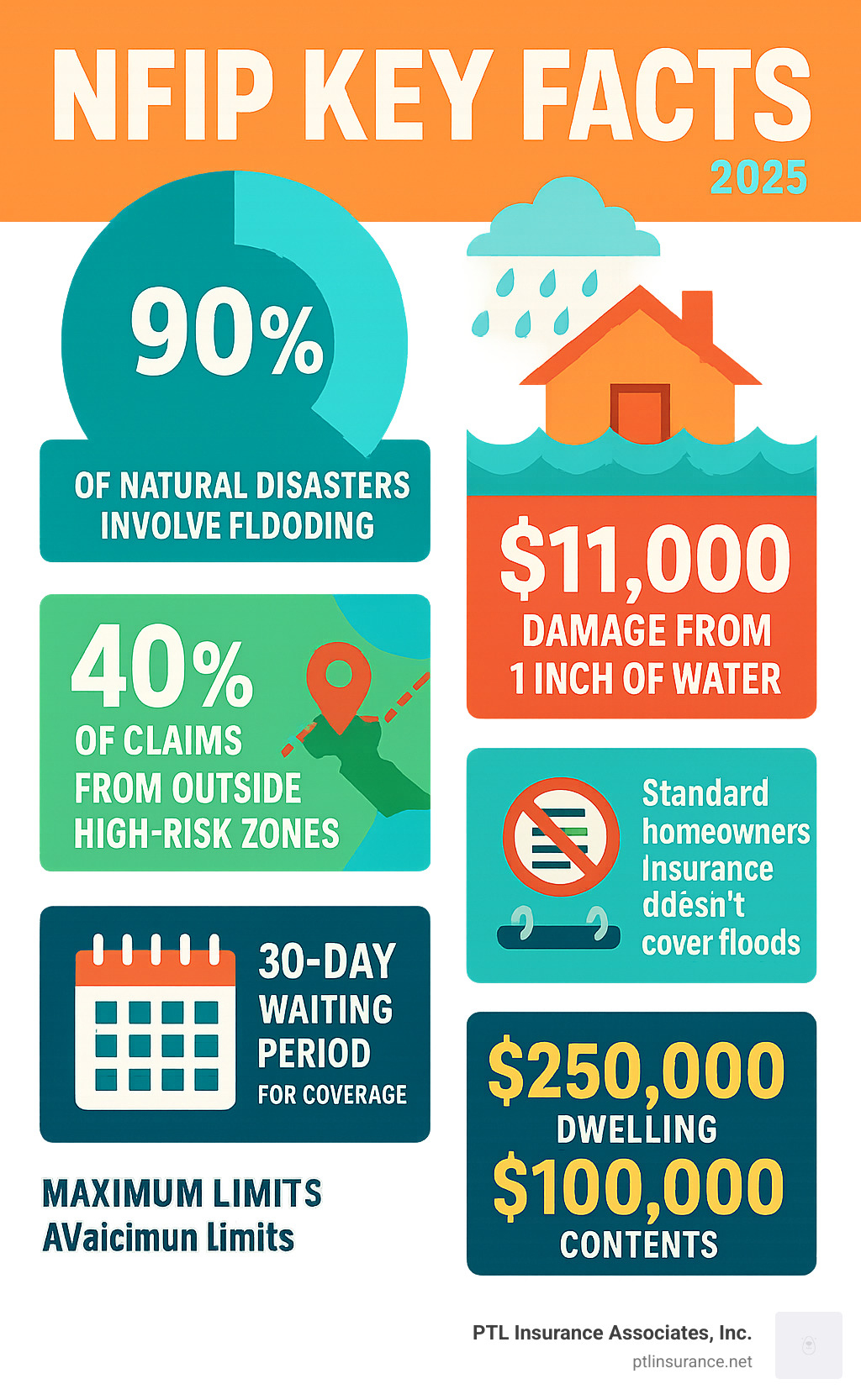
The need isn’t confined to coastal areas or designated floodplains. A staggering number of NFIP claims—over 40%—come from properties outside high-risk flood zones. This means if it can rain, it can flood.
I’m Niki Perez from PTL Insurance Associates, Inc. After years in real estate and insurance, I’ve seen how unexpected flooding can devastate families and businesses who thought they were protected. My experience with NFIP policies has taught me that understanding your options before a storm gathers is the most critical step you can take to protect your assets.
What is the National Flood Insurance Program (NFIP)?
In 1968, Congress addressed the rising costs of disaster relief by creating the NFIP. The goal was to shift from costly disaster handouts to a proactive insurance system that helps communities and property owners manage their flood risk. Before the NFIP, flood victims had few options beyond seeking federal disaster assistance, which often came in the form of loans that had to be repaid.
The program established a crucial partnership: the federal government provides federally-backed flood insurance, but only in communities that agree to adopt and enforce floodplain management regulations. This smart approach is designed to reduce future flood damage by guiding development away from high-risk areas and encouraging flood-resistant construction.
The NFIP provides real insurance coverage, not a government grant. Policyholders pay premiums, and in return, they have a legal right to claim benefits for covered flood losses. This provides a level of financial certainty that disaster assistance simply cannot match.
The Federal Emergency Management Agency (FEMA) oversees the program, setting rates and developing flood maps. However, the policies themselves are sold and serviced through a network of private insurance companies and independent agents, like us at PTL Insurance Associates. This public-private model combines federal oversight with the convenience and expertise of local professionals. For more details, you can visit the official About the National Flood Insurance Program page.
The Three Pillars of the NFIP
The NFIP is built on a three-part foundation that works together to create a comprehensive approach to flood protection.
Flood Risk Mapping
Effective protection starts with understanding the risk. FEMA develops and maintains detailed Flood Insurance Rate Maps (FIRMs), which are the official source for identifying flood hazards. These maps delineate areas into different flood zones based on their level of risk. For example, Zone AE is a high-risk area with a 1% annual chance of flooding, while Zone X represents moderate-to-low risk areas. The maps also establish the Base Flood Elevation (BFE), which indicates the expected height of floodwaters in a major event. You can view your property’s risk profile at the FEMA Flood Map Service Center.
Community Floodplain Management and Mitigation
Insurance is only available in communities that participate in the NFIP. To join, a community must agree to adopt and enforce floodplain management ordinances that reduce future flood risk. This includes measures like requiring new buildings in flood zones to be liftd. Some communities go further by joining the Community Rating System (CRS), implementing additional mitigation efforts to earn premium discounts for their residents. The NFIP also supports larger projects like property buyouts and home elevations through Community mitigation efforts.
The Insurance Component
This is the pillar that directly protects your finances. The NFIP provides federally backed insurance to cover flood damage, which is excluded from standard homeowners policies. Coverage is available for homeowners, renters (for personal belongings), and business owners. It provides a critical financial safety net, ensuring you have the funds to rebuild and recover after a flood. While the NFIP is a great foundation, we often help clients find custom solutions, similar to our approach with home insurance, to ensure complete protection.
Understanding Your NFIP Coverage and Costs
An NFIP policy is divided into two main parts: Building Coverage and Contents Coverage. Building coverage protects the structure of your home, including its foundation, walls, and essential systems like electrical, plumbing, and HVAC. Contents coverage, which must be purchased separately, protects your personal belongings, such as furniture, clothing, and electronics. For residential properties, the NFIP offers up to $250,000 for dwelling coverage and $100,000 for contents coverage. It’s crucial to understand what qualifies as a flood under the policy; you can review the Official Definition of a flood for specifics. Things like landscaping and additional living expenses are typically not covered.
Why You Need Coverage Outside High-Risk Zones
One of the biggest misconceptions is that you only need flood insurance in a high-risk zone. The data tells a different story. As the infographic below shows, a significant portion of flood claims come from areas previously considered safe. In fact, more than 40% of NFIP claims were filed by people outside high-risk zones. Urban flooding from overwhelmed drainage systems is increasingly common. With just one inch of water causing close to $11,000 in damage, relying on federal disaster assistance—which is usually a loan—is a risky gamble. Whether you own a house or need condo insurance Miami, separate flood protection offers true peace of mind.
How Premiums Are Determined: Risk Rating 2.0
FEMA’s pricing methodology, Risk Rating 2.0, has modernized how premiums are calculated. Instead of relying primarily on flood zones, it uses a more sophisticated approach to assess the unique risk of each property. The new system considers a variety of factors, including flood frequency, different types of flooding (river, coastal, rainfall), your property’s distance to a water source, and specific characteristics like foundation type and elevation. It also factors in the cost to rebuild your specific home. This equitable approach means premiums now more accurately reflect a property’s true flood risk. You can Learn about Risk Rating 2.0 to see how these factors might affect your costs.
NFIP vs. Private Flood Insurance: A Comparison
While the NFIP is the most well-known source for flood insurance, a growing private market offers alternatives. Understanding the key differences is essential for choosing the right protection.
The primary distinction lies in flexibility and coverage limits. The NFIP provides standardized, federally-backed coverage available in over 22,000 communities, while private insurance can be more customized but varies by insurer.
| Feature | National Flood Insurance Program (NFIP) | Private Flood Insurance |
|---|---|---|
| Coverage Limits | Up to $250k dwelling / $100k contents | Often higher, customized limits |
| Loss of Use | Not covered | Often included |
| Waiting Period | Typically 30 days | Can be 10 days or less |
| Cost Basis | Risk Rating 2.0 (National standard) | Proprietary underwriting |
Key Differences in Coverage
Private flood insurance often provides higher coverage limits, which is crucial if your home’s value exceeds the NFIP’s $250,000 cap. Another major advantage is Loss of Use coverage, which helps pay for temporary housing and living expenses if you’re displaced by a flood—a benefit not offered by the NFIP. Private policies may also offer Replacement Cost coverage for your belongings, whereas the NFIP typically pays Actual Cash Value, which accounts for depreciation. For businesses, private options might include business income interruption coverage, a vital protection you can learn more about on our business insurance page.
Waiting Periods and Cost Considerations
The NFIP’s 30-day waiting period can be a concern, while private insurers often have shorter waits. Costs can vary widely; sometimes private insurance is cheaper, and other times it’s more expensive. The growth of the Private flood insurance market means more competition and options for consumers. The best choice depends on your property’s value and your risk tolerance. At PTL Insurance Associates, Inc., we help clients compare both to find the ideal fit.
What is the National Flood Insurance Program (NFIP)?
When Hurricane Andrew devastated South Florida in 1992, it exposed a harsh reality for many homeowners: their standard insurance policies did not cover flood damage. This catastrophic event highlighted the critical need for the National Flood Insurance Program (NFIP), which Congress had established decades earlier in 1968.
The program was born from the understanding that relying on disaster aid alone was unsustainable. The NFIP provides actual insurance, not loans that have to be repaid. By paying premiums, property owners secure a financial backstop to rebuild their lives after a flood.
This federal program, managed by FEMA, operates through a unique partnership. To make NFIP coverage available to their residents, local communities must commit to smart floodplain management, which helps make the entire area more resilient. Policies are then sold through private agents like PTL Insurance Associates, Inc., combining federal reliability with local, personal service. You can find more official information at the About the National Flood Insurance Program page.
The Three Pillars of the NFIP
The NFIP‘s effectiveness rests on three interconnected pillars that create a holistic approach to flood risk.
Flood Risk Mapping: FEMA produces Flood Insurance Rate Maps (FIRMs) that identify flood zones and risk levels. These maps are the foundation for underwriting and community planning. You can check your property’s status at the FEMA Flood Map Service Center.
Community Floodplain Management: Communities must adopt and enforce regulations to reduce flood risk to participate in the NFIP. Those that exceed minimum standards can join the Community Rating System (CRS) to earn premium discounts for residents. These Community mitigation efforts are key to long-term resilience.
The Insurance Component: The program provides federally backed flood insurance for homeowners, renters, and businesses in participating communities. This coverage fills the critical gap left by standard property insurance, like the policies we customize for home insurance, ensuring funds are available for recovery.
Understanding Your NFIP Coverage and Costs
Navigating an NFIP policy means understanding its structure and limitations. Coverage is split between the building and its contents, and know you’re not automatically covered for everything.
What’s Typically Covered:
- Building: The physical structure, foundation, electrical/plumbing systems, and permanently installed items like carpets and cabinets.
- Contents: Your personal belongings, such as furniture, clothing, and electronics (if you purchase separate contents coverage).
What’s Often Not Covered:
- Property outside the building (e.g., decks, fences, landscaping).
- Additional Living Expenses (ALE) if you are displaced from your home.
- Vehicles.
It’s a common myth that you’re safe outside a high-risk zone. However, more than 25 percent of flood claims come from moderate-to-low risk areas. Given that just an inch of water can cause thousands in damage, the financial protection from a flood policy is invaluable, whether for a house or a unit covered by Condo Insurance Miami. Premiums are now calculated using Risk Rating 2.0, a system that assesses individual property risk rather than just the flood zone. For a full breakdown, see the Official Definition of a flood and Learn about Risk Rating 2.0.
NFIP vs. Private Flood Insurance: A Comparison
While the NFIP provides a critical foundation for flood protection, the growing private insurance market offers another avenue for coverage. The choice between them depends on your specific needs.
| Feature | National Flood Insurance Program (NFIP) | Private Flood Insurance |
|---|---|---|
| Coverage Limits | $250,000 dwelling / $100,000 contents | Often higher limits available |
| Loss of Use | Not covered | Often included |
| Waiting Period | 30 days (with exceptions) | Often shorter or immediate |
Private policies can offer higher limits, cover additional living expenses, and may have shorter waiting periods. However, availability and cost vary. The NFIP‘s Risk Rating 2.0 has made its pricing more competitive for some, while the Private flood insurance market growth continues to introduce new options. For business owners, comparing how each policy type complements your main business insurance Florida cost is essential. At PTL Insurance Associates, Inc., we help you steer both NFIP and private options to ensure you get the right protection without gaps in coverage.

