


Renting Out Your Condo? Don’t Forget the Right Insurance
Why Landlords Need Different Protection Than Condo Owners
Title: Modern Condo Building; Caption: A typical rental property requiring specialized insurance; Source: Unsplash
As shown in the header image of the modern condo building, these properties represent significant investments that require specialized protection. Condo rental insurance protects property owners who rent out their units from financial losses that standard condo insurance won’t cover. If you’re renting out your condo—whether long-term or short-term—a regular homeowners or condo owner policy likely won’t pay claims related to rental activity.
Quick Answer: What is Condo Rental Insurance?
- What it is: A landlord policy designed for condo owners who rent out their units
- Key difference: Covers loss of rental income and liability from tenant activity
- What it covers: Building property, personal property (like appliances), liability, and loss of rents
- What it excludes: Tenant belongings, floods, earthquakes, and intentional damage
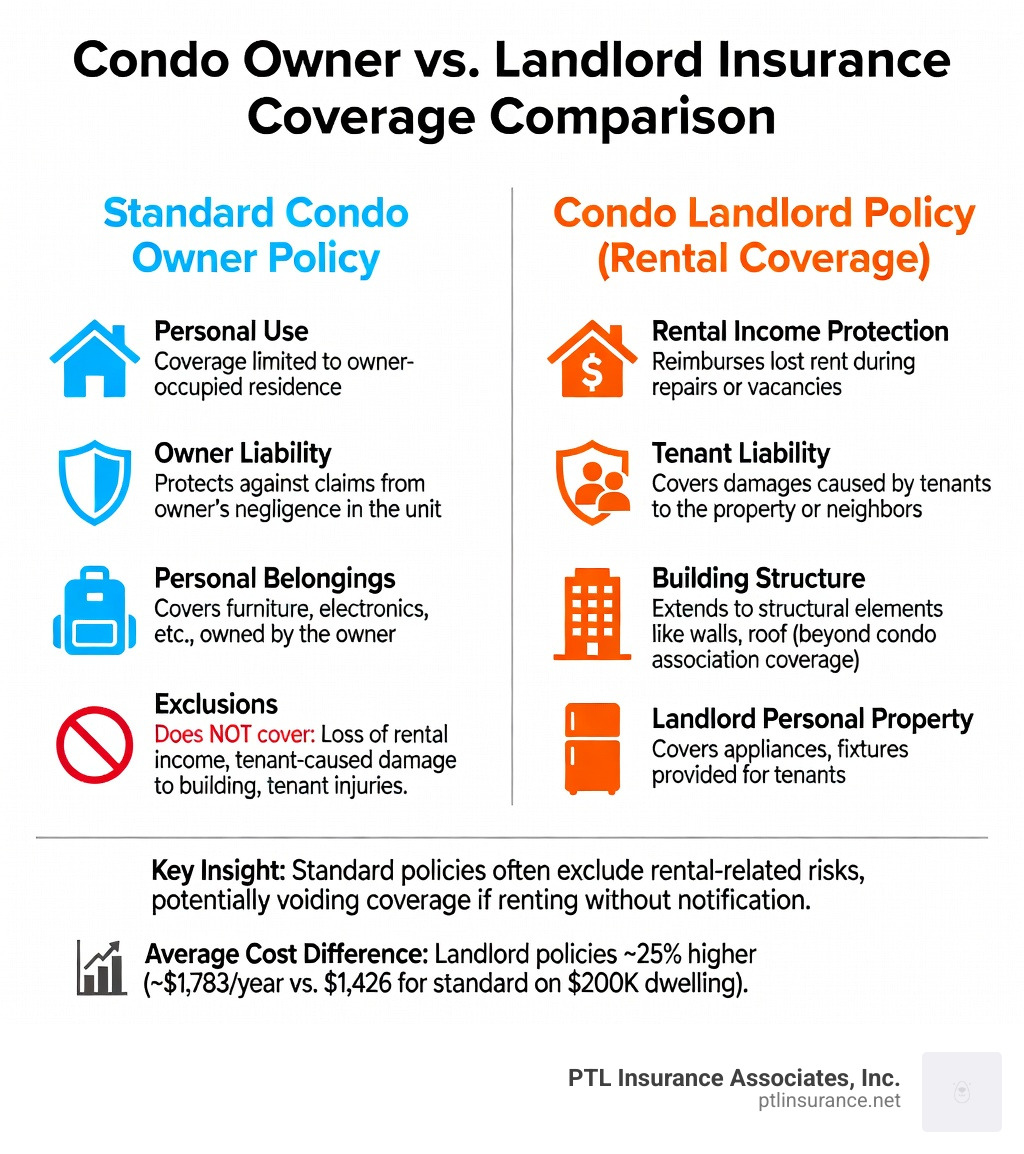
- Average cost: About 25% more than standard condo insurance (roughly $1,783/year for a $200,000 dwelling)
- Who needs it: Any condo owner with a tenant—monthly lease or Airbnb
Why you can’t skip this: Using a standard homeowners policy for a rental property can void your coverage entirely. Insurers may deny claims or cancel your policy if they discover you’re renting without the proper coverage.
Many condo owners in Miami don’t realize their existing policy stops protecting them the moment they sign a lease with a tenant. The risks multiply when you add rental activity—tenant injuries, property damage, lost rental income during repairs, and liability for tenant-caused damage to neighboring units.
I’m Niki Perez, and after years in Real Estate Management Services, I now help property owners at PTL Insurance Associates navigate the complexities of Condo rental insurance to protect their investments. Understanding the gap between owner-occupied and landlord policies can save you from devastating out-of-pocket losses when claims arise.
Simple guide to Condo rental insurance:
What is Condo Rental Insurance and Why Do You Need It?
When you transition from living in your unit to renting it out, your relationship with the property changes from a personal residence to a business investment. This shift requires a specific type of protection often referred to as landlord insurance or a “rental condo unitowners policy.”
In the insurance world, this is typically an HO-6 policy (the standard form for condos) that has been modified or written specifically for non-owner occupancy. It provides a specialized Condo Insurance Coverage framework designed to handle the unique risks of having tenants. According to the Insurance Information Institute on insuring a condo, while your association covers the building’s shell, you are responsible for the “walls-in” portion of the unit. Without the right rental-specific policy, you are essentially flying without a parachute.
How it Differs from Standard Condo Insurance
The primary difference lies in the occupancy. Standard condo insurance is designed for owner-occupied units. It assumes you are there to monitor the property and that the liability risks are limited to your personal guests.
Once you move out and a tenant moves in, the risk profile changes. Condo rental insurance accounts for “business use.” If you fail to notify your insurer of this change, you risk policy voidance. We have seen cases where owners tried to file a claim for a burst pipe, only for the adjuster to discover a tenant was living there. If the policy was written for an owner-occupant, the claim could be denied entirely. Furthermore, Condo Insurance Rates for rentals are generally higher because tenants are statistically less likely to maintain a property as diligently as an owner.
Why Your Homeowners Policy Isn’t Enough
A standard homeowners or condo policy usually contains a “business pursuits” exclusion. This means that any activity generating income—like renting out your unit—may not be covered. If a tenant slips and falls in your kitchen, your standard policy might not provide a defense because the injury arose from a business activity.
Renting creates significant coverage gaps. For example, a standard policy won’t reimburse you for lost rent if a fire makes the unit uninhabitable. To protect your cash flow and your assets, you need specialized Insurance for Rental Homes that specifically names “Loss of Rents” as a covered peril.
What Does Condo Rental Insurance Typically Cover?

When we help Miami landlords set up their policies, we focus on four main pillars of protection. Because you aren’t living there, you don’t need to insure $100,000 worth of clothes and furniture, but you do need to insure the “dwelling” (the unit itself) and your liability. The infographic below visualizes how these protections differ from standard owner-occupied policies, specifically regarding rental income and liability.
| Coverage Type | What it Protects | Importance for Landlords |
|---|---|---|
| Dwelling (Unit) | Walls, flooring, cabinetry, and built-in appliances. | High: Covers the physical structure you own. |
| Liability | Legal fees and medical bills if someone is injured. | Critical: Protects your personal assets from lawsuits. |
| Loss of Rents | Replaces lost income if a covered disaster makes the unit unrentable. | Essential: Maintains your cash flow during repairs. |
| Medical Payments | Small medical bills for guests injured on the property. | Good: Can prevent small injuries from becoming big lawsuits. |
Essential Protections for Landlords
The most vital component is Liability Insurance. If a tenant or their guest is injured due to a maintenance issue—like a loose floorboard or a faulty electrical outlet—you could be held responsible. This coverage pays for legal defense and settlements.
Additionally, you need coverage for the personal property you leave behind. This includes appliances (fridge, stove, dishwasher), window treatments, and any furniture if you are renting the unit furnished. It’s also important to understand Renters Insurance from the landlord’s perspective; while your policy covers your appliances, it will never cover the tenant’s laptop or couch.
Understanding Exclusions and Gaps
No policy covers everything. Standard Condo rental insurance typically excludes:
- Floods and Earthquakes: These require separate policies or endorsements.
- Tenant Belongings: As mentioned, the tenant is responsible for their own stuff.
- Wear and Tear: Insurance is for sudden, accidental damage, not a carpet that gets old and dirty over ten years.
- Home-Sharing: If you are doing short-term rentals, the National Association of Insurance Commissioners warns that standard landlord policies might not apply.
Water damage is a major concern in Miami. While burst pipes are usually covered, “water backup” (when a sewer or drain backs up into the unit) often requires a specific endorsement. Experian on water backup insurance notes that this is one of the most common “hidden” gaps in property insurance.
Navigating Condo Associations and Master Policies
Your insurance doesn’t exist in a vacuum; it sits on top of the Condo Master Insurance Policy held by your Homeowners Association (HOA). In Miami, most associations use a “walls-in” or “original specifications” approach, meaning they cover the building and common areas, but you are responsible for everything inside your unit’s air space.
You must review your Condo Association Insurance bylaws. Some “Bare Walls” policies cover literally nothing inside the unit—not even the drywall or the plumbing fixtures. If your association has a bare walls policy, your individual dwelling limit needs to be much higher.
The Importance of Loss Assessment Coverage
This is a “must-have” for condo landlords. If a major storm hits Miami and the association’s master policy has a massive deductible, or if the damage exceeds their policy limits, the association can “assess” each unit owner to pay the difference.
HO6 Insurance typically includes a small amount of Loss Assessment coverage (often $1,000), but we frequently recommend increasing this to $10,000 or $50,000. If the building’s roof blows off and the association charges every owner $15,000 to fix it, this endorsement will save you from writing a massive check out of pocket.
Short-Term Rentals and Airbnb Risks
Are you planning to list your unit on Airbnb or VRBO? Be careful. Standard Condo rental insurance is usually designed for annual leases. Short-term rentals (STRs) are viewed by insurers as high-risk commercial ventures.
While platforms provide some protection—like Airbnb AirCover—these are contractual guarantees, not a replacement for primary insurance. Many Miami condo boards also have strict rules against STRs. If you violate these rules, your insurance company might use that “illegal act” as a reason to deny a claim. Always look for a specific “Home-Sharing” endorsement if you aren’t doing long-term leases.
The Cost of Condo Rental Insurance
How much will this cost you? On average, landlord insurance costs about 25% more than a standard homeowners policy. If the national average for a condo policy is $1,426, you can expect to pay around $1,783 for the rental version. However, in high-demand areas like Miami, Condo Insurance Cost can vary significantly based on the age of the building and its proximity to the coast.
Factors Affecting Condo Rental Insurance Premiums
Several factors will dictate your final premium:
- Location: Units in Miami Beach will naturally have higher premiums than those further inland due to wind and flood risks.
- Building Age: Older buildings with original plumbing or wiring are more expensive to insure.
- Security Features: Having a 24/7 doorman, gated entry, or monitored fire alarms can earn you significant discounts.
- Deductibles: Choosing a higher deductible (e.g., $2,500 instead of $1,000) will lower your annual premium, but you’ll pay more if a claim occurs.
- Credit Score: In many regions, individuals with strong credit who agree to a soft credit check can save up to 15% on their premiums.
How to Shop for the Right Policy
Don’t just take the first quote you get. Because Condo Insurance Miami is a complex market, working with an independent broker is your best bet. We can compare multiple carriers to find the best fit.
If you have transferred your property to an LLC for asset protection, you must ensure the insurance policy is also in the name of the LLC. If the title is in an LLC but the insurance is in your personal name, the insurer could deny a claim because you (the individual) no longer have an “insurable interest” in the property. For more on setting up your limits correctly, see our Condo Insurance Coverage Guide.
Frequently Asked Questions about Condo Rental Insurance
Do my tenants need their own renters insurance?
Yes, absolutely. We recommend making this a mandatory requirement in your lease agreement. Tenant insurance (often called Seguro de Inquilino) protects the tenant’s belongings, but more importantly for you, it provides them with their own liability coverage. If the tenant accidentally leaves a candle burning and causes a fire, their insurance should pay for the damage, sparing your policy from a claim and a subsequent rate hike.
How much liability coverage should I carry?
The standard recommendation is $1 million in liability. While $300,000 or $500,000 might seem like a lot, a single serious injury or a fire that spreads to multiple units in a high-rise can easily exceed those limits. For landlords with significant assets, we often suggest an “Umbrella Policy” which provides an extra layer of protection (usually $1M to $5M) above your landlord policy. Check out our Condo Insurance Limits Ultimate Guide for a deeper dive into these numbers.
Should I cancel my homeowners policy when I start renting?
You shouldn’t “cancel” it in a vacuum; you should replace it. You want a seamless transition where the new landlord policy begins the exact moment the tenant takes possession. Notify your mortgage company of the change, as they will need proof of the new policy to ensure their interest in the property remains protected. For a step-by-step walkthrough, refer to our Complete Condo Insurance Guide.
Conclusion
Renting out a condo in Miami is a fantastic way to build wealth, but it comes with a unique set of responsibilities. Your insurance needs to evolve alongside your investment. From protecting your unit’s interior to ensuring your rental income stays steady after a disaster, the right Condo rental insurance is the foundation of a successful rental business.
At PTL Insurance Associates, Inc., we’ve spent over 35 years helping Miami property owners find tailored insurance solutions. As an independent broker, we don’t work for one big insurance company—we work for you. We take the time to understand your specific condo association’s master policy and your personal goals to ensure there are no gaps in your protection.
Ready to protect your investment with a policy that actually fits? Get a Condo Insurance Quote from our team today and let us help you navigate the Miami rental market with confidence.

