

Company Medical Insurance Tax: 2025 Smart Guide
Title: Company Medical Insurance Tax — Header
Caption: A Miami small business owner reviews health insurance premium statements and IRS reporting (W-2 Box 12 Code DD) to optimize tax outcomes.
Source: Unsplash
Why Health Insurance Tax Rules Matter for Your Business
The header image above underscores how employer-paid health premiums, IRS reporting, and employee benefits fit together.
Company medical insurance tax rules determine how much your business can deduct for employee health coverage and whether those benefits are taxable to your employees. Understanding these rules can save your business thousands of dollars annually while providing valuable tax-free benefits to your team.
Quick Answer: Company Medical Insurance Tax Basics
- Employer Premiums: Generally 100% tax-deductible as a business expense
- Employee Benefits: Health insurance premiums paid by employers are typically tax-free to employees
- No Payroll Taxes: Employer-paid premiums are exempt from FICA, Medicare, and unemployment taxes
- Reporting: Premium amounts are reported on Form W-2 Box 12 (Code DD) for information only—not as taxable income
- Self-Employed: Can deduct premiums for themselves and family members on Form 1040
- Shareholder-Employees: Special rules apply, particularly for S-Corporation 2% shareholders
As a Miami business owner, you must attract and retain talent while managing your tax obligations. Health insurance is a powerful tool for this. Structured correctly, it’s a win-win: your business gets a tax deduction, and employees receive valuable, tax-free benefits.
The tax advantages are substantial. Every dollar you spend on premiums reduces your taxable business income by a dollar. Your employees get valuable coverage without an increase in their taxable wages, making it a highly tax-efficient form of compensation.
However, the rules for company medical insurance tax treatment are complex, varying by business structure, coverage type, and employee ownership status. Plans like Private Health Services Plans (PHSPs), Health Savings Accounts (HSAs), and cafeteria plans have unique tax implications. Missteps can lead to penalties or lost deductions.
This guide explains the tax treatment of employer-sponsored health insurance, showing you how to maximize deductions, ensure IRS compliance, and structure benefits for maximum value. For a visual overview of how premium payments, coverage, and W-2 reporting flow together, see the mid-article infographic in the Employees section below.
I’m Niki Perez. At PTL Insurance, I’ve helped many South Florida business owners steer company medical insurance tax rules and find affordable coverage. Whether you’re new to offering benefits or optimizing an existing plan, understanding these tax rules is key for making informed decisions.
Tax Implications for Employers: Deducting Premium Costs
Paying for employee health insurance creates a valuable tax deduction, and the IRS makes this straightforward for most employers. The Internal Revenue Service allows businesses to deduct health insurance premiums as an ordinary business expense, directly reducing your taxable income and saving you money at tax time. Whether you’re exploring small business health insurance florida options or have offered coverage for years, understanding these deductions impacts your bottom line.
The expense must be “ordinary and necessary”—common and accepted in your industry, and helpful for your business. Since offering health insurance is standard for attracting talent in Miami, it easily meets this test.
Every dollar spent on premiums reduces your taxable income by a dollar. For a business in a 25% tax bracket, $50,000 in annual premiums could mean $12,500 in tax savings.
How Business Structure Affects Deductions
Your business structure determines how you claim these deductions:
As a sole proprietorship, you report employee premium payments on Schedule C (Line 15) of your Form 1040. Premiums for your own coverage may qualify for a separate deduction, which we’ll cover later.
Partnerships and LLCs taxed as partnerships file Form 1065. The partnership deducts premiums as a business expense, and the deduction flows through to each partner’s personal return via Schedule K-1.
C-Corporations, filing Form 1120, deduct premiums as a business expense. Benefits are tax-free to all employees, including shareholder-employees, with no complications.
S-Corporations file Form 1120S, with income and deductions flowing to shareholders. Special rules apply to “2% shareholders” (owning >2% stock). Premiums for their coverage are added to their W-2 as wages but are often deductible on their personal return, a topic we’ll explore later.
Here’s how the deduction process looks across different business structures:
| Business Structure | Primary Tax Form | How Premiums are Deducted | Employee Benefit Tax Status |
|---|---|---|---|
| Sole Proprietorship | Form 1040 | Schedule C for employee premiums; above-the-line deduction on Form 1040 for owner’s coverage (if eligible) | Tax-free |
| Partnership | Form 1065 | Ordinary business expense; partners’ share flows to Schedule K-1 | Tax-free |
| C-Corporation | Form 1120 | Business expense deduction | Tax-free |
| S-Corporation | Form 1120S | Business expense deduction; for 2% shareholders, premiums added to W-2 Box 1 as taxable wages, then deductible on personal return (if eligible) | Tax-free (with 2% shareholder exception) |
The Small Business Health Care Tax Credit
Beyond the deduction, the Small Business Health Care Tax Credit is a dollar-for-dollar credit that directly reduces your tax bill. The credit can cover up to 50% of the premiums you pay (35% for tax-exempt organizations), but eligibility requirements apply.
To qualify, your business generally needs fewer than 25 full-time equivalent employees, average annual wages below an inflation-adjusted threshold (under $58,000 for 2023), and must cover at least 50% of the premium cost. You must also offer insurance through the Small Business Health Options Program (SHOP) Marketplace or a similar state-based marketplace.
The credit is most generous for businesses with fewer than 10 employees earning lower average wages. As your employee count and wages increase, the credit phases down. Many Miami business owners I’ve worked with qualified for this credit, saving thousands. It’s worth checking if your business meets the criteria on the IRS Small Business Health Care Tax Credit and the SHOP Marketplace page.
The combination of premium deductions and potential tax credits makes offering health insurance more affordable than many business owners realize. Understanding these company medical insurance tax benefits is the first step toward providing valuable coverage while keeping your tax bill in check.
Tax Implications for Employees: Understanding Your Benefits
A key advantage of employer-sponsored health insurance is that it’s tax-free for employees. Premiums you pay don’t count as their taxable income, so they avoid federal income, Social Security, and Medicare taxes on the benefit. This makes it a tax-efficient tool for attracting talent in Miami’s competitive market.
The infographic below visualizes the flow of employer-sponsored coverage: employer pays deductible premiums → insurer provides coverage → employee receives a tax-free benefit, with the total cost reported for information only on W-2 Box 12 (Code DD).
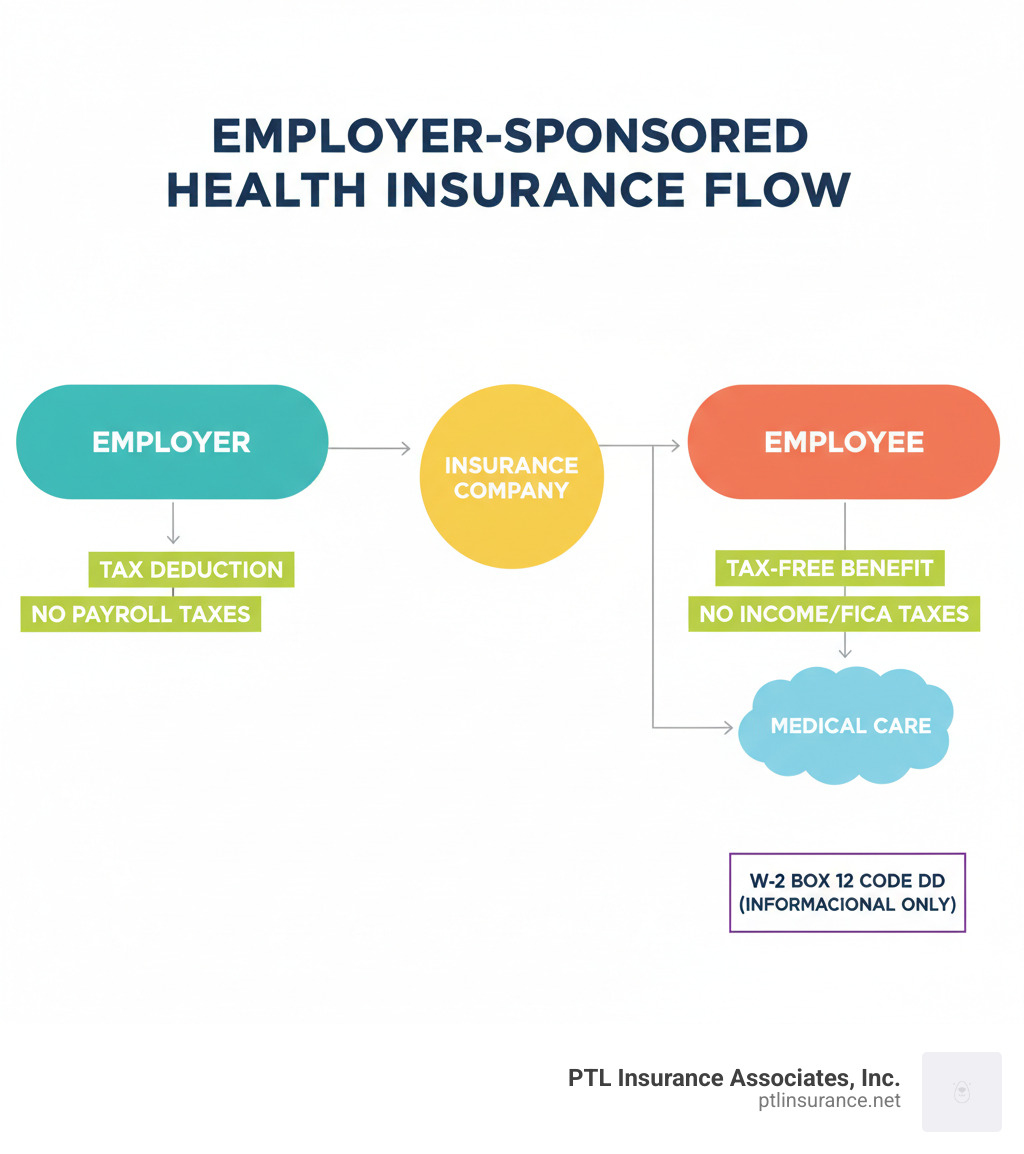
According to Federal tax expenditures for the tax exclusion for employer-sponsored health insurance premiums and Marketplace premium tax credit, 2022, the average employee saved around $2,200 in taxes in 2022 due to this exclusion. This company medical insurance tax advantage makes employer-sponsored coverage more valuable than an equivalent cash raise.
Health Savings Accounts (HSAs) and Flexible Spending Accounts (FSAs) offer more tax breaks. HSAs, paired with high-deductible plans, provide a triple tax advantage: pre-tax contributions, tax-free growth, and tax-free withdrawals for medical costs. FSAs also allow pre-tax contributions, boosting the value of your employee benefits package.
How are employer-provided health premiums reported?
Even though employer-paid health insurance premiums aren’t taxable, the IRS requires them to be reported. You’ll see the value of your employer-sponsored health coverage listed on your Form W-2 in Box 12, marked with Code DD.
This is for informational purposes only. The amount in Box 12 Code DD does not increase your taxable income and is not added to your wages. The IRS requires this reporting to track healthcare costs and show you the full value of your benefits. As explained by MyFlorida, this number is purely for your records.
Tax on Other Insurance: Life, Disability, and More
Health insurance isn’t the only benefit with tax implications. Other types of coverage follow different rules under company medical insurance tax regulations.
Group-Term Life Insurance: The first $50,000 of employer-provided coverage is tax-free. The cost of coverage exceeding $50,000 is considered “imputed income” and is added to your W-2 wages, subject to Social Security and Medicare taxes.
Disability Insurance: The tax treatment depends on who pays the premiums. If your employer pays, the premiums aren’t taxable to you, but any disability benefits you receive are taxable income. If you pay premiums with after-tax dollars, you can’t deduct them, but any benefits you receive are tax-free.
Income Maintenance Plans: These follow the same logic as disability insurance. Employer-paid premiums lead to taxable benefits, while employee-paid premiums (with after-tax dollars) lead to tax-free benefits.
Understanding these distinctions helps you appreciate your full benefits package. At PTL Insurance Associates, we help employers structure these benefits to maximize value for everyone.
Navigating Special Scenarios: The Company Medical Insurance Tax Rules
While basic company medical insurance tax rules are straightforward, some situations are more nuanced. Let’s examine special scenarios for the self-employed, shareholders, and those considering alternative plans to ensure compliance and maximize tax benefits.
How do self-employed individuals deduct health insurance?
If you’re self-employed in Miami (sole proprietor, partner, or LLC member), you can deduct health insurance premiums for yourself, your spouse, and dependents. This valuable “above-the-line” deduction reduces your adjusted gross income.
The requirements are manageable: you cannot be eligible to participate in an employer-sponsored health plan, and you must have net earnings from self-employment. The deduction cannot exceed the net profit from the business that established the plan.
You’ll report this deduction on Form 1040, not Schedule C, which reduces your adjusted gross income. This deduction makes coverage, including self-insured health plans small business options, more affordable. If you receive a premium tax credit from the Marketplace, you can only deduct the portion of premiums you paid out-of-pocket.
What are the rules for shareholder-employees?
When you own part of the company and work for it, the company medical insurance tax rules depend on your business structure.
For S-Corporation 2% shareholders (owning >2% stock), the S-Corp must include health insurance premiums in your W-2 as taxable wages. However, you can then take an above-the-line deduction on your personal Form 1040, similar to the self-employed deduction. This is allowed as long as you aren’t eligible for another employer’s health plan. The result is that the S-Corp gets a business deduction, and you avoid income tax on the premiums.
For C-Corporation shareholder-employees, the treatment is simpler. Premiums are a deductible business expense for the corporation and are completely tax-free to you, just like any other employee. This is a key advantage of the C-Corp structure for health benefits.
The company medical insurance tax treatment of ‘Cost-Plus’ and Fixed-Indemnity Plans
The IRS is cracking down on certain plans, like fixed-indemnity and “cost-plus” arrangements, that may disguise taxable income as tax-free health benefits, as noted in a KPMG analysis, “Tax-Free Fixed Indemnity Healthcare for Employees: End of a Dream“.
Fixed-indemnity plans pay a set amount for a medical event, regardless of the actual cost. The IRS may view these as taxable income replacement rather than true health insurance if payments aren’t tied to actual medical expenses.
“Cost-plus” plans reimburse medical expenses plus a fee. Arrangements without genuine insurance risk, especially those benefiting a sole shareholder, may be deemed disguised compensation by the IRS, making contributions taxable.
The IRS is concerned about plans that blur the line between tax-free medical reimbursement and taxable compensation. Watch out for plans that pay benefits without proof of medical expenses, have no genuine risk transfer, or offer large cash rewards for minimal wellness activities.
For Miami business owners, the lesson is to structure plans carefully with experienced professionals. If a plan’s tax benefits seem too good to be true, they probably are. At PTL Insurance Associates, we help you establish compliant plans from the start to avoid costly consequences.
Frequently Asked Questions about Company Medical Insurance Tax
Working with Miami business owners at PTL Insurance Associates, I frequently answer the same important questions about company medical insurance tax rules. Let’s tackle the most common concerns.
Are employer contributions to an employee’s Health Savings Account (HSA) taxable?
No. Employer contributions to an HSA are generally not included in an employee’s income. The employer gets a tax deduction, and the employee receives the funds tax-free—no federal income, Social Security, or Medicare tax. This creates a triple tax advantage: tax-free contributions, tax-free growth, and tax-free withdrawals for qualified medical expenses.
Can my business deduct premiums for my family’s health insurance?
The answer depends on your business structure, a key factor in company medical insurance tax planning.
If you’re self-employed (a sole proprietor or partner), you can generally deduct premiums for yourself, your spouse, and your dependents on your personal Form 1040. This is an “above-the-line” deduction, provided you aren’t eligible for another employer’s plan.
For corporations, coverage for an owner-employee’s family is usually a fully deductible business expense. For C-Corporations, this is straightforward. For S-Corporations with 2% shareholders, premiums are added to W-2 wages but can then be deducted on the personal return.
Correct plan structure is crucial from the start. Many owners miss deductions because they don’t understand the rules for their specific business type.
What happens if I pay for my own health insurance through my employer with pre-tax money?
This is common in a cafeteria plan (Section 125 plan). When you contribute to premiums through pre-tax payroll deductions, that money is removed from your paycheck before federal income, Social Security, and Medicare taxes are calculated. This lowers your overall taxable income, meaning you keep more of your paycheck.
This benefits both you and your employer, who saves on payroll taxes. While cafeteria plans require administrative setup and IRS compliance, they are worthwhile for most businesses with multiple employees.
If you want to ensure your plan is structured for maximum tax efficiency, that’s a conversation we welcome at PTL Insurance Associates. Understanding company medical insurance tax implications helps us design better benefits packages for you and your team.
Conclusion: Partnering for the Right Coverage and Compliance
Understanding company medical insurance tax rules is about making smart financial decisions for your business and team. As we’ve covered, employer-paid premiums are a win-win: your business gets a tax deduction, and your employees receive tax-free coverage.
You now know that employer deductions for premiums are ordinary business expenses that reduce taxable income. You also understand that employee benefits are tax-free, making health coverage a highly efficient form of compensation, with amounts reported for informational purposes on Form W-2 Box 12 (Code DD).
The details matter. Your business structure—sole proprietorship, partnership, or corporation—affects how you claim deductions. Special rules for the self-employed and 2% S-Corporation shareholders require careful attention.
Structuring plans correctly is critical. The IRS is scrutinizing arrangements like fixed-indemnity and “cost-plus” plans that might disguise income as tax-free benefits. Getting this wrong can lead to penalties and lost deductions.
At PTL Insurance, I’ve seen how the right guidance makes a difference. Every Miami business is unique, so cookie-cutter solutions don’t work for company medical insurance tax strategy. We focus on your specific situation to craft compliant coverage that maximizes your tax advantages.
The tax landscape is always changing. Having a partner who stays current is invaluable. For over 35 years, PTL Insurance Associates has helped Miami businesses build comprehensive benefits strategies that support their bottom line and their employees’ well-being.
Ready to make sure you’re getting every tax advantage available while providing outstanding coverage for your team? Get expert help with your business insurance needs and let’s create a plan that’s perfectly custom to your business. business.

