
Small Business Health Insurance Florida: 2025 Smart Choices
Why Florida Small Business Health Insurance Matters More Than Ever
Finding the right small business health insurance florida can feel overwhelming, but it’s simpler than you might think. Whether you’re legally required to offer coverage, want to attract top talent, or need cost-effective alternatives, understanding your choices is the first step toward making smart decisions for your team and your bottom line.
For most Florida small businesses (fewer than 50 employees), offering health insurance isn’t a legal requirement, but it is a strategic advantage. You have access to traditional group plans from major carriers, as well as flexible alternatives like Health Reimbursement Arrangements (HRAs) that can offer significant savings. Plus, premium payments are typically 100% tax-deductible, providing a valuable financial benefit.
Florida’s economy is powered by 2.8 million small businesses. Yet many owners struggle with providing quality health benefits without breaking the bank. The good news is that the insurance landscape offers more flexibility than ever. From group plans to innovative HRAs, there are solutions for every budget.
“Only a third of companies with one to nine employees offer health insurance compared to 89% that have 30 or more employees,” according to the NFIB Research Center. This gap often exists because owners are unaware of their options.
As an independent broker at PTL Insurance Associates, I’ve spent years helping Florida business owners steer these challenges. My experience shows that with the right guidance, a confusing process can become a strategic advantage for your company.
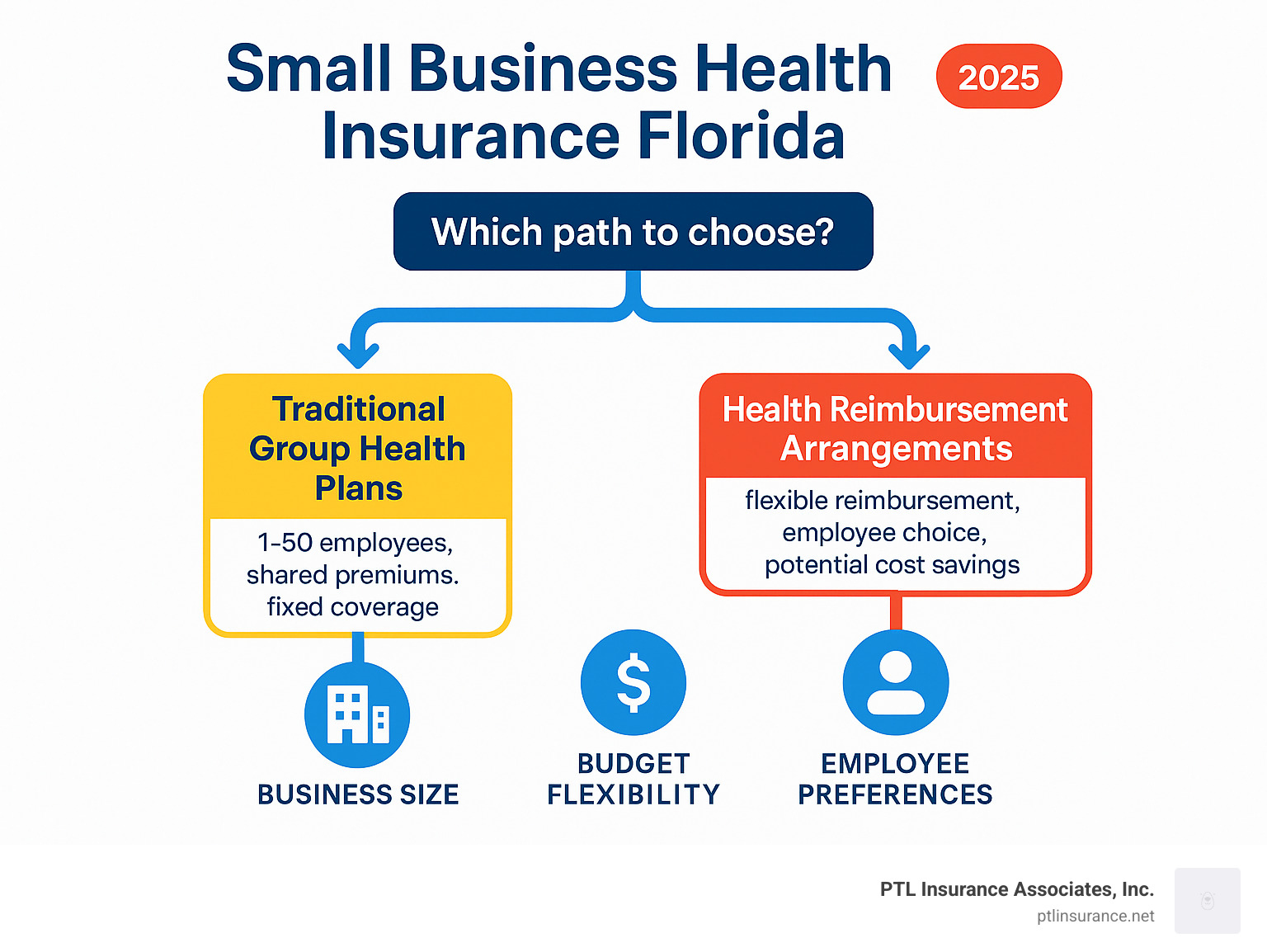
Navigating Health Benefits in the Sunshine State
Florida’s vibrant economy offers incredible opportunities, but navigating employee health benefits can be complex. The sheer volume of information makes it difficult to discern what truly benefits your team and your bottom line.
This guide simplifies these options. We want to empower you with clear, actionable information to make informed decisions about small business health insurance florida. We’ll break down the complexities and help you find solutions that align with your company’s unique needs and goals.
Understanding the Basics: Eligibility and Legal Requirements
Before exploring plan types and costs, it’s crucial to understand the basics. What defines a “small” business for health insurance in Florida, and what are your legal obligations? These foundational points will simplify your decision-making process.
Are You Legally Required to Offer Health Insurance in Florida?
The Affordable Care Act (ACA) created a common myth that all businesses must offer health benefits. However, for most small businesses in Florida, this is not the case.
If your business has fewer than 50 full-time equivalent (FTE) employees, you are not legally required to offer health insurance. This gives you significant flexibility.
While not mandatory, offering health insurance is a powerful strategic move. It helps you attract and retain top talent, as great benefits are a major draw for skilled professionals. It also boosts productivity and morale by showing your team you care about their well-being, leading to fewer sick days and a stronger company culture. A recent survey found that 88% of employers consider health benefits extremely important to their team, highlighting the value of this investment.
Who Qualifies for a Small Group Health Plan?
In Florida, a “small group” is typically a business with 1 to 50 full-time equivalent (FTE) employees. This classification determines which health insurance options are available to you.
- Sole proprietors and family-only businesses (e.g., just you and a spouse) generally do not qualify for group plans. They typically find coverage through the individual health insurance market.
- Businesses with at least one common-law employee (who is not a spouse) likely qualify as a small group and can explore group health insurance options.
Most group plans also have minimum participation requirements, often requiring around 70% of eligible employees to enroll. This ensures a balanced risk pool for the insurance carrier.
Knowing your FTE count is essential. You can learn how to calculate it here: Find out how to count your FTE’s. For more information on how we can support your business with small business health insurance florida and other coverage, visit our Business Insurance Services page: More info about our Business Insurance Services.
Exploring Your Options: Types of Small Business Health Insurance in Florida
Once you determine your eligibility, the next step is understanding the different plan types and funding models. This is where you can balance cost, network access, and employee choice to find the perfect fit for your team.
Common Health Plan Types
When exploring small business health insurance florida, you’ll encounter several common plan structures, each offering a different balance of flexibility and cost.
| Plan Type | Primary Care Physician (PCP) Required? | Referrals for Specialists? | Out-of-Network Coverage? | Typical Cost |
|---|---|---|---|---|
| HMO (Health Maintenance Organization) | Yes | Yes | No (except emergencies) | Lower |
| PPO (Preferred Provider Organization) | No | No | Yes (at higher cost) | Higher |
| EPO (Exclusive Provider Organization) | No | No | No (except emergencies) | Moderate |
| POS (Point of Service) | Yes | Yes (for in-network) | Yes (with referral, at higher cost) | Moderate to Higher |
- HMO Plans: Focus on wellness and require a primary care physician (PCP) to manage care and provide referrals. They generally have lower premiums but less network flexibility.
- PPO Plans: Offer more flexibility, allowing members to see specialists without referrals and access out-of-network providers at a higher cost. Premiums are typically higher.
- EPO Plans: A hybrid that doesn’t require referrals for in-network specialists but generally doesn’t cover out-of-network care, except in emergencies.
- POS Plans: Combine HMO and PPO features, requiring a PCP and referrals but offering an option to go out-of-network for a higher cost.
Choosing the right plan involves considering your employees’ preferences for network size and your budget for premiums and out-of-pocket expenses.

Understanding How Plans are Funded
How your plan is funded impacts your financial risk and potential for savings.
- Fully-Insured Plans: The traditional model where your business pays a fixed monthly premium to an insurance carrier. The carrier assumes all financial risk for claims, offering predictable costs for easy budgeting.
- Level-Funded Plans (Balanced Funding): A popular hybrid approach where you pay a fixed monthly premium, part of which goes into a claims fund. If your group’s claims are lower than expected, you may receive a refund or credit. This offers the predictability of a fully-insured plan with potential savings.
- Self-Funded Options (ASO): Typically for larger businesses, this model involves the business paying for employee healthcare claims directly. You hire an administrator to manage the plan. It offers the most control and savings potential but also carries the most financial risk.
Many carriers in Florida offer competitive portfolios with various funding options, highlighting the flexibility available in the market.
The Cost Factor: What to Expect and How to Save
The cost of small business health insurance florida is a primary concern for most owners. While an exact quote requires a personalized assessment, we can provide a clear picture of what influences costs and what you can generally expect.
Key Factors That Influence Your Premiums
Several key factors determine your monthly premiums:
- Employee Demographics: The age and overall health of your employees play a significant role.
- Business Location: Insurance costs vary by county in Florida. For example, premiums in Miami-Dade County can differ from those in Duval County.
- Plan Metal Tier: Plans are categorized as Bronze, Silver, Gold, or Platinum. Bronze plans have lower premiums but higher out-of-pocket costs, while Platinum plans are the opposite.
- Network and Plan Design: Broader networks (like PPOs) and plans with lower deductibles typically have higher premiums.
- Employer Contribution: The percentage of the premium you choose to cover directly impacts your overall cost. Many employers contribute 50% to 100%.
Recent data shows a wide range in average monthly premiums for small group plans depending on the carrier and plan design. This variation underscores the importance of comparing different options to find the best value.

Tax Advantages and Savings for Your Florida Small Business
Offering health insurance provides significant tax advantages. Premiums your business pays for employee group health plans are typically 100% tax-deductible as a business expense, which can lead to substantial savings.
Additionally, you may qualify for The Small Business Health Care Tax Credit. This credit is available to businesses with fewer than 25 FTE employees that pay average wages below a certain threshold and contribute at least 50% of the premium cost. The credit can cover up to 50% of the premiums you pay, directly reducing your tax liability.
To learn more about this credit, visit the IRS website: The Small Business Health Care Tax Credit. For more insights on managing business insurance costs in Florida, see our guide: Learn more about Business Insurance Florida Cost.
Beyond Traditional Plans: Smart Alternatives for Florida Businesses
While traditional group plans are common, small business health insurance Florida is evolving. Smart alternatives now offer more flexibility, cost control, and employee choice. These options often use a defined contribution model, integrating with the individual health insurance marketplace.
Health Reimbursement Arrangements (HRAs): A Flexible Solution
Health Reimbursement Arrangements (HRAs) are an increasingly popular alternative. With an HRA, you reimburse employees tax-free for qualified medical expenses, including individual health insurance premiums. Instead of choosing a one-size-fits-all group plan, you provide funds, and employees select the coverage that best fits their needs.
Two main types of HRAs are useful for Florida businesses:
- Qualified Small Employer HRA (QSEHRA): Designed for businesses with fewer than 50 FTE employees. You can reimburse employees for individual plan premiums and other medical expenses up to an annual IRS-set limit.
- Individual Coverage HRA (ICHRA): Available to businesses of all sizes, this HRA has no contribution limits and allows you to set different reimbursement amounts for different employee classes (e.g., full-time vs. part-time).
HRAs can lead to significant cost savings. In many Florida counties, individual health plans are more affordable than small group plans. By using an HRA to reimburse these individual plans, you can provide robust benefits while managing your budget effectively. You set the contribution, and your employees get to choose.

What Happened to the SHOP Marketplace in Florida?
The Small Business Health Options Program (SHOP) was created under the ACA to help small employers compare and buy health insurance. However, this is a key piece of information for anyone seeking small business health insurance Florida: Florida currently has no insurance carriers participating in the SHOP Marketplace.
This means you cannot use the federal SHOP website to find group health plans. Instead, you must steer the private insurance market. The most effective way to do this is by working with an independent insurance broker like PTL Insurance Associates. Our expertise and relationships with carriers allow us to help you compare all available options and find the right fit for your business.
Making the Right Choice for Your Team and Your Budget
Finding the perfect small business health insurance florida solution is about balancing great benefits with smart budgeting. The right plan supports your team’s well-being, keeps your business financially healthy, and becomes a key part of your company’s appeal to current and future employees.
How to Choose the Best Health Insurance Plan
Choosing the right plan involves a clear, strategic approach:
- Survey your team’s needs. Understand what matters most to them, whether it’s low deductibles, network flexibility, or specific coverage for family or chronic conditions.
- Set a realistic budget. Determine a sustainable contribution level that works for your business now and as it grows.
- Check network access. Ensure the plan’s network is convenient for where your employees live and work. A great plan is useless if the doctors are too far away.
- Evaluate total costs. Look beyond the premium to consider deductibles, copays, and out-of-pocket maximums to understand the true cost for your employees.
- Consider ancillary benefits. Adding dental, vision, or life insurance can make your benefits package significantly more attractive.
- Work with an independent agent. A broker like PTL Insurance Associates can search across all major carriers to find plans that fit your specific needs and budget, saving you time and effort.
For more information on protecting your business, our guide on General Liability Insurance for Small Businesses may also be helpful.
Enhancing Your Offer with Ancillary Benefits
Ancillary benefits show employees you’re invested in their complete well-being. Consider adding:
- Dental and Vision Insurance: These cover routine care and unexpected expenses that are often not included in health plans.
- Life and Disability Insurance: These provide crucial financial security for employees and their families in case of death, illness, or injury.
- Wellness Programs: Offerings like gym memberships or health coaching promote a healthier workforce and can help manage long-term healthcare costs. Many carriers provide value-added services like nurse advice lines and personalized care programs.
A comprehensive benefits package demonstrates your commitment and can be a deciding factor for top talent in Florida’s competitive job market.
Finding a Provider and Getting Help
When purchasing small business health insurance florida, you’ll find that the Florida Office of Insurance Regulation has approved numerous companies to market small group health plans, including both PPO and HMO options.
While having many choices is good, navigating them can be overwhelming. This is why working with an independent broker like PTL Insurance Associates is so valuable. We provide personalized guidance, helping you compare plans from multiple carriers to find the best fit. We act as your advocate, simplifying complex insurance language and ensuring you get the most value for your investment.
For additional help, you can use government resources to find a local agent or broker for help. For businesses in the Miami area, we invite you to connect with Small Business Insurance Agents in Miami through our specialized local services.
Frequently Asked Questions about Small Business Health Insurance in Florida
Even with a better understanding of small business health insurance Florida, some questions commonly arise. Here are answers to a few of the most frequent ones.
Can my one-person business get a group health plan in Florida?
Generally, no. To qualify for a group health plan in Florida, a business must have at least one common-law employee other than the owner or their spouse. Sole proprietors, freelancers, and single-owner businesses without other employees typically access coverage through the Individual Marketplace. There, you may qualify for premium tax credits to make coverage more affordable.
Are my business’s health insurance premium payments tax-deductible?
Yes, in most cases. Premiums your business pays for employee group health plans are considered a business expense and are generally 100% tax-deductible on your federal taxes. This is a significant financial benefit that helps offset the cost of providing coverage. Always consult a tax professional for advice specific to your situation.
Is it cheaper to get insurance through a broker?
The premium for a specific health insurance plan is regulated, meaning you pay the exact same price whether you buy it directly from a carrier or through an independent broker like PTL Insurance Associates. The price isn’t cheaper, but the value is immense.
A broker provides expert advice, access to multiple carriers and plans, and ongoing support at no extra cost to you. We simplify the complex process of comparing options, handling enrollment, and managing your plan year-round, ensuring you get the right coverage and the most value for your investment.
Conclusion: Your Partner in Florida Business Health
Navigating small business health insurance florida can feel complex, but it doesn’t have to be. With the right information, you can see that you have excellent options. From the predictability of traditional group plans to the flexibility of modern alternatives like HRAs, there is a solution that fits your team and your budget.
Understanding your eligibility, cost factors, and the strategic advantages of offering health benefits empowers you to make confident decisions for your business’s future.
That’s where we come in. At PTL Insurance Associates, Inc., we are more than just brokers; we are your trusted partners. With over 35 years of experience in Miami, we specialize in personalized service and crafting solutions that fit your unique needs. When your employees feel secure, your business flourishes.
Ready to Find the Right Coverage?
Don’t let complexity stop you from taking the next step. The peace of mind that comes with protecting your team and attracting top talent is within reach. We’re here to help you explore every option and find the perfect plan.
Let’s connect and get started. Explore our comprehensive Business Insurance services and let us be your partner in protecting your business and your employees: Explore our comprehensive Business Insurance services.