
Self Insured Health Plans Small Business: Unlock 20%
Taking Control of Your Healthcare Costs
{title=”Self-Funded Health Plans for Small Businesses” caption=”Empowering small businesses with flexible health plan solutions.” source=”PTL Insurance Associates”}
The image above captures the essence of a modern approach to employee benefits: taking direct control to manage costs and improve care. As healthcare costs continue to outpace inflation, self insured health plans small business owners are increasingly adopting as a solution. This approach is fundamentally different from traditional insurance: instead of paying fixed premiums, your business pays for employee medical claims directly as they occur.
Key differences between self-funded and fully-insured plans:
- Premium structure: Pay for actual claims vs. fixed monthly premiums
- Risk: Your business assumes financial risk vs. insurance company bears risk
- Savings potential: Keep unused funds vs. no refund on unused premiums
- Control: Customize plan design vs. limited plan options
- Data access: Full claims transparency vs. limited reporting
Rising healthcare costs are a major concern for business owners. The pandemic has accelerated this trend, pushing more small businesses to explore alternatives that offer greater control over their healthcare spending.
Self-funded plans are no longer exclusive to large corporations. Today, 16% of small business employees are enrolled in self-funded plans, and companies with as few as 10-20 employees are finding success with properly structured arrangements.
As Niki Perez from PTL Insurance Associates, I’ve helped many Miami businesses steer the complexities of self insured health plans small business owners face. The key is to understand both the opportunities and risks before making this important decision for your company and your employees.
What is a Self-Funded Health Plan?
A self-funded health plan essentially cuts out the insurance middleman. Instead of paying a fixed monthly premium to an insurer, your business establishes its own fund to pay employee medical claims directly. It’s like paying for what you use instead of buying an all-inclusive package.
In a traditional fully-insured plan, you pay the same premium regardless of claim volume. The insurer keeps any surplus but also absorbs high claim costs. With self insured health plans small business owners choose, you assume the financial risk but also keep the savings when claims are low. Your employees receive the same quality healthcare, using the same provider networks and ID cards; the only difference is who pays the bills behind the scenes. This approach offers significant transparency and control, allowing you to see exactly where your healthcare dollars are going and retain any surplus.
Fully-Insured vs. Self-Funded: A Direct Comparison
To understand the landscape of self insured health plans small business owners consider, a direct comparison is helpful.
| Feature | Fully-Insured Plan | Self-Funded Plan |
|---|---|---|
| Premium Structure | Fixed monthly premium per employee. | Variable costs based on actual claims + fixed admin fees. |
| Risk Assumption | Insurance company assumes financial risk of claims. | Employer assumes financial risk of claims. |
| Cost Savings Potential | Limited; no refund for unused premiums. | High; potential for surplus refund if claims are low. |
| Flexibility | Limited customization; standard plan designs. | High; customizable benefits to suit specific needs. |
| Regulation | Primarily regulated by state laws. | Primarily regulated by federal laws (ERISA, ACA). |
| Data Access | Limited transparency into claims data. | Full access to detailed claims data. |
This comparison highlights why many Miami businesses I work with are switching. The flexibility and cost savings potential often outweigh the added responsibility, especially for companies with stable cash flow and a healthy workforce.
The Role of a Third-Party Administrator (TPA)
You don’t have to manage a self-funded plan alone. A Third-Party Administrator (TPA) acts as your outsourced benefits department, handling the day-to-day operations.
A TPA processes claims with the same efficiency as a major insurer, often using the same systems and networks. They review claims, ensure they align with your plan, and issue payments. Most TPAs also provide access to established provider networks, helping control costs through pre-negotiated discounts.
The TPA handles administrative tasks like enrollment, ID cards, and member services. They also help you steer complex compliance requirements like ERISA and ACA regulations. Crucially, TPAs provide detailed reporting on your plan’s performance, giving you clear insight into your healthcare spending.
Hiring a third-party administrator (TPA) typically costs $50-$100 per employee per month. While an added expense, this is often less than the markup in traditional insurance premiums and provides professional plan management.
The Self-Insured Health Plans Small Business Equation: Pros vs. Cons
Considering self insured health plans small business options involves weighing significant benefits against new responsibilities. With traditional insurance, you “rent” coverage for a fixed monthly cost, and the insurer handles surprises. With self-funding, you “buy” your plan, gaining control and savings potential but also assuming the risks of ownership.
The Advantages: Why Businesses Make the Switch
The most compelling reason businesses switch is the greater control and flexibility. Instead of cookie-cutter plans, you can design benefits that fit your team’s actual needs.
Claims data transparency is another game-changer. Self-funded plans provide detailed reports on spending, offering actionable data to make smarter decisions. The potential for year-end surplus refunds is also highly appealing; if claims are low, the leftover money in your claims fund returns to your business, not an insurer’s profit margin. You also avoid state premium taxes (typically around 2%) and improve cash flow by paying for claims as they occur rather than in large, fixed premiums.
Potential Cost Savings with self insured health plans small business
The savings can be impressive, with many businesses seeing up to 20% savings compared to traditional plans. This comes from cutting out costs built into carrier premiums.
Lower administrative fees are a major factor. Your TPA’s fee is often less than an insurer’s overhead and profit margin. By paying only for claims incurred, your healthy workforce directly benefits your bottom line, as you are not subsidizing other companies’ high-cost employees. Access to claims data also allows you to implement targeted wellness programs or negotiate better provider rates, driving long-term savings.
The Disadvantages: Understanding the Risks
The biggest challenge with self insured health plans small business owners face is financial volatility. Healthcare costs can be unpredictable. One catastrophic claim, such as for a major surgery or serious illness, could generate hundreds of thousands of dollars in bills, severely straining your finances.
There is also an increased administrative burden. Even with a TPA, you are ultimately responsible for the plan’s performance and compliance. This means more decisions and details to manage. Regulatory compliance with federal laws like ERISA and the ACA can be tricky, and errors can lead to penalties.
Financial Risks of self insured health plans small business
Budgeting uncertainty is a primary stressor. While you might budget $5,000-$10,000 per employee annually, actual costs can swing dramatically. A high-claim year can be difficult; if you budget $100,000 and claims reach $180,000, that $80,000 shortfall must be covered.
Cash flow challenges are particularly acute for smaller groups (under 35-50 employees), where a single large claim can derail the budget. The potential for savings is real, but so is the risk of unexpected costs. It is not a decision to be made lightly.
Managing Risk and Administrative Burdens
While the risks of self insured health plans small business owners choose are real, they are manageable with the right strategy. Smart business owners don’t hope for the best; they build a comprehensive plan that includes financial protections and wellness initiatives to mitigate risk to an acceptable level.
Stop-Loss Insurance: Your Financial Safety Net
Stop-loss insurance is your financial safety net. It’s not health insurance for your employees; it’s a business insurance policy that protects your company from catastrophic claims. This infographic illustrates how a self-funded plan’s finances and risks differ from a fully-insured one, highlighting where stop-loss provides critical protection.
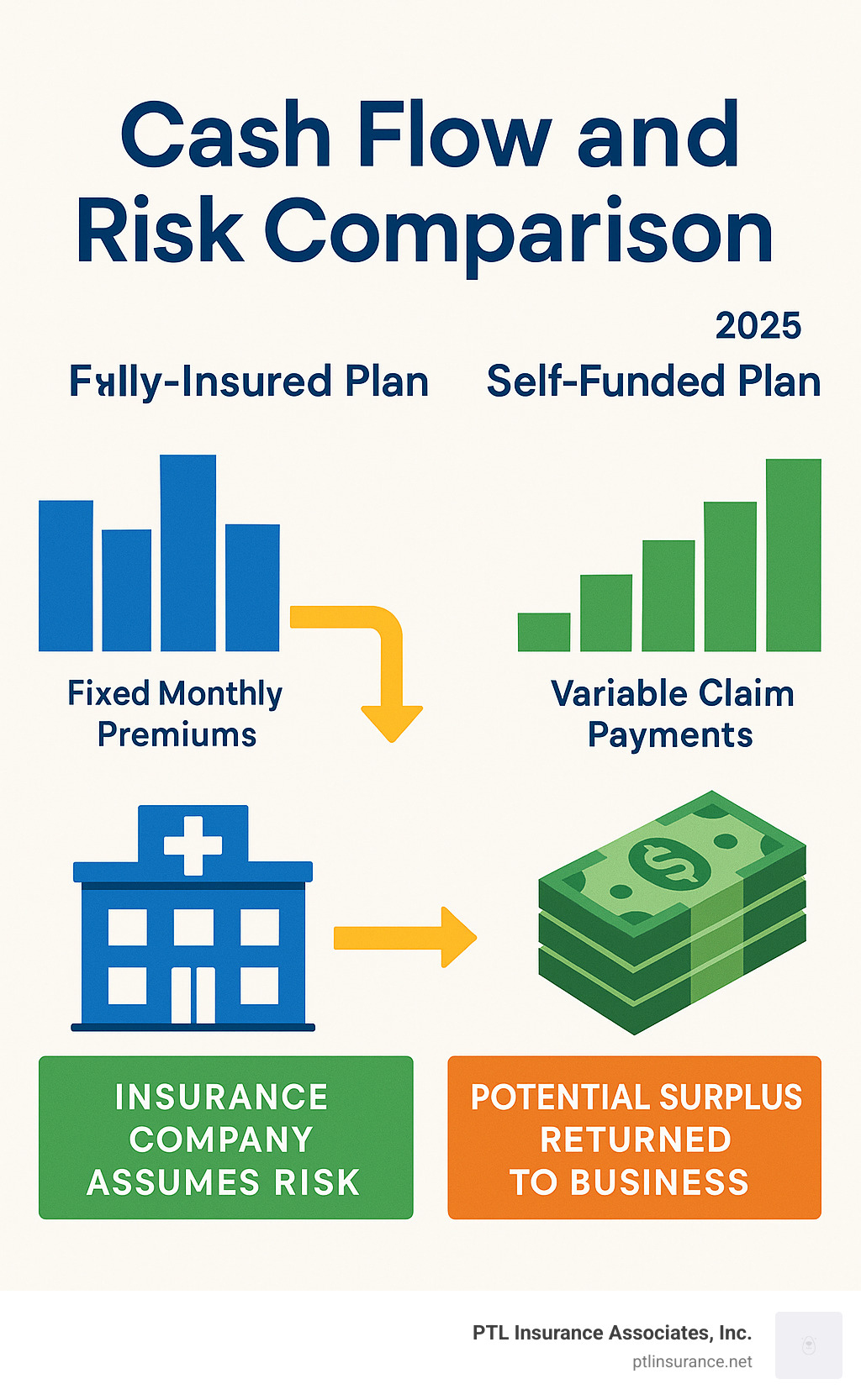
{description=”Cash Flow and Risk Comparison: Fully-Insured vs. Self-Funded Health Plans” title=”Understanding Health Plan Finances” caption=”This infographic illustrates the distinct financial flows and risk allocations in fully-insured versus self-funded health plans.” source=”PTL Insurance Associates”}
Stop-loss coverage comes in two forms:
- Specific stop-loss sets a per-person limit. If your limit is $50,000 and an employee incurs $150,000 in bills, you pay the first $50,000, and the stop-loss carrier covers the remaining $100,000.
- Aggregate stop-loss protects your total annual budget. If you budget $500,000 for claims but they reach $600,000, this coverage pays the $100,000 excess.
The fact that 92.6% of companies with 100-999 employees have stop-loss coverage shows how essential this protection is. The premiums become a predictable monthly cost, providing peace of mind that catastrophic claims won’t derail your finances.
Navigating Regulatory and Administrative Duties
Self-funded plans are free from many state insurance rules but fall under federal oversight, primarily The Employee Retirement Income Security Act (ERISA). This requires you to provide employees with plan documents, summary plan descriptions, and annual reporting.
ACA requirements also apply, such as covering essential health benefits and preventive care. A quality TPA handles most of this day-to-day compliance work, and an experienced consultant can guide you through major decisions. At PTL Insurance Associates, we’ve helped Miami businesses steer these rules for over 35 years, ensuring they remain compliant while focusing on their core business.
Is Self-Funding Right for Your Business?
Deciding if self insured health plans small business owners should pursue requires an honest assessment of your company’s financial health, risk tolerance, and long-term goals. It’s about finding the best fit for your unique situation.
Who Benefits Most from Self-Funding?
The ideal candidate for self-funding has expanded beyond large corporations to include businesses with 10-100+ employees. Success depends less on size and more on specific characteristics.
Companies that thrive with self-funding typically have:
- A relatively healthy workforce with predictable medical needs.
- Financial stability and sufficient cash reserves to handle claim fluctuations. A successful self-funded business can comfortably set aside $5,000-$10,000 per employee per year.
- A genuine interest in understanding healthcare spending and using data to make informed decisions.
- A long-term perspective, as the greatest benefits often emerge over several years of data collection and refinement.
Exploring Alternatives: Level-Funded Plans and HRAs
If you’re intrigued by self-funding but not ready for the full commitment, several excellent middle-ground options exist.
- Level-funded plans are like “self-funding with training wheels.” You pay a predictable monthly amount that covers expected claims, administrative costs, and stop-loss protection. If claims are lower than expected, you may receive a refund at year-end. It combines predictable costs with savings potential.
- Health Reimbursement Arrangements (HRAs) are employer-funded accounts that reimburse employees for medical expenses.
- The Qualified Small Employer HRA (QSEHRA) is for businesses with fewer than 50 employees. It provides a monthly allowance for employees to buy their own individual insurance.
- The Individual Coverage HRA (ICHRA) is for businesses of any size. It allows you to offer different allowance amounts to different employee classes, who then choose their own marketplace plans.
- An Integrated HRA can supplement an existing group plan by helping employees cover out-of-pocket costs like deductibles and copays.
These alternatives offer a path to more flexible healthcare funding without the full risk of a self-insured plan.
Frequently Asked Questions about Self-Funded Plans
When I discuss self insured health plans small business options with owners, these questions frequently arise. Here are the answers based on my experience helping Miami businesses.
What is the minimum number of employees needed to self-insure?
There is no legal minimum number of employees for a self-funded plan. While larger groups (35-50+ employees) were once the standard due to more predictable claims, the market has changed. Today, many TPAs and stop-loss carriers work with groups as small as 10-20 employees, using sophisticated risk assessment tools. For businesses with fewer than 20 employees, level-funded plans are often a great starting point, offering many self-funding benefits with the predictability of fixed monthly payments.
How much money should a business set aside for claims?
Setting the right amount for your claims fund requires careful analysis, not guesswork. A common starting point is allocating between $5,000 and $10,000 per employee per year. However, the precise amount depends on factors like employee demographics (age, gender, health status) and historical claims data. An experienced TPA performs an actuarial analysis based on your group’s specific characteristics to project expected claims. At PTL Insurance Associates, we help clients review these data-driven forecasts to ensure they align with your cash flow and business goals.
Can I switch back to a fully-insured plan if self-funding doesn’t work out?
Yes, absolutely. You are never locked into a self-funded plan. You can transition back to a fully-insured plan, typically during your open enrollment period or at the end of your plan year. Businesses might switch back after a high-claim year or if the administrative duties feel too burdensome. This isn’t a failure; it’s a learning experience about what works best for your company. An experienced insurance professional can help you evaluate your plan’s performance objectively and determine if adjustments or a switch to a different model—like a level-funded or fully-insured plan—is the right move. Making decisions based on data and expert guidance is key.
Chart Your Course to Better Business Health Insurance
Choosing the right health insurance is a critical decision for your business. As we’ve seen, self insured health plans small business owners are considering offer compelling benefits but also come with significant responsibilities.
The advantages are clear: greater control over plan design, full transparency into spending, and real potential for cost savings. By avoiding insurer profit margins and state premium taxes, and by retaining surplus funds in low-claim years, many businesses save up to 20%.
However, these plans require you to assume financial risk. Monthly costs will fluctuate, and a catastrophic claim could strain your budget without protection. This is why stop-loss insurance is an essential safety net and a skilled third-party administrator is a vital partner. Together, they make self-funding a manageable and powerful strategy.
Success depends on making an informed decision. If your business has stable cash flow, a relatively healthy workforce, and a desire for more control, self-funding could be transformative.
At PTL Insurance Associates, we have spent over 35 years helping Miami businesses steer these complex choices. We analyze your unique needs, demographics, and risk tolerance to provide honest advice. If self-funding is right for you, we’ll help structure a plan that protects your business and your employees.
Ready to explore the control and savings a self-funded plan could bring to your business? We’re here to guide you.