


Florida Small Business Health Insurance Requirements 1st
Why Understanding Florida Small Business Health Insurance Requirements Is Critical for Your Success
Caption: Understanding Florida’s health insurance landscape is a cornerstone of building a resilient business. Source: Unsplash.
Florida small business health insurance requirements can feel overwhelming, but understanding them is essential for protecting your business and attracting top talent. While Florida doesn’t mandate that small businesses provide health insurance, federal laws and state regulations create a complex web of rules that can impact your operations, finances, and legal compliance.
Quick Answer for Florida Small Business Owners:
- No state mandate: Florida doesn’t require small businesses to offer health insurance
- Federal ACA applies: Businesses with 50+ full-time equivalent employees must provide coverage or pay penalties
- Small employer definition: 1-50 eligible employees working 25+ hours per week
- Guaranteed-issue protection: Insurance companies can’t deny coverage based on employee health status (groups of 2-50)
- Cost controls: Florida uses modified community rating to limit premium variations
The stakes are high. As one insurance expert notes from the research, “I’ve watched too many Florida entrepreneurs lose everything because they thought ‘optional’ coverage was truly optional.” Beyond legal compliance, offering health benefits can be the difference between landing that star employee and watching them walk to your competitor.
Florida’s unique business environment – with 2.8 million small businesses employing 3.6 million people – creates both opportunities and challenges. Hurricane risks, a competitive job market, and Florida’s lawsuit-friendly courts make proper insurance planning more critical than ever.
As Niki Perez from PTL Insurance Associates, I’ve spent years helping Florida business owners steer these florida small business health insurance requirements after transitioning from Real Estate Management Services to insurance. My experience has shown me that understanding these rules upfront can save you thousands in penalties and help you build a stronger, more attractive workplace.
To help you visualize these key compliance points, the infographic below breaks down the essential requirements and deadlines.
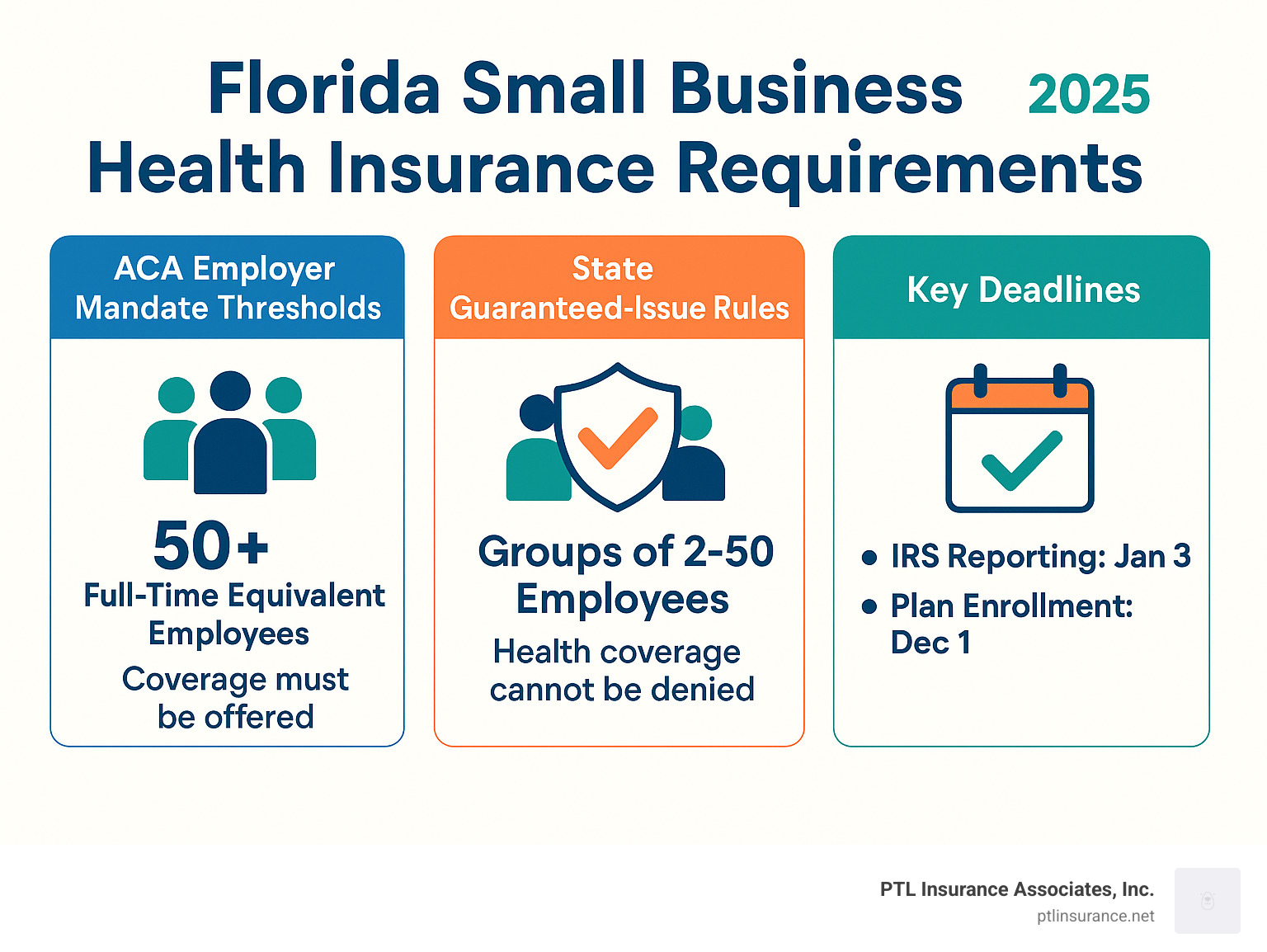
Florida small business health insurance requirements terms to know:
Defining Your Business: Are You a “Small Employer” in Florida?
Understanding where your business fits in Florida’s health insurance landscape is like finding your place on a map – you need to know where you are before you can figure out where you’re going. The good news? Florida’s definition of a “small employer” is pretty straightforward once you break it down.
According to Florida Statute 627.6699, you’re considered a small employer if your business employed an average of at least 1 but not more than 50 eligible employees during the previous calendar year. There’s a catch though – you also need to employ at least 1 employee on the first day of your plan year and have your main business location in Florida. Think of it as Florida’s way of saying, “Hey, you’re one of us, and we’ve got rules that work for businesses your size.”
But here’s where it gets interesting: not every person on your payroll counts as an “eligible employee.” In Florida, an eligible employee typically works a normal workweek of 25 or more hours. So if you have a mix of full-time and part-time staff, only those putting in substantial hours will factor into your small employer status.
The Full-Time Equivalent (FTE) calculation might sound intimidating, but it’s actually pretty logical. Let’s say you have 8 full-time employees and 6 part-timers who each work 60 hours monthly. Your FTE would be 8 (full-timers) plus (6 part-timers × 60 hours) ÷ 120 = 11 FTEs total. This math helps determine whether you qualify for small group plans or need to worry about federal ACA mandates.
Now, what about sole proprietors and independent contractors? Here’s where things get a bit tricky. While Florida’s statute technically includes self-employed individuals in the small employer definition, the reality is different. If you’re self-employed with no employees (except maybe your spouse), you typically can’t qualify for traditional small group health plans. Instead, you’d need to look at individual health insurance options through the marketplace.
Independent contractors are another story entirely – they’re generally not counted as employees for health insurance purposes since they’re not on your W-2 payroll. This distinction matters because it affects both your employee count and your obligations.
Getting these definitions right from the start saves you headaches later. It’s the foundation for understanding all other florida small business health insurance requirements that follow. For a deeper dive into how these classifications impact your overall business insurance strategy, check out our comprehensive guide on business insurance services.
Who Qualifies: Employee Eligibility Rules
Once you’ve established that you’re a small employer, the next puzzle piece is figuring out which of your employees can actually enroll in your group health plan. It’s not as simple as “everyone who works here gets coverage” – there are specific rules that determine eligibility.
Full-time status is the starting point. While Florida defines eligible employees as those working 25+ hours per week, most group health plans require employees to work at least 30 hours weekly to qualify for benefits. It’s one of those situations where federal standards and insurance company requirements don’t always align perfectly with state definitions.
Waiting periods are standard practice for new hires. Most plans allow you to set a waiting period of 30 to 90 days before new employees can enroll. This gives you time to make sure they’re a good fit and helps control costs by ensuring you’re not covering someone who might leave after a week. Federal law caps this at 90 days, so you can’t make people wait longer than that.
Dependent coverage is where your health plan really starts to shine as an employee benefit. Most plans extend coverage to spouses and children up to age 26, regardless of whether those kids are students, married, or living at home. It’s a significant value-add that can make your job offer much more attractive to candidates with families.
Sometimes employees will want to waive coverage – maybe they’re covered under a spouse’s plan or have other insurance. While this is perfectly legal, many insurance carriers have minimum participation requirements. They might need at least 70% of eligible employees to enroll for the group plan to be approved. Getting signed waiver forms from employees who decline coverage isn’t just good practice – it’s essential documentation if questions arise later.
Here’s what you need to verify for each employee’s eligibility: Does the employee work your plan’s required hours? Have they completed any waiting period? Are they a W-2 employee rather than a contractor? Are you offering the same coverage options to all eligible employees? Do you have proper documentation for anyone who declines coverage?
The “No-Mandate” Rule for Small Businesses
Here’s the question I hear most often from Florida business owners: “Do I actually have to offer health insurance?” And honestly, it’s music to my ears when I can tell them, “Nope, you don’t have to – but you might want to anyway.”
If your business has fewer than 50 full-time equivalent employees, neither the federal ACA nor Florida state law requires you to provide health insurance. No penalties, no fines, no government breathing down your neck. It’s one less regulatory burden for small business owners who already have plenty on their plates.
But here’s the thing – just because you don’t have to doesn’t mean you shouldn’t consider it. In Florida’s competitive job market, offering health benefits can be the difference between landing that perfect employee and watching them accept an offer from your competitor down the street. It’s not just about the coverage itself; it’s about what it signals. When you offer health insurance, you’re telling potential employees that you’re serious about their wellbeing and that you’re in this for the long haul.
The impact on employee morale is real and measurable. Employees with health coverage tend to miss fewer work days, worry less about medical bills, and show higher job satisfaction. It’s an investment that often pays for itself through improved productivity and reduced turnover.
While Florida doesn’t participate in the federal SHOP marketplace (meaning you can’t buy small business plans directly through the government exchange), you still have plenty of options. Working with an independent broker like us often gets you better rates and more personalized service than you’d find through a government portal anyway.
The bottom line? You have the freedom to choose what’s right for your business. Some small employers decide to wait until they’re more established, while others use health benefits as a key recruiting tool from day one. Both approaches can work – it depends on your industry, your budget, and your business goals.
For more information about what SHOP eligibility looks like in other states, you can visit the SHOP eligibility page, though remember that in Florida, you’ll work directly with carriers or through brokers like us to find your perfect plan.
Understanding Florida Small Business Health Insurance Requirements
While small businesses in Florida aren’t typically required to provide health insurance, understanding the broader landscape of florida small business health insurance requirements is essential for planning your company’s future growth and ensuring you stay compliant as you expand.
The Affordable Care Act (ACA) creates the most significant compliance hurdle for growing businesses. Once you reach 50 or more full-time equivalent employees, you become what’s called an “Applicable Large Employer” (ALE). At this point, you’re generally required to offer affordable health coverage that meets minimum value standards to your full-time employees, or face substantial penalties.
For 2025, the affordability threshold means your employer-sponsored health coverage can’t cost more than 9.02% of an employee’s household income (this percentage increases from 8.39% in 2024). This is a moving target that changes annually, so staying informed about these adjustments is crucial for maintaining compliance.
Even if you’re well below the 50-employee threshold, offering group health plans comes with important reporting and disclosure duties. You’ll need to provide employees with a Summary of Benefits and Coverage (SBC) document, which explains your health plan’s coverage and costs in a clear, standardized format that helps employees understand what they’re getting.
Additionally, you must report the cost of employer-sponsored group health insurance coverage on employees’ W-2 forms. While this doesn’t create a tax burden for most employees, it’s a federal requirement that helps track healthcare spending across the economy.
Then there’s continuation coverage – better known as COBRA and mini-COBRA. If you have 20 or more employees, federal COBRA laws allow employees and their families to continue group health coverage for a limited time after certain qualifying events like job loss or reduced hours. For smaller employers with fewer than 20 employees, Florida’s “mini-COBRA” law provides similar continuation rights, though with some differences in coverage periods and requirements.
Navigating these federal and state compliance requirements can feel overwhelming, especially when you’re focused on running your business. That’s where having an experienced insurance partner becomes invaluable – we help ensure you understand your obligations and have the right systems in place to meet them.
For more comprehensive information on employee benefits, including these federal and state compliance nuances, visit More info on Employee Benefits.
Key State-Level Florida Small Business Health Insurance Requirements
Florida has crafted specific state laws that govern the small group health insurance market, creating important protections that make coverage more accessible and fair for small businesses. These florida small business health insurance requirements at the state level are designed to level the playing field and ensure your business can secure quality coverage regardless of your employees’ health status.
The most significant protection Florida offers is the “guaranteed-issue basis” for small employer health plans. This means insurance carriers in Florida must offer and issue health benefit plans to eligible small employers with 2 to 50 eligible employees. They cannot deny your business coverage based on your employees’ health status, claims history, or pre-existing conditions. This is a game-changer for small businesses, eliminating the fear that one employee’s health issue could make your entire group uninsurable.
When it comes to pre-existing conditions, Florida law provides clear limitations on how long health plans can exclude coverage. For the smallest groups (fewer than two employees), pre-existing condition exclusions cannot extend beyond 24 months. These exclusions apply to conditions that were manifested or treated within 24 months before coverage begins, or to existing pregnancies.
For employees who don’t enroll when first eligible (called “late enrollees”), the exclusion period can also be up to 24 months, but only if they weren’t continuously covered by creditable coverage within 63 days before the new coverage starts. These rules ensure that employees can access care even with prior health issues, while still providing some protection for insurance carriers against adverse selection.
Florida also mandates specific enrollment periods to ensure fair access to coverage. Insurance carriers must offer an initial enrollment period of at least 30 days when a plan is first offered to your business. Additionally, there’s an annual 30-day open enrollment period when employees can make changes to their coverage.
For very small groups (fewer than two employees), there’s a special 31-day open enrollment period from August 1st through August 31st each year when guaranteed-issue coverage must be offered. This provides a clear window for the smallest businesses to secure or change their health insurance coverage.
These comprehensive protections, outlined in detail in Florida Statute 627.6699, create a stable and accessible market for small businesses seeking health insurance. Understanding these rules helps you steer the insurance marketplace with confidence, knowing that Florida law works to protect your access to quality coverage. For the complete details, we recommend reviewing Chapter 627 Section 6699 – 2023 Florida Statutes.
Navigating the Costs and Florida Small Business Health Insurance Requirements
Understanding how insurance companies determine your premiums is crucial for budgeting and making informed decisions about your florida small business health insurance requirements. Florida uses what’s called a “modified community rating” system, which provides structure and predictability to how your rates are calculated.
Rather than setting premiums based solely on your specific employees’ health status or claims history, insurance carriers in Florida set rates based on broader community characteristics. However, they can make adjustments based on several specific factors that directly impact your premiums.
Age plays a significant role in premium calculations – older employees typically have higher healthcare costs, which is reflected in their rates. Family composition also matters significantly, as covering a spouse or entire family costs more than individual coverage. If you have employees who use tobacco, expect to see higher rates for those individuals, as tobacco use is a well-established risk factor for numerous health conditions.
Your geographic location within Florida can create substantial rate variations. Healthcare costs in Miami-Dade County, for example, may differ significantly from those in rural counties, and insurance rates reflect these local market conditions.
What’s particularly important for small business owners is understanding Florida’s rate protection rules. Insurance companies cannot deviate more than 15% from their approved base rate when adjusting for factors like claims experience or health status. This prevents dramatic rate swings that could make coverage unaffordable.
Even more reassuring is Florida’s annual adjustment cap: your renewal premium cannot increase more than 10% annually due to your group’s claims experience or health status changes. This provides crucial predictability for budgeting purposes, though it’s worth noting that broader market factors can still affect overall rate levels.
For the smallest businesses (fewer than two eligible employees), Florida provides additional protection by ensuring rates cannot exceed 150% of the rate charged to small employer groups of 2-50 employees. This prevents the tiniest businesses from being priced out of the market entirely.
When choosing between plan types, understanding the cost implications helps you make the right decision for your team:
HMO (Health Maintenance Organization) plans typically offer the most restricted network but usually come with the lowest premiums. They’re ideal for businesses with employees who don’t mind staying within a specific provider network and want predictable costs.
PPO (Preferred Provider Organization) plans provide moderate network flexibility, allowing employees to see out-of-network providers at higher costs. They generally fall in the moderate cost range and work well for businesses whose employees value choice in their healthcare providers.
High Deductible Health Plans (HDHPs) offer the most network flexibility and typically have the lowest monthly premiums, but employees face higher out-of-pocket costs before coverage kicks in. They’re particularly attractive for younger, healthier workforces and can be paired with Health Savings Accounts for tax advantages.
Understanding these cost factors and plan differences helps you steer Florida’s small group market more effectively, ensuring you find coverage that fits both your budget and your employees’ needs.

