


Understanding Professional Liability Insurance for Your Business
Why Your Business Needs Professional Liability Protection
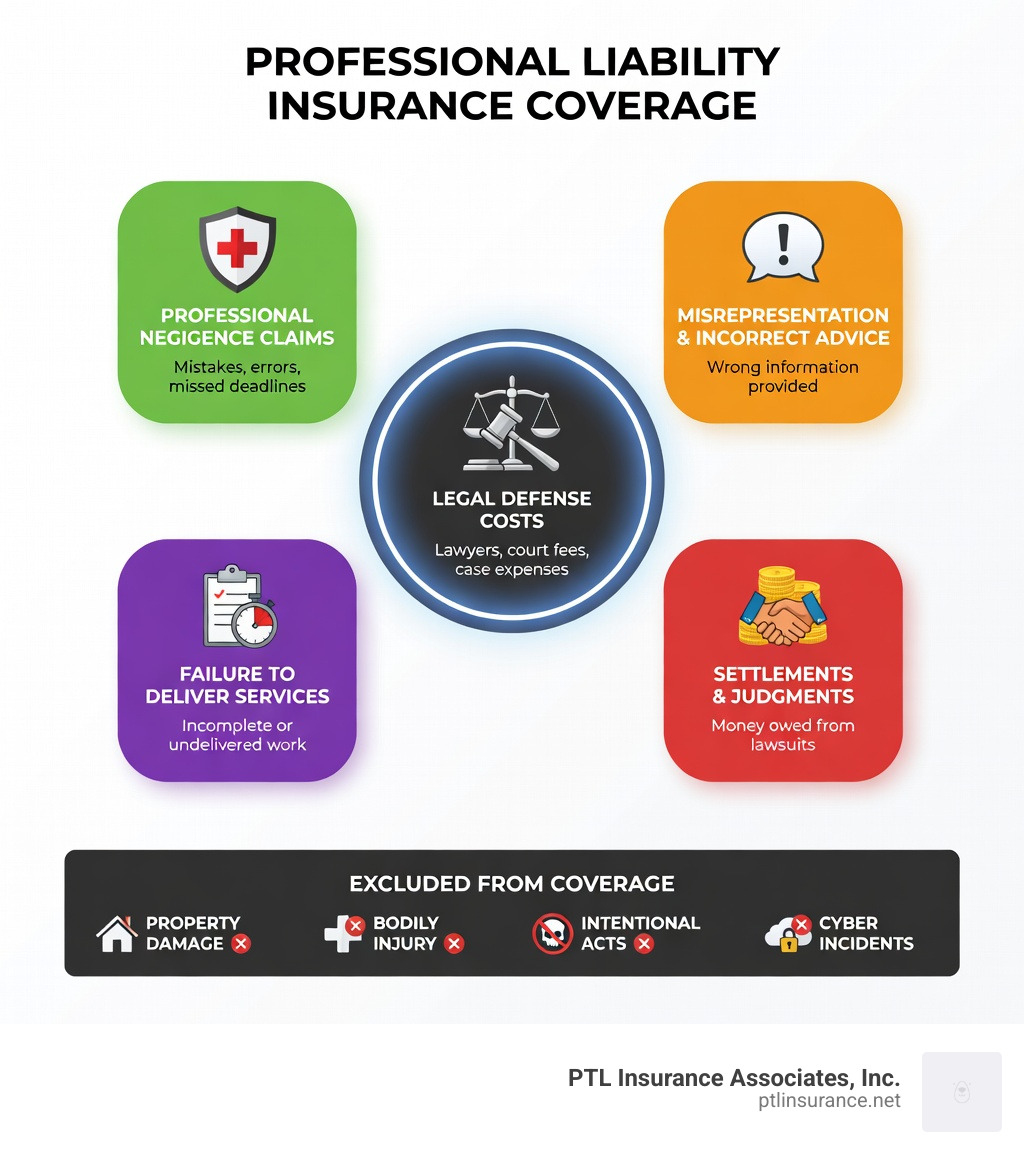
As illustrated in the header image, business professional liability insurance protects companies and professionals from financial losses when clients claim negligence, errors, or omissions in the services you provide. Also called errors and omissions (E&O) insurance, this coverage pays for legal defense costs, settlements, and damages when clients sue over professional mistakes—even if you did nothing wrong.
Quick Answer: What Business Professional Liability Insurance Covers
- Legal defense costs – Lawyers, court fees, and case expenses
- Settlements and judgments – Money owed to clients from lawsuits
- Professional negligence claims – Mistakes, errors, or missed deadlines
- Misrepresentation – Incorrect advice or information provided
- Failure to deliver services – Incomplete or undelivered work
- Coverage limits – Typically $1 million per claim, $1 million aggregate
What It Doesn’t Cover:
- Property damage or bodily injury (covered by general liability)
- Intentional or criminal acts
- Employee injuries (covered by workers’ compensation)
- Data breaches (requires cyber liability coverage)
The numbers tell a compelling story. The median cost for professional liability insurance is just $61 per month—less than most business phone bills. Yet a single lawsuit can cost tens of thousands or even millions in legal fees and damages. For small businesses in Miami and across Florida, this protection isn’t optional when your reputation and financial security are on the line.
Consider this real scenario: A property manager makes repeated paperwork mistakes that cost a property owner $50,000. The owner sues. Without professional liability insurance, that business faces bankruptcy. With coverage, the policy handles reimbursement expenses up to the policy limits.
Any business that provides advice, professional services, or specialized expertise faces this risk. Accountants who file taxes. Consultants who provide strategic guidance. Real estate agents who represent buyers and sellers. Technology professionals who build systems. Even if you follow every best practice, an unhappy client can still sue—and defending yourself costs money whether you’re at fault or not.
I’m Niki Perez, and after years in Real Estate Management Services, I’ve seen how crucial business professional liability insurance is for protecting professionals from unexpected claims. At PTL Insurance Associates, my husband Erik and I help Miami businesses steer these coverage decisions with confidence.
To help visualize these protections, the infographic below outlines the primary coverage areas and key exclusions discussed above.
Key terms for business professional liability insurance:
What is Business Professional Liability Insurance?
At its core, business professional liability insurance is a specialized type of liability insurance designed to protect individuals and companies who provide professional advice or services. If you are an expert in your field, your clients expect a certain standard of care. When they feel you’ve fallen short of that standard and suffered a financial loss as a result, they may file a lawsuit.
This coverage is frequently referred to by different names depending on the industry:
- Errors and Omissions (E&O): Common in the real estate, insurance, and consulting sectors.
- Malpractice Insurance: The standard term for healthcare and legal professionals.
According to Professional Liability Insurance Explained, the policy functions as a shield against claims of professional negligence, misrepresentation, or inaccurate advice. It differs from other policies because it specifically addresses the financial harm caused by your work, rather than physical damage. In a litigious environment like Miami, where expectations are high, even a simple misunderstanding can escalate into a “he-said, she-said” legal battle that could drain your business accounts.
Coverage and Exclusions: What’s Protected?
Understanding what is inside—and outside—your policy is the first step toward true peace of mind. A comprehensive business professional liability insurance policy typically covers:
- Legal Defense Costs: Even if a claim is completely groundless, you still have to hire a lawyer to prove it. These fees are often “in addition to” the policy limits in some forms, though they frequently “erode” the limit in others.
- Settlements and Judgments: If you are found liable or choose to settle to avoid a lengthy trial, the policy pays the damages up to your limit.
- Breach of Contract: In some instances, if a professional error leads to a breach of your service agreement, the policy may provide coverage.
- Worldwide Coverage: Many modern policies cover services provided anywhere in the world, provided the lawsuit is filed within a covered territory (usually the U.S. or Canada).
However, no policy covers everything. For a deeper look at the broader landscape, see our Liability Insurance Florida Complete Guide. Common exclusions include:
- Intentional Acts: Fraud, dishonest acts, or criminal prosecution are never covered.
- Bodily Injury and Property Damage: These are the domain of General Liability. If a client trips in your office, that’s General Liability. If you give them advice that causes them to lose $100,000, that’s Professional Liability.
- Cyber Incidents: While some E&O policies have small sub-limits for data breaches, most require a separate cyber policy to handle full-scale hacking events.
Who Needs This Protection and Is It Required?
If your business involves a “fee for service” or “advice for a fee” model, you likely need this protection. It isn’t just for doctors and lawyers; it’s for anyone whose mistake could cost a client money.
Industry-Specific Business Professional Liability Insurance Needs
Different industries face unique exposures. Our Professional Liability Coverage Ultimate Guide details how these risks manifest:
- Healthcare: Protects against misdiagnosis or treatment errors.
- Legal: Covers missed filing deadlines or errors in legal research.
- IT Services: Essential for software failures, coding errors, or system downtime that halts a client’s business.
- Consulting: Protects against strategic advice that fails to produce promised results.
- Architects and Engineers: Focuses on design flaws or structural miscalculations. In fact, building design professionals typically pay less than $145 per month for coverage, despite the high stakes of their projects.
- Real Estate: Covers failure to disclose property defects or errors in contract preparation.
Legal and Contractual Requirements
In many cases, the choice to carry insurance is taken out of your hands.
- State Mandates: Florida, like many states, may require certain licensed professionals (such as healthcare providers) to carry minimum levels of coverage to maintain their license.
- Licensing Boards: Professional organizations often set standards that include mandatory insurance.
- Client Contracts: It is very common for large clients or government entities to require proof of business professional liability insurance before they will sign a contract with you. They want to know that if you make a mistake, you have the financial backing to make it right.
- Medical Requirements: As noted in medical liability insurance requirements, physicians often must prove coverage to gain hospital privileges.
Professional Liability vs. General Liability Insurance
One of the most common mistakes we see at PTL Insurance Associates is a business owner thinking their General Liability (GL) policy covers everything. It doesn’t. GL is about “slips, trips, and falls.” Professional Liability is about “errors, omissions, and bad advice.”
| Feature | General Liability (GL) | Professional Liability (PL) |
|---|---|---|
| Primary Risk | Physical injury or property damage | Financial loss due to service errors |
| Example Scenario | A client slips on your wet office floor | You miss a tax deadline, costing a client $10k in fines |
| Claim Types | Bodily injury, property damage, advertising injury | Negligence, misrepresentation, inaccurate advice |
| Key Benefit | Protects your physical assets and “premises” | Protects your professional reputation and expertise |
To ensure your business is fully protected, most Florida companies need both. You can learn more about how they work together in our guides on General Liability and Workers Comp Insurance and the broader Business Liability Insurance overview.
Policy Mechanics: Claims-Made vs. Occurrence
Understanding when a policy covers you is just as important as what it covers. Most business professional liability insurance policies are written on a claims-made basis.
- Claims-Made Basis: The policy must be active both when the error happened and when the claim is filed. If you cancel your policy on Monday and a client sues you on Tuesday for work you did last year, you likely have no coverage unless you have special provisions.
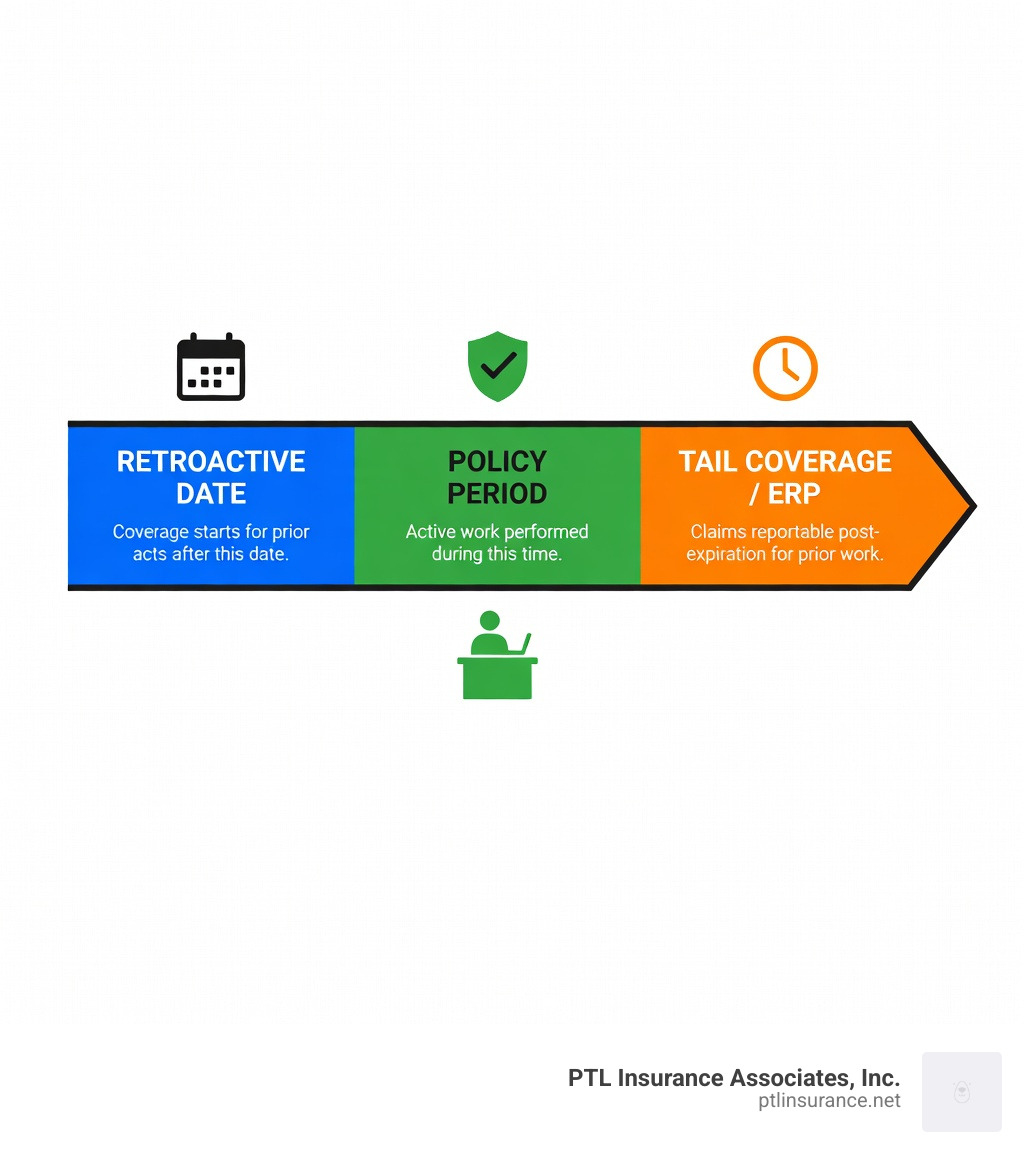
- Retroactive Dates: This is a “line in the sand.” The policy will cover errors that happened after this date, as long as the claim is made while the policy is active.
- Tail Coverage (Extended Reporting Period): If you retire or close your business, you can buy a “tail.” This allows you to report claims for a set period (often 1–6 years) after the policy ends for work you did while it was active.
The following infographic visualizes these critical policy timelines, showing how coverage applies from the retroactive date through the extended reporting period.
This is particularly relevant for those looking into Cyber Liability Insurance Miami FL, which also frequently uses claims-made forms.
Costs and Premium Factors
How much will you pay? While the national median is around $61 per month, your specific price depends on several variables.
Factors Influencing Business Professional Liability Insurance Costs
- Industry Risk: A structural engineer or a surgeon will pay significantly more than a graphic designer because their mistakes carry higher stakes.
- Business Size and Revenue: More clients and higher revenue mean more opportunities for something to go wrong.
- Claims History: Like auto insurance, a history of frequent lawsuits will drive up your premiums.
- Coverage Limits and Deductibles: Choosing a $2 million limit instead of $1 million will increase the cost. Similarly, a lower deductible (what you pay out of pocket) means a higher premium.
- Location: Operating in a high-litigation area like Miami can influence rates compared to rural areas.
The global market size and growth trends show that as the market grows, more specialized options are becoming available, which can sometimes help drive competitive pricing for niche industries.
Strategies to Reduce Premiums
You don’t have to just accept high rates. We recommend these steps to lower your risk profile:
- Strict Documentation: Keep detailed records of all client communications and approvals.
- Robust Contracts: Use clear, lawyer-reviewed contracts that define the scope of your work.
- Employee Training: Ensure your staff is up-to-date on industry standards.
- Quality Control: Implement a “second set of eyes” policy for all major deliverables.
For more tips, check out our guide on the Best Liability Insurance for Small Business.
Frequently Asked Questions
How do I obtain proof of professional liability insurance?
Most clients or landlords will ask for a Certificate of Insurance (COI). This is a one-page document issued by your insurance broker (like us!) that summarizes your policy. It includes the policyholder name, the insurance carrier, the effective dates, and the coverage limits. You can usually request one from your agent and have it in your inbox within the hour.
What are common examples of professional liability claims?
- Accounting: An accountant misses a deduction, leading to a massive IRS penalty for the client.
- IT/Tech: A developer launches a software update that crashes a client’s e-commerce site during Black Friday.
- Consulting: A business consultant recommends a merger that fails due to overlooked financial data.
- Real Estate: An agent forgets to mention that a house is in a flood zone.
Does professional liability cover independent contractors?
Generally, your policy covers you and your employees. It usually does not cover independent contractors or subcontractors unless they are specifically added as “Additional Insureds.” We always recommend that you require your contractors to carry their own business professional liability insurance and provide you with a COI before they start work.
Conclusion
Navigating business professional liability insurance doesn’t have to be overwhelming. Whether you’re a consultant in Coral Gables or a tech startup in Downtown Miami, protecting your expertise is the smartest investment you can make. At PTL Insurance Associates, Inc., we’ve spent over 35 years providing personalized, custom coverage to the Florida community.
We don’t believe in one-size-fits-all insurance. We take the time to understand your specific risks and build a policy that fits your business like a glove. Don’t wait for a disgruntled client to threaten your livelihood. Reach out to us today for a comprehensive risk assessment and get a customized business insurance quote that protects your future.

