


Beyond the Basics: What Every Business Needs to Know About Commercial Auto Liability
Why Commercial Auto Liability Insurance is Non-Negotiable for Your Business
Caption: Commercial vehicles, like the truck pictured, are essential business assets that require specialized liability protection. Title: Commercial Truck on Highway. Source: PTL Insurance Associates, Inc. Custom Image.
For any business that relies on vehicles, the open road represents both opportunity and significant risk. Commercial auto liability insurance is a crucial form of business insurance that protects your company from financial loss if a vehicle you own, lease, or use for work is involved in an at-fault accident that injures someone or damages their property. Here’s what it covers:
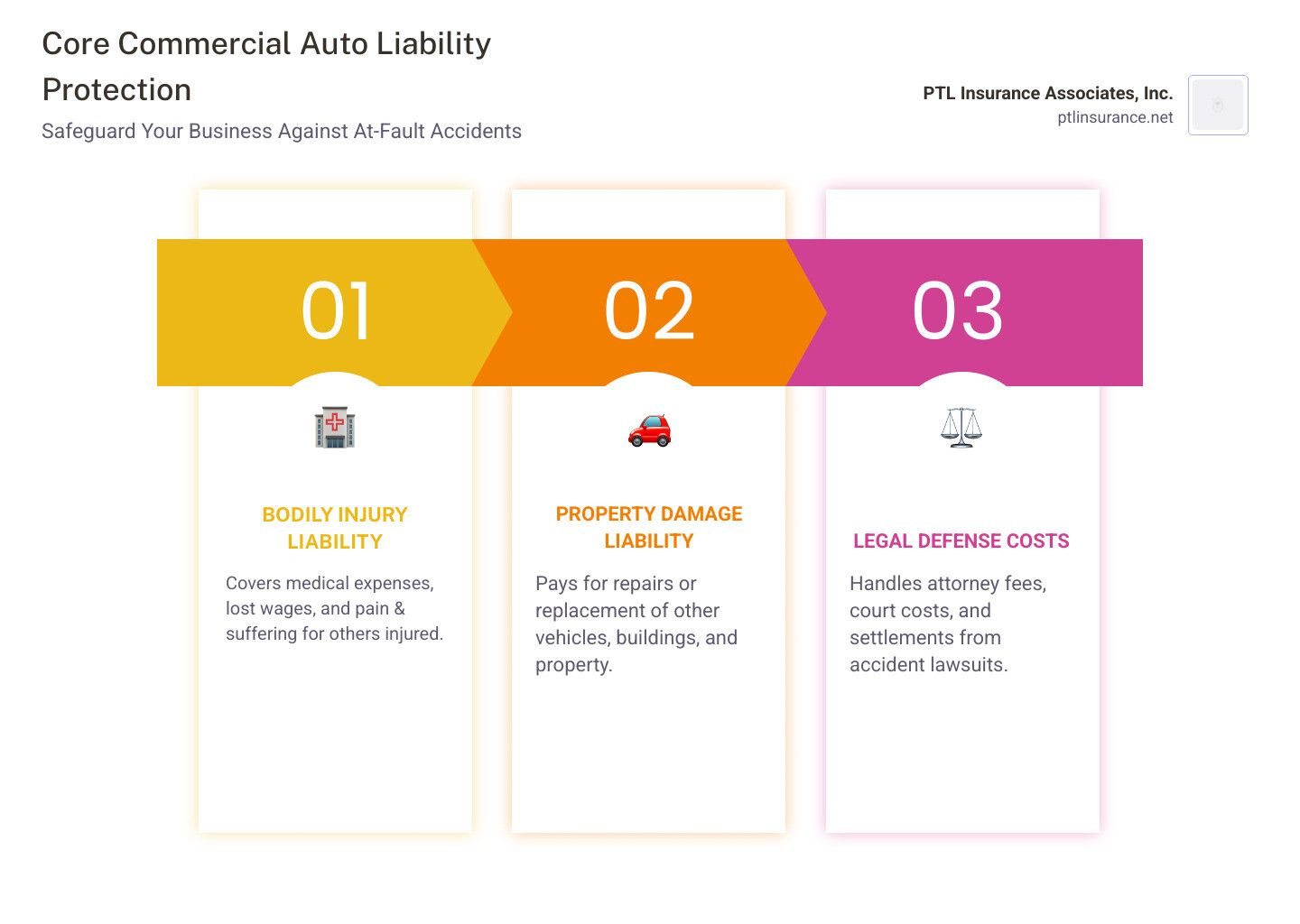
- Bodily Injury Liability: Medical expenses, lost wages, and pain and suffering for people injured in an accident where you or your employee is at fault
- Property Damage Liability: Repairs or replacement costs for other vehicles, buildings, fences, or property damaged in an accident
- Legal Defense Costs: Attorney fees, court costs, and settlement expenses if your business is sued after an accident
Who needs it: Any business that uses vehicles—whether you own a fleet, rent trucks occasionally, or have employees drive their personal cars for work errands. Most states require it by law.
Recommended coverage: Experts suggest $500,000 to $1 million in liability coverage, well above most state minimums, to truly protect your business assets.
Every day, business owners in Miami face a hidden financial risk. A single at-fault accident involving a business vehicle can trigger a lawsuit that threatens everything you have built. Whether it is a delivery van rear-ending another car or an employee causing a collision, your business and personal assets are on the line without proper commercial auto liability insurance.
The stakes are high. According to industry data, commercial auto insurance policies commonly carry Combined Single Limits of $500,000 or $1 million, because the cost of serious accidents regularly exceeds state-required minimums. Yet many business owners either carry inadequate coverage or do not fully understand what their policy actually protects.
This guide breaks down the essentials of commercial auto liability insurance in straightforward terms. We will cover who needs it, what it actually pays for, how much coverage makes sense for your specific business, and what factors affect your premium costs.
I am Niki Perez, and I work alongside my husband at PTL Insurance Associates, Inc. We help Miami business owners steer commercial auto liability insurance to find coverage that truly protects their operations. Understanding your liability exposure is the first step toward building a solid financial shield for your business.
Terms related to commercial auto liability insurance:
The Foundation: What is Commercial Auto Liability Insurance and Who Needs It?
At its core, commercial auto liability insurance is your business’s financial shield against the unpredictable nature of the road. It is a specialized type of business insurance designed to cover the financial responsibilities that arise when a vehicle used for your business causes an accident that results in injuries to others or damage to their property. This is not just a good idea; it is a legal requirement in most states, including Florida, to help ensure that businesses can cover the financial repercussions of accidents caused by their operations.
Think of it as a three-pronged defense mechanism:
- Bodily Injury Liability: This covers the costs associated with injuries to other people involved in an accident where your business is at fault. This can include medical expenses, hospital stays, rehabilitation, lost wages, and even pain and suffering.
- Property Damage Liability: This covers the cost of repairing or replacing property belonging to others that was damaged in an accident you caused. This most commonly includes other vehicles, but can also extend to structures like fences, lampposts, or buildings.
- Legal Defense Costs: Perhaps one of the most critical aspects. If your business is sued after an accident, this coverage pays for your attorney fees, court costs, and any settlement or judgment awarded against your business, up to your policy limits. Legal battles can be incredibly expensive, regardless of the outcome.
This protection helps ensure that an unfortunate incident on the road does not derail your business’s financial stability.
Defining Your Need for Coverage
The question of “who needs commercial auto liability insurance?” has a broad answer: virtually any business that uses vehicles for its operations. This is not limited to large trucking companies or delivery services. If your business relies on vehicles in any capacity, chances are you need this coverage.
Consider these scenarios:
- Company-owned fleets: If your business owns vehicles, from sedans for sales teams to heavy-duty trucks for construction, each vehicle needs to be covered under a commercial auto policy. This applies to businesses with at least one commercial-rated vehicle, or those with several vehicles that might qualify for Fleet Insurance with potentially more competitive pricing.
- Leased or rented vehicles: Even if you do not own the vehicles outright, but lease them for business operations or rent them occasionally for special projects, you need commercial auto liability insurance. A personal auto policy typically will not cover these business uses.
- Employee-owned vehicles for work: This is a common and often overlooked area. If your employees use their personal cars for work-related tasks—whether it is making deliveries, visiting clients, or running errands for the business—their personal auto policy may not provide adequate coverage in the event of an accident. Your business could still be held liable. This is where “non-owned auto” coverage, often an add-on to your commercial policy, becomes important.
- Contractors and service providers: From plumbers and electricians driving vans full of tools to landscapers with pickup trucks and trailers, if your vehicle is essential to your service, it needs commercial coverage.
- Delivery services: Whether it is food delivery, package delivery, or specialized courier services, these vehicles are constantly on the road and represent a significant liability exposure.
In Florida, as in most states, auto insurance is mandatory. However, personal policies are not designed for business use. The rating factors and coverage needs for business vehicles are fundamentally different. We work with businesses across Miami, from small startups to established enterprises, to help ensure they meet Florida’s requirements and have the right level of protection.
How It Protects Your Business from Financial Ruin
The primary function of commercial auto liability insurance is to act as a crucial firewall, protecting your business assets from the potentially devastating financial fallout of an at-fault accident. Without it, a single severe incident could lead to:
- Direct financial losses: If your business is found liable for an accident, you could be responsible for medical bills, property damage repairs, and lost wages for the injured parties. These costs can quickly escalate into hundreds of thousands, or even millions, of dollars.
- Lawsuit protection: Beyond the immediate costs, a lawsuit can tie up your business in lengthy and expensive legal proceedings. Your liability coverage steps in to cover the costs of legal defense, up to your policy limits.
- Protection of business assets: Without adequate coverage, your business’s cash reserves, equipment, property, and even future earnings could be seized to satisfy a judgment.
- Protection of personal assets: For many small business owners, especially sole proprietors, there is often a blurred line between business and personal finances. A lack of sufficient commercial auto liability insurance could mean that your personal savings, home, and other assets become vulnerable to a lawsuit targeting your business.
Consider a real-world claim scenario: A delivery driver for your Miami-based catering company is involved in a severe multi-vehicle accident on I-95, causing significant injuries to several people and totaling multiple vehicles. The medical bills alone could easily exceed $500,000, and property damage could add another $100,000. If your business only carried the state minimum liability, your company would be on the hook for the difference. With solid commercial auto liability insurance, your policy would step in to cover these substantial costs, allowing your business to recover and continue operating.
Decoding Your Policy: Coverage Details and Limits Explained
Navigating the specifics of an insurance policy can sometimes feel like deciphering a complex code. However, understanding the components of your commercial auto liability insurance is essential for ensuring your business is adequately protected. The core of liability coverage revolves around Bodily Injury (BI) and Property Damage (PD), but how these limits are structured can significantly impact your protection.
What Does Commercial Auto Liability Insurance Actually Cover?
As noted earlier, commercial auto liability insurance primarily covers your legal responsibility to others if your business vehicle causes an accident. The scope of this coverage typically includes:
- Third-party injuries: Medical expenses for anyone injured in an accident you cause, other than your own employees (who would typically be covered under workers’ compensation) or passengers in your vehicle (who might be covered by other parts of your commercial auto policy like Medical Payments or PIP). It can also cover lost wages if the injured party is unable to work, and compensation for pain and suffering.
- Medical expenses: From emergency room visits and ambulance rides to long-term physical therapy, these costs are covered up to your policy limits.
- Lost wages: If an injured party cannot work due to their injuries, your policy can compensate them for their lost income.
- Pain and suffering: This is a non-economic damage that compensates individuals for the physical and emotional distress caused by their injuries.
- Other vehicle repairs: Covers the cost to repair or replace other vehicles damaged in an at-fault accident.
- Damaged property: Extends to other property, such as fences, guardrails, traffic signs, buildings, or even pets that might be injured or killed in an accident.
- Legal fees: Includes the costs of defending your business in court if a lawsuit arises from an accident. This encompasses attorney fees, court costs, and any judgment or settlement your business is legally obligated to pay, up to policy limits.
The infographic below provides a clear visual breakdown of these three pillars of liability protection.
It is important to differentiate this from other commercial auto coverages like collision (which pays for damage to your vehicle), comprehensive (which covers non-collision damage to your vehicle like theft or certain weather events), or medical payments/personal injury protection (which covers medical expenses for your drivers and passengers, regardless of fault). While these are vital components of a full commercial auto policy, liability is specifically about protecting your business from financial responsibility to others.
Understanding Liability Limits: Split vs. Combined Single Limit (CSL)
When you look at your commercial auto liability insurance policy, you will notice numbers that represent your coverage limits. These limits define the maximum amount your insurance company will pay out for a covered claim. There are two primary ways these limits are structured: split limits and combined single limits.
Split Limits Explained
Split limits are expressed as three distinct numbers, typically written as $X/$Y/$Z. Each number represents a specific maximum payout:
- Per-person limit (X): The maximum amount your policy will pay for bodily injury to any one person in an accident.
- Per-accident limit (Y): The maximum total amount your policy will pay for all bodily injuries in a single accident, regardless of how many individuals are injured.
- Property damage limit (Z): The maximum amount your policy will pay for all property damage caused in a single accident.
Example: A policy with split limits of $100,000/$300,000/$50,000 means:
- $100,000 is the most your policy will pay for one person’s bodily injuries.
- $300,000 is the most your policy will pay for all bodily injuries in that accident.
- $50,000 is the most your policy will pay for all property damage in that accident.
If a single person’s medical bills exceed $100,000, or if the total bodily injury costs for everyone involved exceed $300,000, your business would be responsible for the difference. The same applies to property damage if it exceeds $50,000.
Combined Single Limit (CSL) Explained
A Combined Single Limit (CSL) is a single, overall number that represents the maximum amount your insurance company will pay for all bodily injuries and property damage expenses resulting from a single accident.
Example: A policy with a CSL of $1,000,000 means that your policy will pay up to $1,000,000 for any combination of bodily injury and property damage costs in one accident.
Flexibility: The advantage of a CSL is its flexibility. If an accident results in very high bodily injury costs but minimal property damage, the entire $1,000,000 can be allocated to cover the bodily injury claims. Conversely, if property damage is extensive but injuries are minor, the funds can be shifted accordingly.
| Feature | Split Limits ($X/$Y/$Z) | Combined Single Limit (CSL) ($A) |
|---|---|---|
| Structure | Three separate limits: per person BI, per accident BI, PD | One single limit for all BI & PD |
| Flexibility | Less flexible; limits are capped for each category | More flexible; the entire limit can be applied to any combination |
| Use Case | May be chosen for lower premiums | Often preferred for higher protection and complex claims |
| Example | $100,000/$300,000/$50,000 | $500,000 or $1,000,000 |
Split limits might initially appear more affordable, but a CSL often provides more robust and adaptable protection, especially given the rising costs of medical care and vehicle repairs. Many commercial auto policies, particularly for businesses with significant exposure, opt for a CSL to provide a larger, more flexible pool of money for potential claims. We often advise our Miami clients to consider CSLs of $500,000 or $1,000,000 for broader protection.
Learn more from the Insurance Information Institute’s Handbook.
Determining the Right Amount of Coverage for Your Business
Deciding how much commercial auto liability insurance your business needs is a critical decision that goes beyond simply meeting minimum legal requirements. It involves a risk assessment, understanding your specific operations, and thinking through potential financial impacts.
State Minimums vs. Recommended Protection
Every state, including Florida, mandates a minimum amount of auto liability insurance. These minimums are often quite low and are typically designed to ensure that some financial responsibility is in place, but they are rarely sufficient to cover the actual costs of a serious accident.
- Inadequate minimums: If your business vehicle causes a severe accident resulting in significant injuries or extensive property damage, the state-required minimum coverage can quickly be exhausted.
- Financial exposure: When claims exceed your policy limits, your business becomes directly responsible for the remaining balance. This exposure can be immense.
- Lawsuit gaps: Minimum coverage leaves a dangerous gap between what your policy pays and what you might owe in a lawsuit. A single accident could easily lead to a judgment far exceeding state minimums.
Recommended limits: This is why insurance professionals, including us at PTL Insurance Associates, Inc., recommend securing coverage limits significantly higher than the state minimums. A common recommendation is a minimum of $500,000 up to $1 million in commercial auto liability coverage for businesses.

How Much Commercial Auto Liability Insurance Does Your Business Really Need?
There is no one-size-fits-all answer, but these factors influence the optimal amount of commercial auto liability insurance for your Miami business:
Vehicle usage:
- Hauling goods or equipment: Vehicles that transport heavy or hazardous materials, or expensive equipment, carry a higher risk.
- Transporting people: If your business transports clients, patients, or other non-employees, your liability exposure increases.
- Frequency of use and annual mileage: Vehicles driven frequently or for long distances have a greater chance of being involved in an accident.
Type of vehicles: The size and type of vehicles in your fleet matter. A large commercial truck or a fleet of delivery vans inherently poses a greater risk for causing significant damage or injury compared to a small sedan used occasionally for business errands.
Business assets: The more assets your business has, the more you stand to lose in a lawsuit. Higher coverage limits act as a stronger shield for your financial stability.
Contract requirements: Many contracts, especially those with larger clients or government entities, will stipulate specific minimum commercial auto liability insurance limits that you must carry.
Industry risk: Certain industries face higher risks. For example, a construction company operating heavy machinery on public roads will likely need higher limits than a real estate agency whose agents occasionally drive clients.
Commercial umbrella policy: For businesses that want an extra layer of protection, a Commercial Umbrella Policy can provide additional liability coverage that applies after the limits of your primary policies (like commercial auto liability) have been reached. This can be a cost-effective way to obtain higher overall limits for catastrophic claims.
The Bottom Line: Costs, Claims, and Customizing Your Policy
Understanding the fundamentals of commercial auto liability insurance is just the beginning. To effectively manage your business’s risk, you also need to know what factors influence your premium, how to steer the claims process, and how you can strategically combine policies for protection and savings.
What Influences the Cost of Your Premium?
The cost of commercial auto liability insurance can vary, but several factors come into play when calculating your premium:
- Driving records: The driving history of all individuals who operate your business vehicles is a major factor. A history of accidents, traffic violations, or DUIs among your drivers will likely result in higher premiums.
- Claims history: Your business’s past claims experience directly impacts your rates. A history of frequent or costly claims signals a higher risk to insurers.
- Vehicle type and age: The make, model, year, and type of vehicle (for example sedan, van, or heavy truck) all affect cost.
- Garage location: Where your vehicles are primarily garaged and operated plays a role. Areas with higher traffic density, crime rates, or accident frequencies typically have higher insurance costs.
- Annual mileage: The more miles your commercial vehicles travel annually, the greater their exposure to potential accidents.
- Industry risk: Certain industries are inherently riskier than others.
- Coverage limits and deductibles: Higher liability limits usually result in higher premiums. Similarly, choosing lower deductibles for physical damage coverages (collision and comprehensive) will also increase your premium.
We work with a network of insurance providers to shop for competitive rates and customize a policy that fits your budget and protection needs. It is not just about finding the cheapest policy; it is about finding the right value that protects your business effectively.
Read California’s Commercial Insurance Guide for more insights.
Filing a Claim and Bundling for Savings
Filing a Claim for Commercial Auto Liability Insurance
Even with good safety measures, accidents can happen. Knowing how to file a claim efficiently is crucial for minimizing disruption to your business:
- Report the accident quickly: As soon as it is safe to do so, report the accident to the police and your insurance provider.
- Document the scene: If possible and safe, collect information. This includes photos of the accident scene, damage to all vehicles and property, contact information for other drivers and witnesses, and police report numbers.
- Cooperate with your adjuster: Your insurance company will assign an adjuster to investigate the claim. Provide them with all requested information promptly and accurately.
- Seek legal counsel if necessary: If a lawsuit is filed against your business, your commercial auto liability insurance will typically cover your legal defense costs, but it can still be wise to consult with your own legal counsel.
Bundling for Savings
One useful strategy for managing insurance costs while enhancing protection is bundling your policies. Many insurers offer discounts when you combine different types of business insurance.
- Business Owner’s Policy (BOP): For many small to medium-sized businesses, a BOP can combine commercial property insurance, general liability insurance, and business interruption coverage into a single package.
- Commercial Package Policy (CPP): Larger or more complex businesses might opt for a CPP, which allows for greater customization, combining multiple lines of coverage like commercial property, general liability, and commercial auto into one policy.
- Bundling discounts: Many businesses can qualify for discounts when they bundle their commercial auto liability insurance with other essential coverages like general liability or workers’ compensation. This can simplify your insurance management and help reduce the chance of gaps in coverage between different policies.
By taking a holistic approach to your business insurance needs, you can work toward comprehensive protection at a more favorable price point.
Conclusion
Understanding commercial auto liability insurance is more than just checking a box; it is about safeguarding your business’s future. From defining who needs it to decoding policy limits and managing costs, this guide has outlined the most important aspects of this coverage.
Key takeaways:
- Commercial auto liability insurance is essential for any business using vehicles.
- It helps protect against bodily injury, property damage, and legal defense costs.
- State minimums are often inadequate; many businesses should aim for $500,000 to $1 million in coverage, or more, especially with a Commercial Umbrella Policy.
- Factors like driving records, vehicle type, and location significantly influence premiums.
- Bundling policies can lead to savings and more coordinated protection.
At PTL Insurance Associates, Inc., we believe that every business in Miami deserves personalized service and custom coverage options. For over 35 years, we have been helping businesses steer the complexities of insurance, working to ensure you have the right shield against unexpected risks. To build the right protection for your business, explore our comprehensive commercial auto insurance solutions.

