


Assurity Bond: Essential Guide 2025
Caption: Understanding the terms of an assurity bond is the first step to protecting your business.
Understanding Surety Bonds: Your Quick-Start Guide
An assurity bond (commonly known as a surety bond) is a three-party financial guarantee that protects one party from losses if another fails to meet its contractual obligations. As the image above illustrates, understanding these agreements is key to protecting your business. Here’s a quick overview:
Quick Definition:
- What it is: A legally binding contract between a Principal, Obligee, and Surety.
- Purpose: To guarantee that contractual obligations will be fulfilled.
- Key difference from insurance: The principal must repay any claims paid by the surety.
- Market size: The US surety bond market generated approximately $8.6 billion in direct written premium in 2022.
The Three Parties:
- Principal – The party who needs the bond (e.g., a contractor or business owner).
- Obligee – The party who requires the bond (e.g., a project owner or government agency).
- Surety – The party that guarantees the principal’s performance (an insurance company).
For small business owners in Miami, an assurity bond may be necessary to obtain licenses, bid on construction projects, or meet other legal requirements. Unlike traditional insurance, a surety bond acts like a line of credit that guarantees your promises—and you are responsible for repaying any claims.
I’m Niki Perez, and at PTL Insurance, my husband and I specialize in helping Miami business owners steer complex requirements like assurity bonds. With years of experience, we’ve assisted countless contractors and entrepreneurs in securing the bonds they need to grow.
The Fundamentals: What is a Surety Bond and Who is Involved?
An assurity bond is a contractual promise backed by money, where one party guarantees that another will fulfill its commitments. It creates a financial safety net that protects the party requiring the guarantee while opening doors for the party providing it. For Miami businesses, understanding how these bonds work is essential for compliance, growth, and winning new opportunities.
The Three Key Players
Every assurity bond involves three distinct parties in a carefully balanced relationship, as the infographic below illustrates. Let’s break down their roles.
- The Principal: The business or individual who needs the bond. If you’re a contractor bidding on a Miami project or a business owner applying for a license, you are the principal. You pay a premium for the bond and are responsible for repaying the surety for any claims paid on your behalf.
- The Obligee: The party requiring and protected by the bond. This is often a government agency, like the City of Miami, or a project owner. The obligee needs assurance that you will fulfill your obligations.
- The Surety: The company (usually an insurance company) that issues the bond and backs it financially. The surety evaluates your financial stability before guaranteeing your performance. If you default, the surety pays the obligee and then collects reimbursement from you under an indemnity agreement.
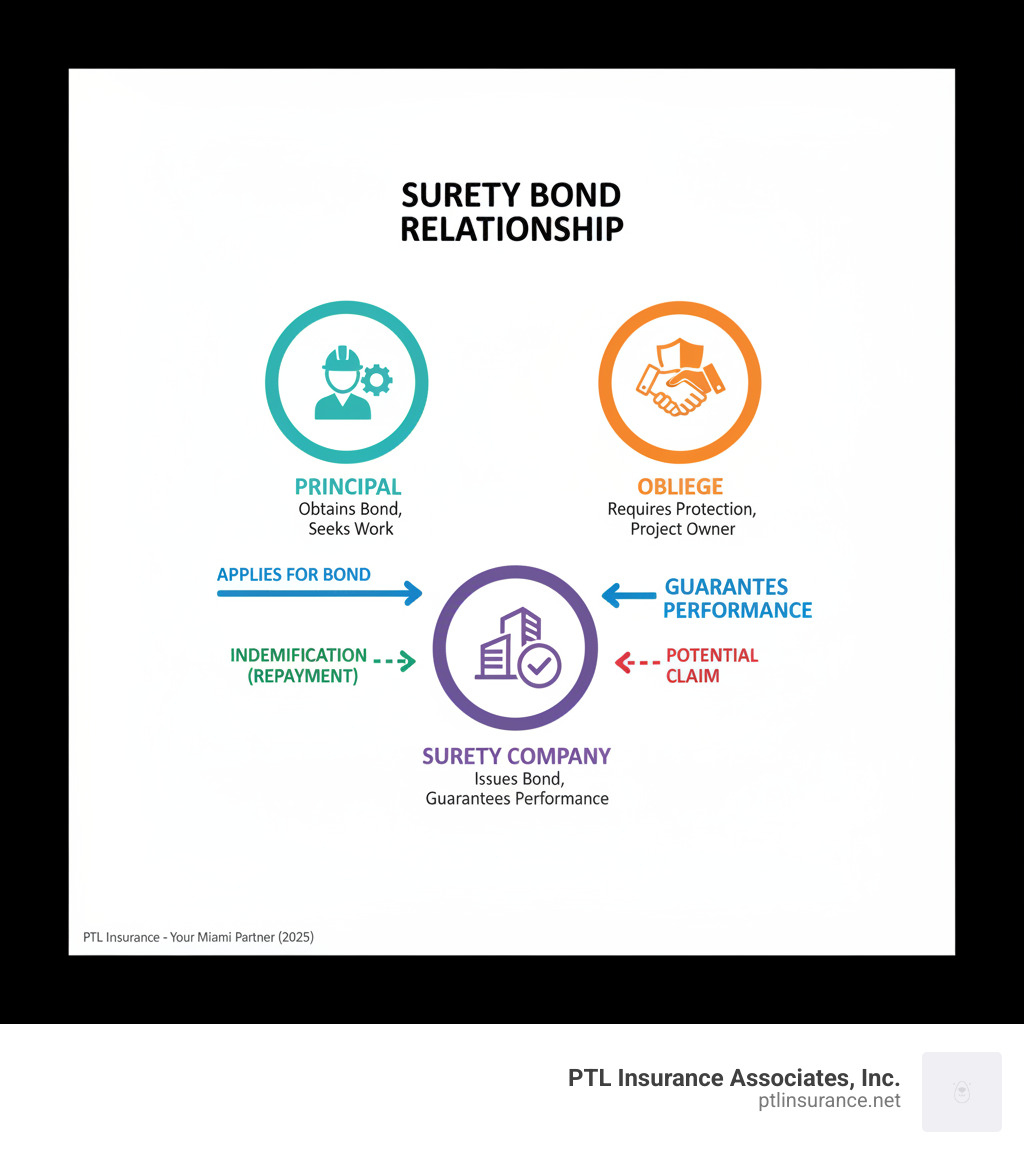
This system is built on trust and accountability. The surety protects the obligee while holding you, the principal, responsible for your commitments.
Surety Bonds vs. Insurance: A Critical Distinction
Many business owners confuse surety bonds with insurance, but they are fundamentally different. Understanding this distinction can prevent costly surprises. The table below highlights the key differences.
| Feature | Surety Bond | Traditional Insurance Policy |
|---|---|---|
| Parties Involved | Three (Principal, Obligee, Surety) | Two (Insured, Insurer) |
| Loss Expectation | Loss is not expected; Principal is expected to perform | Loss is expected (e.g., car accident, fire) |
| Premium Purpose | Fee for the surety’s guarantee and credit backing | Payment for risk transfer; covers potential losses |
| Repayment Obligation | Principal must reimburse surety for any claims paid | Insured does not reimburse insurer for claims paid |
| Risk Transfer | Minimal risk transfer for the principal; surety extends credit | Significant risk transfer from insured to insurer |
| Underlying Principle | Guarantee of performance or financial obligation | Protection against unforeseen events and financial loss |
The most critical difference is that you must pay the surety back. A surety bond is more like a line of credit than an insurance policy. If the surety pays a claim because you failed to meet an obligation, you are legally required to reimburse them for every dollar. This repayment obligation is why sureties carefully evaluate your credit and financial standing before issuing a bond. An assurity bond is a guarantee of your credit and character, not a tool to transfer your risk of loss.
A Deep Dive into Contract and Commercial Surety Bonds
Assurity bonds fall into two main categories: contract surety and commercial surety. Contract bonds are the foundation of the construction industry, while commercial bonds ensure businesses and public officials operate ethically and legally. Both use the same three-party agreement to serve different purposes, creating a foundation of trust that keeps our economy moving.
Contract Surety Bonds: The Backbone of Construction
Contract surety bonds are the construction industry’s safety net, protecting project owners (obligees) from financial loss if a contractor (principal) fails to complete a project. Given the risks in construction, these bonds are often legally required for public projects.
- Bid Bonds: Guarantee that a contractor who wins a bid will enter into the contract at the price quoted, preventing bidders from backing out.
- Performance Bonds: Guarantee that the contractor will complete the project according to the contract’s terms. If the contractor defaults, the surety steps in to ensure the project is finished.
- Payment Bonds: Guarantee that the contractor will pay all subcontractors, laborers, and material suppliers, preventing liens against the project.
- Warranty Bonds: Guarantee that the contractor will fix any defects in materials or workmanship for a specified period after project completion.
Federal law, under the Miller Act, mandates performance and payment bonds for federal construction projects over $150,000. Florida’s “Little Miller Act” applies similar rules to state and local public works, protecting public funds and ensuring workers are paid. You can learn more about how we help contractors meet these requirements on our Surety Bonds page. The complexities of these bonds are further explored in resources like the Problems of Private Claimants Under Miller Act Payment Bonds.
Commercial Surety Bonds: Ensuring Public and Legal Trust
Commercial surety bonds cover a vast range of activities, ensuring that businesses and individuals comply with laws and regulations. For many Miami businesses, these bonds are a prerequisite for operation.
- License and Permit Bonds: Required by government agencies for certain professions (e.g., auto dealers, mortgage brokers, notaries in Florida) to protect the public from fraud or misconduct.
- Court Bonds: Used in legal proceedings. Judicial bonds guarantee payment of damages if a court rules against the principal, while fiduciary bonds (or probate bonds) ensure that court-appointed individuals like estate executors manage assets honestly.
- Public Official Bonds: Protect taxpayers from misconduct by elected or appointed officials who handle public funds, guaranteeing their faithful performance of duties.
- Miscellaneous Commercial Bonds: This broad category includes ERISA bonds (protecting employee benefit plans), customs bonds (for importers), tax bonds (guaranteeing tax payments), and business service bonds (protecting clients from employee theft).
All commercial bonds serve to build public trust, proving that a business is committed to its obligations. At PTL Insurance Associates, Inc., we have over 35 years of experience helping Miami businesses secure the right commercial bonds, turning compliance into a competitive advantage.
The Practical Side of an Assurity Bond: Process, Costs, and Legalities
Understanding what an assurity bond is and why you need one leads to the next questions: how do you get one, and what does it cost? An assurity bond is more than a requirement; it’s a tool that builds client confidence and opens doors to new opportunities. Let’s break down the practical steps.
How to Obtain a Surety Bond
Securing an assurity bond is a straightforward process, especially with an experienced broker.
- Find the Right Broker: An independent broker like PTL Insurance Associates, Inc. acts as your advocate. We have relationships with multiple surety providers, allowing us to shop for the best rates and terms for your Miami-based business.
- Complete the Application: You’ll provide information about your business, the specific bond required, and your financial background. This helps the surety understand your reliability as a principal.
- Provide Financial Documentation: Transparency is key. You will typically need to submit business and personal financial statements, recent tax returns, and bank statements. This helps the surety assess your creditworthiness.
- Undergo Underwriting Assessment: The surety’s underwriters will evaluate your application based on the “Three C’s”: Character (reputation and integrity), Capacity (experience and ability to perform the obligation), and Capital (financial strength).
- Receive Bond Issuance: Once approved, you pay the premium, and the surety issues the bond. We deliver it to the obligee, and you are officially bonded.
The primary risk is that if a valid claim is made, you are responsible for repaying the surety. This is governed by the indemnity agreement you sign. If a claim occurs, the surety investigates its validity. If valid, the surety pays the obligee and then seeks full reimbursement from you, the principal. This is a critical distinction from insurance.
Calculating the Cost of an Assurity Bond
The cost of an assurity bond, known as the premium, is a percentage of the total bond amount (the penal sum). This premium typically ranges from 1% to 5% of the penal sum annually.
Several factors influence your premium:
- Penal Sum: The bond amount required by the obligee. A larger bond amount means a higher premium.
- Risk Profile & Creditworthiness: This is the most significant factor. Strong personal and business credit (scores above 700) lead to lower rates. Weaker credit may result in higher premiums or collateral requirements.
- Bond Type: A simple notary bond is inexpensive, while a large construction performance bond carries more risk and a higher premium.
- Financial Stability: Sureties look for healthy cash flow, sufficient working capital, and a strong balance sheet. A solid financial position lowers your perceived risk and your premium.
Building a good track record with your surety can lead to better rates over time.
The Legal Framework and Evolution of an Assurity Bond
The legal basis for assurity bonds has evolved to meet modern business needs.
- The Miller Act: This landmark 1935 federal law requires contractors on federal construction projects valued at $150,000 or more to secure performance and payment bonds. It protects taxpayer funds and ensures subcontractors get paid.
- Little Miller Acts: Most states, including Florida, have their own versions of the Miller Act that apply to state and local public works projects, creating a consistent framework for contractors.
- Electronic Surety Bonds (ESBs): The digital age has transformed the bonding process. ESBs allow for electronic application, issuance, and delivery, for many license and permit bonds. This technology, used by systems like the NMLS, makes getting bonded faster and more efficient than ever.
This legal and technological framework ensures bonds remain a reliable tool for guaranteeing obligations. For related risk management insights, see our articles on 3PL Insurance and Getting Bonded and Insured for Small Business. At PTL Insurance Associates, Inc., we help Miami businesses steer these requirements with personalized guidance.
Frequently Asked Questions about Surety Bonds
Here are answers to the most common questions we hear from Miami business owners at PTL Insurance Associates, Inc. about assurity bonds.
What happens if a claim is made on my surety bond?
If a claim is filed against your bond, the surety company investigates to confirm its validity. If the claim is valid, the surety pays the obligee up to the bond amount. However, under the indemnity agreement you signed, you are legally obligated to reimburse the surety for the full amount paid, plus any associated costs. Unlike insurance, the ultimate financial responsibility remains with you, the principal.
Can I get a surety bond with bad credit?
Yes, it is often possible to get an assurity bond with bad credit, but it will be more challenging and expensive. Applicants with lower credit scores should expect higher premiums. The surety may also require collateral or a co-signer to mitigate their risk. As independent brokers, we work with specialized surety markets that cater to higher-risk applicants and can help you find a solution.
How long does a surety bond last?
The term of a surety bond depends on its purpose:
- Contract Bonds: These typically last for the duration of the construction project, plus any required warranty period.
- License and Permit Bonds: Most are issued for a one-year term and must be renewed annually to keep your business license active.
- Court Bonds: These remain in effect for as long as the legal matter requires, which could be several years.
It’s crucial to track your bond’s expiration and renewal dates to avoid a lapse in coverage, which could suspend your business operations. Working with a broker can help ensure you stay on top of these important deadlines.
Conclusion: Securing Your Business’s Future
An assurity bond is more than a regulatory requirement; it’s a powerful tool that builds trust, protects stakeholders, and open ups business opportunities. Whether on a Miami construction site or in a professional office, a bond demonstrates your financial stability, credibility, and commitment to your work. It can be the key to winning larger projects, securing government contracts, and satisfying the licensing requirements that allow your business to grow.
In Miami’s competitive market, being bonded gives you a critical edge. It positions your business as a trustworthy partner, which can make all the difference in being considered for a lucrative project or obtaining a vital permit.
Navigating the surety process doesn’t have to be overwhelming. At PTL Insurance Associates, Inc., my husband and I have spent over 35 years providing personalized guidance to Miami business owners. We take the time to understand your unique needs, explain your options, and leverage our relationships with multiple surety providers to find the right solution for your budget.
Your business’s future is built on reliability. Let us help you take the next step with confidence. Find the right surety bond for your Miami business with PTL Insurance Associates, Inc., and find how the right bond can open new doors to success.

