


Non damage business interruption insurance: Secure 2025
Beyond Broken Windows and Flooded Floors
Title: Non-Damage Business Interruption Insurance: Protecting Your Income
Caption: Safeguarding your business from disruptions that don’t involve physical damage.
Source: PTL Insurance Associates, Inc.
Non damage business interruption insurance protects your business income when operations are disrupted by events that don’t cause physical damage to your property—like cyber attacks, supply chain failures, power grid outages, or government-mandated closures.
Quick Definition:
- Traditional Business Interruption (BI): Requires physical damage to your property (fire, flood, storm) to trigger coverage.
- Non-Damage BI: Covers income loss from external, non-physical events that halt your operations—no broken windows required.
For decades, business interruption insurance focused on one simple idea: if your building burns down or a hurricane floods your warehouse, your policy covers the lost income while you rebuild. But today’s risks look very different.
Your business can grind to a halt without a single brick being damaged. A cyber attack can lock you out of your systems. A key supplier across the globe can face political unrest or a regulatory shutdown. A power grid failure can leave your operations dark for days. A pandemic can empty your streets without touching your storefront.
Traditional insurance policies weren’t designed for this interconnected world. They rely on a “damage trigger”—actual physical loss to your property. If your walls are standing and your roof is intact, many standard policies won’t pay a dime, even if you’re losing thousands of dollars every day you can’t operate.
This gap is costing businesses dearly. According to recent industry surveys, business interruption is now cited as a major concern by 31% of companies, and for some industries, the worst-case loss scenario has shifted from property damage to a major cyber event. Many business owners in Miami and across Florida don’t realize just how exposed they are until it’s too late.
As Niki Perez, I’ve spent years helping Florida business owners steer these complex insurance challenges after building expertise in Real Estate Management Services before joining PTL Insurance. I’ve seen how critical non damage business interruption insurance has become for protecting modern businesses against the full spectrum of risks they actually face.
The good news? There are insurance solutions designed specifically for these modern, non-physical risks. This guide will walk you through what non-damage business interruption coverage is, how it works, and how to determine if your business needs it.
What is Non-Damage Business Interruption Insurance and How Does It Differ?
To truly understand non damage business interruption insurance, we first need to clarify its traditional counterpart. Traditional business interruption insurance, often an endorsement to a commercial property policy, is designed to replace lost income and cover ongoing operating expenses when a business cannot operate due to physical damage to its own property from a covered peril. Think fire, storm, or equipment breakdown. If a hurricane damages your Miami storefront, traditional BI steps in.
However, the world is rapidly changing. As one source notes, “Non-damage business interruption insurance extends coverage to events that disrupt a business’s income flow without causing physical damage.” This is the fundamental difference. Where traditional BI requires a “damage trigger” – typically to the policyholder’s own property or assets – non damage business interruption insurance steps in when that physical damage hasn’t occurred. It protects your income stream when external, non-physical events halt your operations.
This distinction is crucial, as traditional policies often fall short in today’s interconnected landscape. They might offer a “Denial of Access” extension, for example, but even that is usually triggered by physical damage to a nearby property, and often comes with lower limits than direct property damage.
Here’s a quick comparison:
| Feature | Traditional Business Interruption (BI) | Non-Damage Business Interruption (BI) -|
| Trigger | Physical damage to your property (fire, flood, etc.) | External, non-physical events (cyber attack, supply chain failure, etc.) -|
| Coverage Scope | Lost income and operating expenses during restoration. | Lost income, operating expenses, and extra costs from a wider range of disruptions. -|
| Example | A fire closes your restaurant. | A key supplier’s factory shuts down, halting your production. -|
This infographic visually summarizes the key differences:
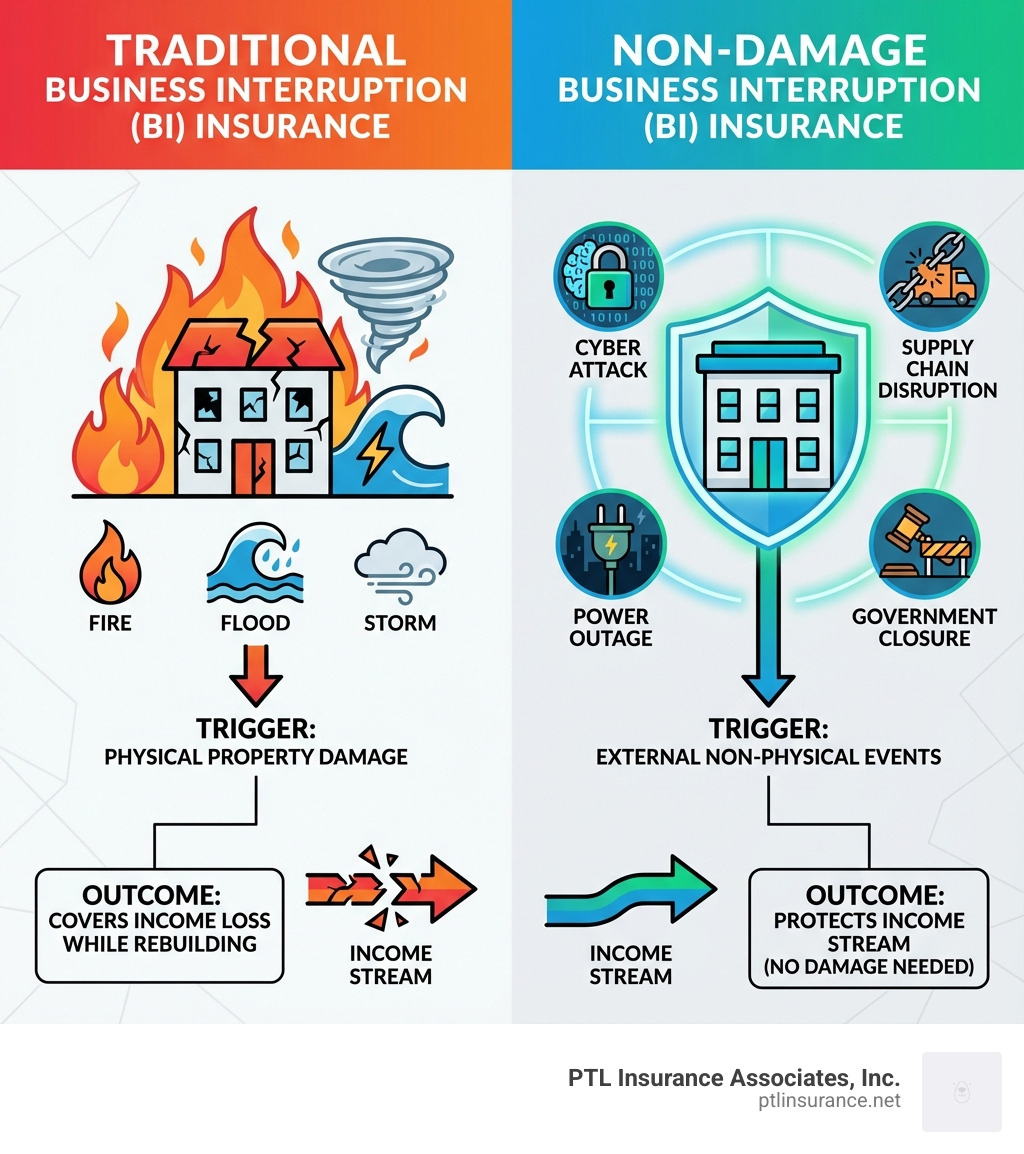
While these extensions offer valuable protection, they differ from standalone non damage business interruption insurance because they typically still require physical damage as the ultimate trigger, even if it’s not to your own facility. True non-damage policies remove this physical damage requirement altogether for a broader range of events.
To dig deeper into business interruption options specific to our region, explore more about business interruption in Florida.
Common Triggers and Covered Losses for Non-Damage Policies
The beauty of non damage business interruption insurance lies in its ability to respond to a diverse array of modern threats that don’t involve a single broken window or scorched wall. These policies are specifically designed to cover the financial fallout from events that disrupt your operations without causing physical damage.
Common examples that trigger non damage business interruption insurance
The events that can trigger non damage business interruption insurance are as varied as the interconnected world we live in. Here are some of the most common examples:
- Cyber Attacks: This is rapidly becoming one of the most significant non-damage triggers. A data breach, ransomware attack, or denial-of-service attack can cripple your IT systems, halt operations, and lead to massive financial losses without any physical damage. The potential worst-case loss scenario for some businesses is rapidly changing from property damage to a major cyber event.
- Power Grid Failure/Utility Outages: Widespread blackouts, even without physical damage to your specific facility, can stop your business cold. If a major utility provider experiences an outage across Miami-Dade County, and your business relies on electricity, you’re out of luck.
- Supply Chain Failure: This is a huge one in our globalized economy. If a key supplier (even one on the other side of the world) faces a regulatory shutdown, political unrest, or an unexpected operational halt, your inventory could dry up, forcing you to cease production or sales. We’ve seen how interconnected supply chains can lead to costly domino effects.
- Key Supplier Insolvency: The financial collapse of a crucial supplier or transportation provider (like the Hanjin shipping crisis) can leave your business without essential components or distribution channels.
- Transportation Network Shutdown: Major road closures, port closures (like those that can impact PortMiami), or airport disruptions can prevent goods from reaching you or your customers, impacting your ability to do business.
- Regulatory Action: Government-mandated closures due to health code violations, environmental issues, or the withdrawal of a product’s marketing authorization (especially critical for life sciences companies) can trigger losses.
- Terrorism Threats: While actual attacks cause physical damage, credible threats can lead to city-wide lockdowns, evacuations, or severe disruptions in public access, causing significant income loss for businesses in affected areas, even if their property is untouched.
- Pandemics and Infectious Diseases: While many standard BI policies explicitly exclude these (especially after COVID-19), specialized policies or endorsements are emerging to address the financial impact of outbreaks leading to closures or reduced operations.
For businesses in Florida, particularly those dealing with sensitive data or online operations, cyber risks are paramount. To understand how we can help protect you from these modern threats, check out our insights on business insurance for theft and cyber risks.
What Financial Losses Can Be Covered?
When a non-damage event disrupts your business, the financial fallout can be devastating. Non damage business interruption insurance aims to put your business back in the same financial position it would have been in had the disruption not occurred. This means covering a range of financial losses that directly result from the interruption:
- Lost Profits/Gross Margin: This is the core of BI coverage. It compensates for the net profit you would have earned during the period of interruption.
- Ongoing Operating Expenses: Even when your doors are closed, many expenses continue. This includes rent or mortgage payments for your Miami office or warehouse, employee payroll, taxes, and loan payments.
- Extra Expenses to Mitigate Loss: These are reasonable costs incurred to minimize the period of interruption or to continue operations from a temporary location. This could involve renting temporary office space, expedited shipping for new supplies, or paying overtime to get back up and running faster.
- Relocation Costs: If the disruption forces you to temporarily move your operations, the costs associated with relocation can be covered.
- Remediation Costs: In the case of a cyber attack, for example, costs associated with data recovery, system restoration, or forensic analysis can be included.
Protecting your revenue stream and covering these vital expenses is crucial for survival. It ensures that even when the unexpected happens, your business has the financial means to weather the storm and rebuild.
To learn more about safeguarding all your company’s valuable resources, explore how to protect your business assets.
Why This Coverage is Essential for Modern Business Resilience
In today’s dynamic and interconnected business world, relying solely on traditional business interruption insurance is like bringing a knife to a gunfight. The modern threat landscape, especially for businesses in a busy hub like Miami, demands a more sophisticated approach. Non damage business interruption insurance isn’t just a nice-to-have; it’s a fundamental pillar of business resilience.
One of the most compelling reasons for this coverage is the sheer unpredictability of non-physical disruptions. Unlike a fire, which is often localized, a cyber attack or a major supply chain disruption can have widespread and cascading effects. These events can trigger a domino effect of losses that traditional policies simply aren’t equipped to handle.
How Non-Damage BI Helps Maintain Cash Flow
The ability to maintain cash flow during a disruption is paramount to a business’s survival. Without it, even a temporary closure can lead to insolvency. Non damage business interruption insurance directly addresses this by providing the necessary funds when your income stream is severed.
- Immediate Financial Relief: Upon a covered non-damage event, the policy provides funds to cover those critical ongoing expenses like rent, payroll, and loan payments, preventing a rapid accumulation of debt.
- Covering Fixed Costs: It ensures that your fixed costs are met, allowing you to avoid defaulting on obligations.
- Avoiding Layoffs: By covering employee payroll, it helps you retain your skilled workforce, a key asset that’s difficult and costly to replace.
- Parametric Triggers and Fast Payouts: Some advanced non-damage policies, particularly those for specific perils like natural catastrophes or cyber events, can incorporate “parametric triggers.” This means a payout is triggered automatically when a pre-defined event occurs (e.g., an earthquake of a certain magnitude, or a widespread utility outage lasting a specified duration), regardless of physical damage. This leads to unambiguous, fast payment processes, removing cash flow uncertainty and helping you get back on your feet quickly.
This proactive financial safeguard is indispensable. It’s about ensuring your business can breathe, even when external forces try to choke its operations.
If you’re ready to explore how this kind of financial protection can benefit your business, we invite you to get a commercial insurance quote.
The Key Benefits of Having Non-Damage Business Interruption Coverage
The advantages of embracing non damage business interruption insurance are clear and compelling for any forward-thinking business in Florida:
- Fills Critical Coverage Gaps: It addresses the significant blind spots left by traditional BI policies, which are often limited by the physical damage trigger. This means protection against a broader spectrum of risks.
- Protects Against Modern, Complex Risks: From sophisticated cyber threats to intricate global supply chain vulnerabilities, this coverage is custom for the challenges of today’s interconnected business environment.
- Improves Business Continuity Planning: Having this insurance forces businesses to think critically about potential non-physical disruptions and integrate financial recovery into their overall business continuity strategy.
- Provides Financial Certainty: Knowing you have a safety net for these non-damage events allows for greater peace of mind and strategic planning, reducing the uncertainty of potential income loss.
- Customizable to Specific Industry Risks: Whether you’re in a highly regulated sector like life sciences (where regulatory non-compliance can halt operations) or a tech company vulnerable to cyber events, policies can be custom to your unique exposures.
How to Choose a Policy and Steer the Claims Process
Selecting the right non damage business interruption insurance policy requires careful consideration and a thorough understanding of your business’s unique vulnerabilities. It’s not a one-size-fits-all solution, especially given the diverse nature of non-physical risks.
When evaluating policies, we advise our clients to look beyond just the price. Key factors include:
- Policy Wording: This is paramount. Does the policy clearly define what constitutes a “non-damage event”? Are the triggers ambiguous or specific? We’ll help you scrutinize the fine print.
- Coverage Limits: Ensure the limits are adequate to cover your potential lost profits and ongoing expenses for a realistic period of disruption. Underestimating this can leave you exposed.
- Deductibles: Understand the amount you’ll need to pay out-of-pocket before coverage kicks in.
- Waiting Periods: Many BI policies have a waiting period (e.g., 24-72 hours) after an event before coverage applies. Be aware of this and plan accordingly.
- Period of Restoration: This defines how long the policy will pay for lost income and expenses. Ensure it’s sufficient for your potential recovery time, which could be extensive for complex non-damage events.
- Insurer’s Financial Strength: Especially for specialized or large-scale non-damage risks, the financial strength and capacity of the insurer are crucial. You want to be confident they can pay out large, complex claims.
Understanding these elements is vital to securing effective protection. To learn more about assessing your overall BI needs, you can read more at Do I Need Business Interruption Insurance?
Assessing your need for non damage business interruption insurance
Determining your need for non damage business interruption insurance involves a proactive and detailed assessment of your business’s risk profile. We help our clients in Miami and across Florida conduct this crucial evaluation:
- Risk Assessment: Identify all potential non-physical events that could disrupt your operations. Think beyond the obvious. What if your cloud provider goes down? What if a key piece of software you rely on has a critical vulnerability exploited?
- Value Chain Analysis: Map out your entire supply chain, from raw materials to end customer. Identify critical dependencies—suppliers, distributors, technology providers, and even key customers. What happens if one of them is hit by a non-damage event?
- Identifying Critical Dependencies: Pinpoint the specific elements (systems, people, infrastructure, external services) without which your business cannot function.
- Scenario Planning: Conduct “what-if” exercises. What would be the impact of a week-long power outage? A month-long cyber attack? A regulatory recall of your product?
- Quantifying Potential Losses: Estimate the financial impact of these scenarios. This includes lost revenue, ongoing expenses, and potential extra costs to mitigate the disruption. Forensic accountants can be invaluable in this pre-loss analysis.
- Consulting an Insurance Professional: This is where we come in. Our team at PTL Insurance Associates, Inc. can help you interpret your risk assessment, understand the available coverage options, and tailor a policy that truly fits your needs.
For a comprehensive overview of managing your business’s protection, our complete guide to business insurance in Miami offers valuable insights.
The Role of Forensic Accountants in Claims
In the intricate world of non damage business interruption insurance claims, forensic accountants play an absolutely critical role. Unlike claims for physical damage where the cause-and-effect might be more straightforward, non-damage events can present complex challenges in proving the direct financial impact.
Forensic accountants are experts at:
- Quantifying Complex Losses: They carefully analyze financial records, sales projections, and operational data to accurately calculate lost profits and additional expenses directly attributable to the non-damage event. This is crucial when the link between a non-physical event and financial loss needs to be clearly established.
- Validating Lost Income: They help substantiate what your business would have earned had the interruption not occurred, often a contentious point in claims.
- Documenting Extra Expenses: They ensure that all reasonable and necessary extra expenses incurred to mitigate the loss or resume operations are properly documented and accounted for.
- Bridging the Gap Between Event and Financial Impact: In non-damage scenarios, the chain of causation can be less obvious. Forensic accountants provide the objective financial analysis needed to connect the dots between the trigger event (e.g., a cyber attack) and the resulting financial loss.
- Assisting Loss Adjusters: They work with loss adjusters to provide credible, verifiable financial data, streamlining the claims process and helping to ensure a fair settlement.
Their expertise is invaluable, especially when dealing with the nuances of how a non-physical event translates into tangible financial losses for your business.
Frequently Asked Questions about Non-Damage Business Interruption Insurance
We often get insightful questions from our clients in Miami about the specifics of non damage business interruption insurance. Here are some of the most common ones:
What is the biggest mistake businesses make regarding business interruption?
The biggest mistake we see businesses make, particularly concerning business interruption, is assuming their standard property insurance policy covers all types of interruptions. Many business owners simply don’t realize that traditional BI primarily requires physical damage to their property. They often:
- Don’t understand the physical damage trigger: They believe any event that stops their business will be covered, unaware of the specific requirement for physical damage.
- Underestimate the impact of supply chain or cyber events: They haven’t fully assessed how a non-physical disruption to a key vendor or their IT systems could cripple their operations.
- Lack awareness of non-damage BI options: They simply don’t know that specialized insurance exists to cover these modern risks.
This oversight can leave them dangerously exposed when a non-physical event inevitably strikes.
Are pandemics like COVID-19 covered?
Historically, standard business interruption policies have explicitly excluded losses due to viruses, bacteria, and communicable diseases. This became a major point of contention during the COVID-19 pandemic, as most businesses found their claims denied because there was no physical damage to their property.
Post-COVID, while many insurers have reinforced these exclusions, there has been an emergence of specialized policies or endorsements designed to cover specific pandemic-related business interruptions. It’s crucial for businesses to:
- Review their policy language carefully: Always check for specific virus and bacteria exclusions.
- Understand the “physical damage” requirement: Many courts upheld that the presence of a virus does not constitute physical damage.
- Explore specialized coverage: If pandemic risk is a significant concern for your business, discuss with us if any specialized options are available or if government backstops exist.
Can I get a policy that covers a shutdown due to a nearby protest or civil unrest?
This is a nuanced area. Traditional business interruption policies may offer some protection through Civil Authority coverage or Denial of Access clauses, but these often still require physical damage to a nearby property to be triggered. For example, if a protest turns violent and damages the building next door, leading authorities to close your street, your civil authority coverage might kick in.
However, if a protest or civil unrest leads to a shutdown purely due to safety concerns, without any physical damage in the immediate vicinity, traditional BI extensions typically would not apply. This is where the specific wording of your policy is absolutely crucial. Some non-damage policies, or specialized endorsements, might offer broader coverage for such events, but discuss these specific scenarios with us.
For businesses in urban centers like Miami, understanding how your policy responds to civil disruptions is increasingly important. To explore options for your specific location, you can find business insurance near you.
Secure Your Operations Against the Unseen
The business world has evolved, and so too must our approach to risk management. The days when property damage was the sole focus of business interruption planning are behind us. Today, the unseen threats – cyber attacks, supply chain disruptions, regulatory actions, and utility failures – pose just as significant, if not greater, risks to your income and your very existence.
Non damage business interruption insurance is not merely an insurance product; it’s a strategic imperative for modern business resilience. It provides the financial safety net that allows you to weather the storm of non-physical disruptions, maintain cash flow, protect your profits, and ultimately, keep your business thriving in Miami and across Florida.
At PTL Insurance Associates, Inc., we understand the unique challenges faced by businesses in our dynamic region. With over 35 years of experience, our independent insurance brokers specialize in providing personalized service and tailoring coverage options to your specific needs. We’re here to guide you through the complexities of non damage business interruption insurance, helping you identify your exposures and build a robust shield against the unseen.
Don’t let a non-physical event turn off your lights for good. Let us help you secure your operations against the full spectrum of modern risks.

