


Commercial Vehicle Insurance Policies 2026: Protect
Why Your Business Vehicle Needs More Than Personal Coverage
Commercial vehicle insurance policies are specialized insurance products designed to protect vehicles used for business purposes, offering higher liability limits, broader coverage for business activities, and protection that personal auto policies explicitly exclude. From large trucks like the one pictured to small delivery vans, any vehicle used for work needs this specialized protection. Here’s what you need to know:
Key Differences Between Personal and Commercial Auto Insurance:
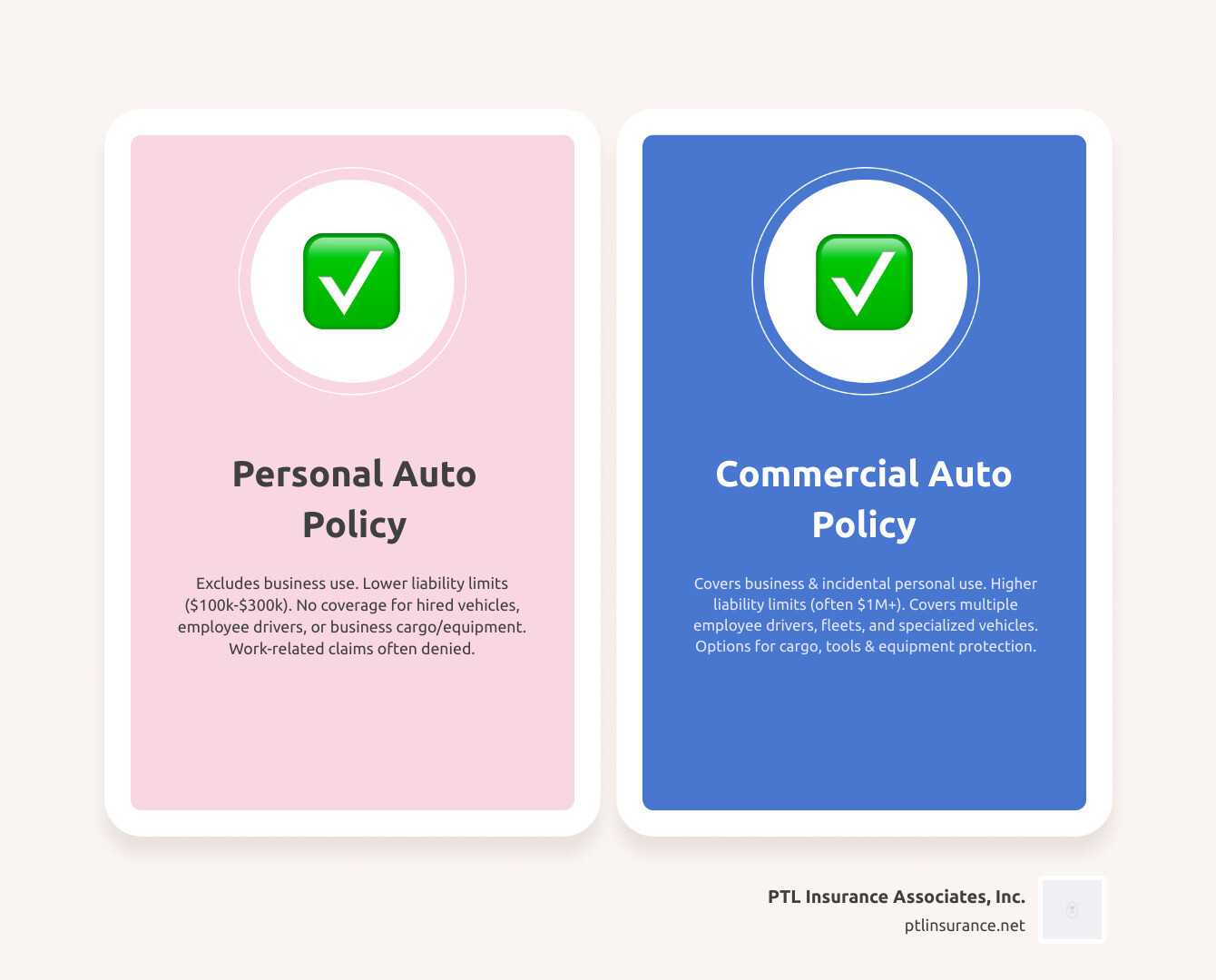
- Coverage Scope: Personal policies exclude business use; commercial policies cover both business and personal use
- Liability Limits: Commercial policies offer higher limits (often $1M+) vs. typical personal limits ($100k-$300k)
- Vehicle Types: Commercial policies cover work trucks, vans, trailers, and specialized vehicles
- Driver Coverage: Commercial policies can cover multiple employees and authorized drivers
- Equipment Protection: Options to cover tools, cargo, and business equipment (with endorsements)
If you’re using your vehicle to transport equipment to job sites, deliver goods, meet clients, or perform any work-related activities, your personal auto policy likely won’t cover accidents that occur during business use. Most personal policies contain explicit business-use exclusions—meaning if you file a claim after a work-related accident, your insurer can deny coverage entirely. This leaves you personally responsible for property damage, medical bills, and legal expenses that can easily reach hundreds of thousands of dollars.
The stakes are high: in 2022 alone, almost 6,000 large trucks were involved in fatal crashes, and more than 120,000 were involved in injury crashes. Whether you operate a single work van or a fleet of delivery trucks, adequate commercial coverage protects your business from financial catastrophe.
I’m Niki Perez, and after years in Real Estate Management Services, I now work alongside my husband at PTL Insurance Associates, where we help Miami business owners steer commercial vehicle insurance policies to find the right protection at competitive rates. Understanding the fundamentals of these policies is essential for protecting both your assets and your livelihood.
Commercial vehicle insurance policies terms to remember:
- commercial vehicle insurance for personal use
- commercial vehicle insurance providers
- commercial vehicle insurance third party
Understanding the Fundamentals of Commercial Auto Insurance
At its core, commercial auto insurance is specifically designed to cover liability and physical damage for vehicles used in your business operations. While it might seem similar to your personal car insurance, the differences are significant and crucial for business owners.
A personal auto policy is built around the assumption that you’re using your vehicle for personal errands, commuting, and leisure. It’s not designed to handle the increased risks associated with business use, such as more mileage, heavier loads, transporting equipment, or employees driving company vehicles. Because business vehicles are typically exposed to more risk than personal ones, most personal auto policies contain explicit exclusions for business use. This means if an accident occurs while you or an employee are performing work-related tasks—whether it’s delivering goods, meeting customers, picking up supplies, or transporting equipment—your personal policy could deny the claim, leaving your business vulnerable to substantial out-of-pocket expenses.
Commercial vehicle insurance policies, on the other hand, anticipate and cover these business-related risks. They provide the necessary protection for amounts, situations, and usage that a personal policy simply won’t. For instance, commercial policies often offer much higher liability limits, which are vital for protecting your business assets in case of a major accident involving serious injuries or extensive property damage. These higher limits can be essential for meeting contractual obligations or simply providing adequate financial protection for your company.
It’s also important to understand that commercial auto insurance stands apart from other business insurance policies, like a Business Owner’s Policy (BOP). While a BOP might bundle general liability and property insurance, it typically does not include coverage for vehicle-related accidents. For comprehensive protection, a dedicated commercial auto policy is indispensable.
The infographic below visualizes these critical differences, highlighting the coverage gaps that a personal policy leaves open for business-related activities.
To learn more about how we can help you tailor a policy for your business, visit our page on Commercial Auto Insurance.
Who Needs Commercial Auto Insurance?
If your business relies on vehicles for any aspect of its operations, chances are you need commercial auto insurance policies. This isn’t just for large trucking fleets; it applies to a wide range of businesses, from sole proprietors to established companies.
Consider these scenarios:
- Contractors and Tradespeople: If you’re a carpenter, electrician, plumber, landscaper, or painter, your vehicles are essential for transporting tools, materials, and equipment to job sites.
- Delivery Services: Whether you deliver food, packages, flowers, or any other goods for a fee, your personal auto policy will likely exclude coverage for these activities. This includes local courier services and even restaurants using cars for pizza delivery.
- Food Trucks and Mobile Businesses: Any vehicle that serves as your place of business, like a food truck, requires specialized commercial coverage.
- Businesses with Employee Drivers: If your employees use company-owned vehicles, or even their personal vehicles, for work-related tasks, your business needs protection against potential accidents.
- Service Providers: Businesses that use vehicles for client visits, sales calls, or transporting clients.
- Non-profits: Organizations using vehicles for their operations, such as transporting volunteers or donated goods.
The rule of thumb is simple: if a vehicle is used to generate income or conduct business operations, it needs commercial auto coverage. Businesses like contractors, landscapers, and truck drivers usually need a commercial auto policy, but even shops and restaurants that use a car to run errands or transport clients might need it. Without it, you could face significant financial risks.
We help businesses across Miami, Florida, secure the right coverage. Explore our insights on Commercial Insurance Miami and Business Insurance for Contractors.
What Types of Vehicles Are Covered?
Commercial vehicle insurance policies are remarkably versatile and can cover a broad spectrum of vehicles, reflecting the diverse needs of businesses. Unlike personal policies that typically cover standard cars, commercial policies extend to almost any vehicle used for business purposes.
Here’s a list of common vehicle types covered:
- Cars and SUVs: For businesses that use standard passenger vehicles for sales calls, client meetings, or general business errands.
- Pickup Trucks: Essential for many trades, these are covered whether they’re light-duty for small loads or heavy-duty for towing.
- Vans (Cargo and Passenger): Including work vans for technicians, delivery vans for goods, and passenger vans for shuttle services or transporting teams.
- Box Trucks: Commonly used for deliveries, moving services, or transporting goods.
- Dump Trucks: Critical for construction, landscaping, and waste management.
- Semi-Trucks and Tractors: The backbone of the commercial trucking industry, these require specialized heavy-duty coverage.
- Trailers: Whether utility trailers, flatbeds, refrigerated trailers, or car haulers, these are typically covered under the commercial auto policy, though specific listing and coverage details may apply based on weight and use.
The key determinant is the use of the vehicle, not just its type. If it’s on the road for your business, it belongs under a commercial policy.
Core Coverages and Specialized Options in Commercial Vehicle Insurance Policies
Just like personal auto insurance, commercial vehicle insurance policies include several fundamental coverages designed to protect your business from various risks on the road. However, commercial policies offer higher limits and additional specialized options custom to business needs.
The core coverages typically found in a commercial auto policy include:
- Bodily Injury Liability: This coverage pays for medical expenses and lost wages for others if you or an employee are at fault in an accident that causes injury.
- Property Damage Liability: This covers the cost of repairing or replacing property belonging to others that is damaged in an accident where your business vehicle is at fault.
- Combined Single Limit (CSL): Instead of separate limits for bodily injury per person, per accident, and property damage, a CSL policy provides one overall limit that applies to all damages in a single accident. This can offer more flexibility in claims.
- Collision Coverage: This pays for damage to your business vehicle resulting from a collision with another vehicle or object, regardless of fault.
- Comprehensive Coverage: This protects your business vehicle from non-collision incidents such as theft, vandalism, fire, falling objects, or damage from natural disasters.
- Medical Payments (MedPay)/Personal Injury Protection (PIP): This coverage pays for medical expenses for you and your passengers (employees, clients) who are injured in an accident involving your business vehicle, regardless of who is at fault. In Florida, PIP is a mandatory coverage.
- Uninsured/Underinsured Motorist Coverage (UM/UIM): This protects your business if you or an employee are involved in an accident with a driver who either has no insurance or insufficient insurance to cover the damages they cause.
Specialized Commercial Vehicle Insurance Policies and Endorsements
Beyond the core coverages, commercial vehicle insurance policies offer a range of specialized options and endorsements crucial for specific business operations. These can fill critical gaps that standard policies might miss.
- Hired and Non-Owned Auto (HNOA): This is a vital coverage for businesses where employees use their personal vehicles for work-related tasks (e.g., sales calls, deliveries) or when your business rents or borrows vehicles. HNOA provides liability coverage for your business in these situations, protecting you if an employee causes an accident while driving a non-owned vehicle for business purposes.
- Motor Truck Cargo Insurance: Specifically for businesses that transport goods for others, this coverage protects against the loss or damage of the cargo being hauled due to perils like collision, fire, or theft. This is particularly important for trucking companies and freight haulers.
- Trailer Interchange: If your business often uses trailers owned by other trucking companies under an interchange agreement, this coverage is essential. It provides physical damage coverage for non-owned trailers in your care, custody, or control.
- Inland Marine for Tools/Equipment: While your commercial auto policy typically covers permanently attached equipment (like a ladder rack), it generally does not cover loose tools, equipment, or materials transported in your vehicle. For contractors, landscapers, and other trades, an Inland Marine policy or endorsement added to a General Liability policy is necessary to protect these valuable items against theft, damage, or loss.
- Bobtail Insurance: This is a specific type of coverage for semi-truck drivers (often owner-operators) who drive their truck without a trailer (bobtailing) or when operating without dispatch. It covers liability when the truck is not pulling a loaded trailer and is not under dispatch.
- Bailee Coverage: While not strictly an auto coverage, it’s often relevant for businesses that transport or hold others’ property. If your business transports goods for clients, Bailee coverage protects against loss or damage to that property while it’s in your possession. You can find more information about this on our Bailees Insurance Coverage page.
Understanding Exclusions in Your Policy
Just as important as knowing what your commercial vehicle insurance policies cover is understanding what they don’t. Exclusions define situations or losses that your policy will not cover, and being aware of them can prevent costly surprises. Common exclusions in commercial auto policies include:
- Intentional Damage: Damage caused intentionally by you or an employee is almost always excluded.
- Unlisted Drivers: While some policies may offer limited coverage for occasional drivers, if an unlisted driver with regular access to your vehicle causes an accident, coverage may be reduced to state minimum limits or denied entirely. It’s best to list all regular drivers on your policy.
- Theft of Personal Items: Your commercial auto policy typically covers damage to the vehicle itself, but not personal belongings (like backpacks, phones, or wallets) left inside. These items are outside the scope of the policy.
- Unattached Equipment (Without Endorsement): As mentioned, loose tools, equipment, and other work materials transported in your vehicle are generally not covered by the commercial auto policy unless a specific Inland Marine endorsement is added.
- Use for Illegal Activities: Any damage or liability arising from the use of your vehicle in illegal activities will not be covered.
- Impaired Driving: Accidents caused by a driver under the influence of alcohol or drugs are typically excluded.
We always recommend reviewing your specific policy with one of our experienced agents in Miami, Florida, to ensure you understand all coverages and exclusions and have no unexpected gaps.
Navigating Costs, Requirements, and Savings
The cost of commercial vehicle insurance policies can vary significantly based on numerous factors, but understanding these elements can help you manage your premiums effectively. While average costs for commercial truck insurance can range from approximately $767 to $1,041 per month per vehicle, or between $5,000 and $15,000 annually per truck, these are just averages. Your specific premium will depend on your unique business profile.
The commercial driving landscape carries inherent risks, which directly influence insurance costs. In 2022, nearly 6,000 large trucks were involved in fatal crashes—a 1.8% rise from 2021 and a concerning 49% jump over the last decade. Additionally, over 120,000 large trucks were involved in crashes resulting in an injury in 2022. These statistics, from the National Safety Council, highlight the liftd risks associated with commercial vehicle operations, which insurers factor into pricing.
Minimum Insurance Requirements for Commercial Vehicles
Both state and federal governments set minimum insurance requirements for commercial vehicles to ensure businesses can cover potential damages and injuries. In Florida, specific state minimums apply, and it’s important to note that these state requirements can sometimes be higher than federal mandates.
For businesses operating commercial vehicles, especially trucks, federal regulations are primarily governed by the Federal Motor Carrier Safety Administration (FMCSA). The FMCSA mandates that companies carry specific levels of public liability and cargo coverage, with requirements varying based on what’s being transported, vehicle size, and business structure.
Here are some key FMCSA liability minimums:
- Trucks under 10,001 pounds:
- Non-hazardous freight: Minimum coverage of $300,000.
- Hazardous freight: Minimum coverage of $5,000,000.
- Trucks over 10,001 pounds:
- Non-hazardous cargo: Minimum coverage of $750,000.
- For-hire truckers and private carriers transporting oil: At least $1 million in liability coverage.
- For-hire truckers and private carriers hauling explosives or hazardous materials: At least $5 million in liability coverage.
Beyond just having the coverage, trucking companies engaged in interstate transit and select cargo hauling must also provide proof of insurance by filing specific documents with the FMCSA, such as the BMC-91X form (for motor carriers and freight forwarders) and the MCS-90 form (for carriers transporting hazardous cargo). These filings confirm you meet the necessary liability and environmental restitution coverage.
Ensuring compliance with both Florida state laws and federal FMCSA regulations is critical. Failing to meet these requirements can lead to severe penalties, including fines, license suspension, and restrictions on your business operations.
Factors That Influence the Cost of Commercial Vehicle Insurance Policies
Understanding the factors that influence the cost of your commercial vehicle insurance policies can empower you to make informed decisions and potentially save money. Here are the primary elements our Miami team considers when helping you secure a quote:
- Vehicle Type and Weight: Heavier, larger, or more specialized vehicles (like dump trucks or semi-trucks) generally cost more to insure due to their higher potential for causing damage in an accident. The vehicle’s age, make, and model also play a role.
- Driving Radius: How far your vehicles typically travel impacts risk. Local operations (within 50 miles) usually have lower premiums than intermediate (51-200 miles) or long-distance (over 200 miles) hauling.
- Cargo Type: Transporting hazardous materials, valuable goods, or anything that could cause significant environmental damage or financial loss will result in higher premiums due to increased risk.
- Driver Records and Experience: The driving history of everyone who operates your commercial vehicles is a major factor. Clean driving records, experience, and a lack of accidents or violations can lead to lower rates. Conversely, a history of claims or poor driving records will increase costs.
- Coverage Limits and Deductibles: Choosing higher liability limits provides more protection but also increases premiums. Similarly, opting for a lower deductible (the amount you pay out-of-pocket before insurance kicks in) will result in higher premiums.
- Claims History: Your business’s past claims experience directly impacts your rates. A history of frequent or expensive claims will likely lead to higher premiums.
- Location: Where your business operates and where your vehicles are garaged (e.g., Miami, Florida) can influence rates due to local traffic patterns, accident rates, and theft statistics.
We are committed to helping you find affordable solutions. Learn more about how these factors affect your rates on our Commercial Vehicle Insurance Price page.
To save money on your premiums, consider these best practices:
- Maintain a Clean Driving Record: Encourage safe driving habits among all employees.
- Implement a Risk Management Policy: Formal safety programs, driver training, and regular vehicle maintenance can demonstrate a commitment to safety.
- Choose the Right Coverage: Only buy the coverage you truly need, but avoid declining optional coverages that could leave you exposed in a major incident.
- Increase Deductibles: If you can afford to pay more out-of-pocket in the event of a claim, a higher deductible can lower your premium.
- Explore Discounts: Ask about discounts for multi-policy bundles, continuous coverage, or paying your premium in full.
- Consider Telematics: Some programs monitor driving behavior and can offer discounts for safe driving.
Frequently Asked Questions about Commercial Auto Insurance
We often hear similar questions from Miami business owners about their commercial vehicle insurance policies. Here are some of the most common ones, answered to help you better understand your coverage needs.
How do I get a quote for commercial auto insurance?
Getting a quote for commercial vehicle insurance policies is a straightforward process, but it requires specific information to ensure accuracy and provide you with the most competitive rates. When you contact us at PTL Insurance Associates, we’ll typically ask for the following details:
- Business Information: Your legal business name, address (especially important for Miami and Florida-specific rates), type of business (e.g., contracting, delivery, landscaping), and how long you’ve been in operation.
- Vehicle Information: For each vehicle you want to insure, we’ll need its year, make, model, Vehicle Identification Number (VIN), and Gross Vehicle Weight (GVW).
- Vehicle Use: How each vehicle is primarily used (e.g., transporting equipment, making deliveries, client visits, towing).
- Driver Information: Details for all individuals who will operate the commercial vehicles, including their names, dates of birth, driver’s license numbers, and driving history (accidents, violations).
- Coverage Needs: Your desired liability limits, preferred deductibles, and any specific endorsements you might need (like cargo coverage or hired/non-owned auto).
- Previous Insurance History: Information about your current or previous commercial auto policies, including claims history.
Having this information ready will help us quickly provide you with a custom quote that meets your business’s unique needs in Florida. Ready to get started? Visit our Commercial Auto Insurance Quote page.
What is the difference between commercial auto and a Business Owner’s Policy (BOP)?
This is a common point of confusion for many business owners. While both commercial auto insurance policies and a Business Owner’s Policy (BOP) are crucial for comprehensive business protection, they cover very different types of risks.
Business Owner’s Policy (BOP): A BOP is a package policy that typically combines two essential coverages:
- General Liability Insurance: This protects your business from claims of bodily injury or property damage that occur on your business premises, as a result of your operations, or from your products or services (e.g., a customer slips and falls in your shop, or your product causes injury).
- Commercial Property Insurance: This protects your business’s physical assets, such as your building, equipment, inventory, and furniture, from perils like fire, theft, or vandalism.
- Why it doesn’t cover vehicle accidents: Crucially, a BOP generally does not provide coverage for accidents involving vehicles owned, leased, or used by your business. Vehicle-related liability and physical damage are specifically excluded from the general liability portion of a BOP.
Commercial Auto Insurance: This policy, as we’ve discussed, is solely focused on providing liability and physical damage coverage for your business vehicles. It covers injuries and property damage caused by your vehicles, as well as damage to your own business vehicles.
A BOP protects your business from risks at your location and from your operations/products, while commercial vehicle insurance policies protect your business from risks on the road. They are complementary policies, and most businesses in Miami, Florida, that use vehicles for work will need both for complete protection. Relying solely on a BOP will leave a significant gap in coverage for any vehicle-related incidents.
Does commercial auto insurance cover personal use of a business vehicle?
This is an excellent question, and the answer can sometimes be surprising to business owners transitioning from personal policies. Generally, yes, commercial vehicle insurance policies can cover the personal use of a business vehicle, unlike personal policies which explicitly exclude business use.
If you have a commercial auto policy, it typically covers your vehicle for both commercial and incidental personal use. This flexibility is one of the key advantages of a commercial policy. For example, if you use your work van for occasional personal errands on the weekend, your commercial policy would likely still provide coverage.
However, clarify what “personal use” means in the context of your specific policy and discuss this with your insurance agent. Some policies might have limitations on the extent or nature of personal use. For instance, while driving home from a job site is typically covered, using a heavy-duty commercial truck solely for a cross-country family vacation might fall outside the intended scope of some policies.
The critical distinction is that a commercial policy is designed to cover the primary business use and often extends to incidental personal use, whereas a personal policy is designed for primary personal use and explicitly excludes any business use.
For a deeper dive into this topic, refer to our guide on Commercial Vehicle Insurance for Personal Use.
Secure Your Business on the Road
The road ahead for your business can be unpredictable, but with the right commercial vehicle insurance policies, you can steer it with confidence. The risks of inadequate coverage are simply too high: facing fines, license suspension, restrictions on your business operations, or having to pay for damages out of pocket can derail even the most successful enterprise. It is crucial to get the correct amount of coverage so that you can be covered in case of lawsuits or large claims.
At PTL Insurance Associates, we understand that every business in Miami, Florida, is unique, with its own set of vehicles, drivers, and operational risks. That’s why we don’t believe in one-size-fits-all solutions. Our strength lies in providing personalized service and tailoring coverage options that precisely match your needs. With over 35 years of experience as an independent insurance broker, we have the expertise to assess your specific situation and connect you with the most suitable and comprehensive commercial vehicle insurance policies.
We’ll help you understand the nuances of federal and state requirements, identify the specialized endorsements your business needs, and explore all possible avenues to save money on your premiums without compromising essential protection. Our goal is to ensure your business assets, employees, and operations are safeguarded against the financial fallout of vehicle-related incidents.
Don’t leave your business vulnerable to the unexpected. Protect your livelihood with expertly crafted commercial vehicle insurance policies from PTL Insurance Associates.

