


First time home insurance: 6 Smart Steps Guide
Your Guide to Protecting Your Biggest Investment

Title: First-Time Home Insurance Guide
Caption: A comprehensive guide to understanding and securing home insurance for your first home.
Source: PTL Insurance Associates, Inc.
First time home insurance is a policy that protects your new home and belongings from damage or loss due to covered events like fire, theft, or storms. It’s typically required by your mortgage lender and, as the image above illustrates, acts as a protective shield for your biggest investment, shielding you from financial disaster if something happens to your property.
Quick Answer for First-Time Buyers:
- What it covers: Your home’s structure, personal belongings, liability if someone gets hurt on your property, and temporary living expenses if your home becomes uninhabitable
- When to buy: Secure a policy before closing (usually at least 3 days prior)
- Average cost: Around $1,445 per year nationally, though this varies significantly by state
- Not optional: Mortgage lenders require proof of insurance before finalizing your loan
- Key decision: Choose your coverage limits and deductible carefully—too little coverage leaves you exposed, while a higher deductible can lower your premium
Buying your first home is exciting—and a bit overwhelming. You’ve saved for the down payment, secured a mortgage, and found the perfect place. Now you’re facing another critical step: getting the right insurance coverage.
Unlike mortgage insurance (which protects your lender if you can’t pay), home insurance protects you. If a fire destroys your kitchen, a storm tears off your roof, or someone slips on your front steps and sues, your policy steps in to cover the costs. Without it, you’d pay for repairs, replacements, and legal fees out of pocket—potentially tens or hundreds of thousands of dollars.
But here’s the challenge: insurance policies are packed with jargon, exclusions, and fine print. How much dwelling coverage do you actually need? What’s the difference between personal property and other structures? Should you add flood insurance in Miami? These aren’t questions you can guess at.
This guide breaks down everything you need to know about first time home insurance. You’ll learn what’s covered (and what’s not), how to calculate the right amount of protection, and how to save money without cutting corners. By the end, you’ll be ready to shop confidently and protect your biggest investment.
As Niki Perez, I’ve spent years helping homeowners steer the insurance process after transitioning from Real Estate Management Services to PTL Insurance with my husband Erik. We’ve guided countless first-time buyers through securing first time home insurance that fits their needs and budget, especially here in Miami where hurricane and flood risks demand special attention.
The Essentials: Understanding Home Insurance Basics
When you become a homeowner, you’re not just buying a place to live; you’re making a significant investment. Protecting that investment is paramount, and that’s where first time home insurance comes into play. It’s more than just a piece of paper; it’s a financial safety net that ensures your biggest asset is safeguarded against life’s unpredictable moments.
What is Home Insurance and Why is it Crucial?
At its core, home insurance provides financial protection if your home or personal property is damaged due to a covered incident, often called a peril. These perils can include a wide range of events such as fires, windstorms, explosions, theft, and vandalism. Imagine a strong tropical storm hitting Miami, causing damage to your roof and forcing you to temporarily relocate. Without home insurance, you’d be solely responsible for the repair costs and any additional living expenses. With a policy, we help cover those costs, providing much-needed peace of mind.
For first-time homebuyers, home insurance is crucial for several reasons:
- Financial Safety Net: It protects your investment from unforeseen events, preventing these incidents from becoming catastrophic financial burdens. The average cost of home insurance is around $1,445 per year nationally, but this pales in comparison to the cost of rebuilding a home.
- Lender Requirement: If you have a mortgage, your lender will almost certainly require you to have a valid home insurance policy in place before finalizing your loan. This protects their financial interest in the property, which serves as collateral for your loan. Without it, you won’t be able to close on your home.
- Covers Repair and Rebuilding Costs: Home insurance covers repair or replacement costs for damage caused by covered perils. This includes the structure of your home and other buildings on your property.
- Liability Protection: It also helps cover the cost of liability claims if someone is injured by or on your property, or if one of your household members accidentally damages someone else’s property. This can cover medical expenses and legal fees, shielding you from potentially devastating lawsuits.
Home insurance protects your investment and provides peace of mind, ensuring you are covered in case of damage or loss. For more information, you can explore our Homeowners Insurance Guide for First-Time Homebuyers.
Home Insurance vs. Mortgage Insurance (PMI)
This is a common point of confusion for many first-time buyers, but understanding the difference is vital.
- Home Insurance: This protects you, the homeowner, and your property. It covers the physical structure of your home, your belongings, and provides liability protection against specific perils. If a fire damages your home, your home insurance policy pays to rebuild or repair it.
- Mortgage Insurance (often called Private Mortgage Insurance or PMI in the U.S.): This protects your lender, not you. Lenders require PMI when you make a down payment of less than 20% of the home’s purchase price. It protects the lender in case you default on your mortgage payments. Once you reach 20% equity in your home, you can usually request to have PMI removed.
The key takeaway is that these are two entirely separate policies with different purposes. One protects your personal investment and financial well-being, while the other safeguards the lender’s loan. You will likely need both if your down payment is less than 20%.
Decoding Your Policy: What’s Covered (and What’s Not)
Understanding what your first time home insurance policy covers can feel like deciphering a secret code. But don’t worry, we’re here to break it down. A standard home insurance policy is designed to protect various aspects of your property and your financial liability. As the infographic below illustrates, a standard policy is built on six core pillars of protection.
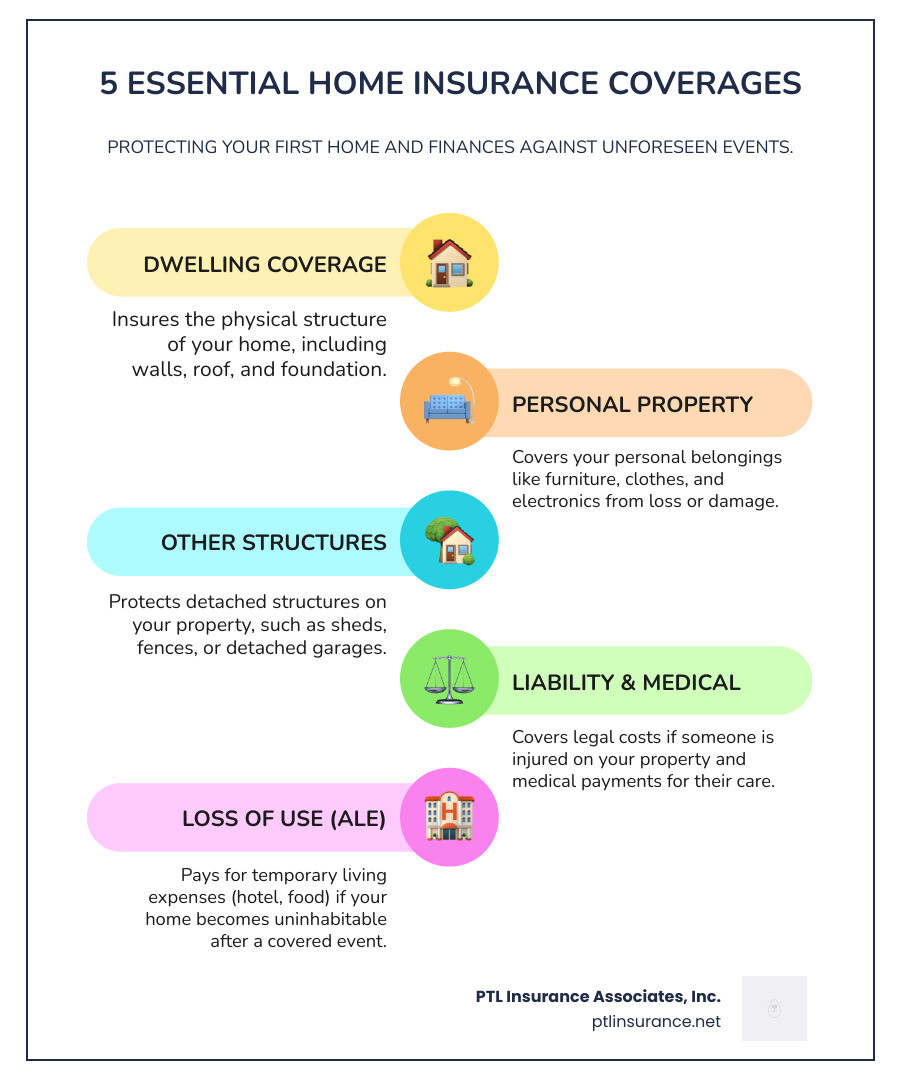
Your policy will outline specific coverage limits—the maximum amount your insurer will pay for a covered claim in each category. It’s crucial to understand these limits, as well as the difference between Replacement Cost (RC) and Actual Cash Value (ACV) when it comes to personal property. RC pays to replace items at today’s prices, while ACV factors in depreciation. We almost always recommend Replacement Cost coverage for better protection.
The 6 Core Coverage Types
A standard home insurance policy typically includes six main types of coverage:
- Dwelling Coverage: This protects the physical structure of your home, including the foundation, roof, walls, and windows, against covered perils. It’s what pays to rebuild your house if it’s destroyed.
- Personal Property Coverage: This covers your belongings inside your home, such as furniture, electronics, clothing, and appliances. It pays to repair or replace these items after a covered incident. This coverage often extends to your personal property even if it’s temporarily located elsewhere, like in a storage unit.
- Other Structures Coverage: This protects structures on your property that are not attached to your main residence. Think detached garages, sheds, gazebos, or fences.
- Loss of Use (Additional Living Expenses – ALE): If a covered event makes your home temporarily uninhabitable, ALE coverage pays for the extra costs you incur. This can include hotel stays, temporary rental housing, restaurant meals, and other necessary expenses while your home is being repaired.
- Personal Liability Insurance: This is a big one. It protects you financially if someone is injured on your property and you’re found legally responsible, or if you or a household member accidentally cause damage to someone else’s property. It covers medical expenses and legal fees if you’re sued.
- Medical Payments to Others: This coverage helps pay for medical bills when a guest is injured on your property, regardless of who is at fault. This is generally for smaller medical claims and can help prevent a liability lawsuit.
For those living in condominiums, there are specific policies custom to your needs. You can find More info about Condo Insurance Coverage on our site.
Determining How Much Coverage You Need
Knowing what’s covered is one thing; knowing how much coverage you need is another. Here are some general guidelines we use to help our clients determine appropriate limits:
- Dwelling Coverage: This should be 100% of your home’s replacement cost, not its market value. The replacement cost is what it would take to rebuild your home from the ground up, factoring in current labor and material costs.
- Personal Property Coverage: Typically, this is set at 50% to 70% of your dwelling coverage. We always recommend creating a detailed home inventory of all your belongings, especially high-value items, to ensure this amount is sufficient.
- Other Structures Coverage: A good rule of thumb is 10% of your dwelling coverage.
- Personal Liability Coverage: We advise at least $300,000 in liability coverage. However, depending on your assets and potential risks (like a swimming pool), you might consider higher limits or an umbrella policy.
- Additional Living Expenses (ALE): This is often 20% to 30% of your dwelling coverage, and ensure it covers potential temporary housing costs in your area.
- Medical Payments Coverage: We recommend at least $5,000.
To help you get started, you can use our Home Insurance Calculator to estimate your potential needs.
Common Exclusions and Necessary Add-Ons
While standard policies are comprehensive, they don’t cover everything. It’s vital to understand common exclusions, especially in a region like Miami, Florida.
- Floods: Standard home insurance policies almost universally exclude flood damage. Given Miami’s coastal location and susceptibility to heavy rainfall, flood insurance is often a separate, crucial purchase. If your new home is in a high-risk flood zone, your lender will likely require it. We have a detailed National Flood Insurance Program guide to help you steer this, and you can find official information from the federal government at FloodSmart.gov.
- Earthquakes: While less common in Florida, earthquake damage is also typically excluded.
- Sewer Backup: Damage caused by overflowing sewer systems is often an add-on, not standard.
- Maintenance Issues: Damage resulting from neglect or a lack of maintenance (e.g., a leaky roof you ignored for years) is generally not covered.
- High-Value Items: Standard personal property coverage may have “special limits” for specific high-value items like jewelry, art, or firearms. If your collectibles exceed these limits, you’ll need to add an endorsement or a separate policy.
Understanding these exclusions allows us to discuss necessary riders or endorsements to ensure you have truly comprehensive protection for your new home.
The Price Tag: Factors Influencing Your First Time Home Insurance Cost
“How much will this actually cost me?” is a question we hear all the time from first-time homebuyers. While the national average for home insurance is around $1,445 per year, this figure can fluctuate wildly. For instance, homeowners in Florida often face higher premiums due to the increased risk of hurricanes and tropical storms.
The good news is that understanding the factors that influence your premium empowers you to make informed decisions and potentially find savings.
What Determines Your Home Insurance Premium?
Several key factors come into play when calculating your first time home insurance premium:
- Home’s Location: This is huge, especially in Miami. Proximity to the coast, risk of hurricanes, flood zones, and even local crime rates all impact your premium. A home further inland or closer to a fire station might see lower rates.
- Age and Construction of Home: Older homes can sometimes cost more to insure due to outdated systems (plumbing, electrical) or unique construction materials that are expensive to replace. However, houses built with durable materials like brick or those that have recently undergone significant updates (like a new roof designed for wind mitigation) can sometimes qualify for discounts.
- Claims History: Your personal claims history, as well as the claims history of the property itself, can influence rates.
- Credit-Based Insurance Score: In Florida, insurers may use a credit-based insurance score to help determine your premium. A good score often indicates a lower risk.
- Proximity to Fire Hydrant/Station: Homes closer to emergency services often receive lower rates.
To get a better sense of how these factors play out, you can check out our insights on the Average Cost of Homeowners Insurance.
The Role of Your Deductible
Your deductible is the amount you pay out-of-pocket towards a covered loss before your insurance coverage kicks in. For example, if you have a $1,000 deductible and a covered claim results in $10,000 worth of damage, you’ll pay the first $1,000, and your insurer will cover the remaining $9,000.
Here’s how it affects your premium and claim payout:
- Premium Impact: Generally, the higher your deductible, the lower your annual premium. This is because you’re agreeing to take on more of the initial financial risk.
- Claim Payout: A higher deductible means you’ll pay more out-of-pocket if you need to file a claim.
Choosing the right deductible involves balancing lower premiums with what you can comfortably afford to pay if a claim arises. Our research shows that homeowners can save an average of 11% per year by increasing their deductible from $1,000 to $2,500. It’s a significant saving, but only if you have that $2,500 readily available.
Smart Strategies for Saving Money
We know every dollar counts, especially for first-time homebuyers. Here are some smart strategies to save money on your first time home insurance premiums without compromising essential coverage:
- Bundling Home and Auto Insurance: This is one of the easiest ways to save. Many insurers offer significant discounts when you combine your home and auto policies. We help our clients find the best options to Bundle House and Car Insurance for maximum savings.
- Installing Security Systems: A monitored alarm system can deter burglars and lead to discounts.
- Smoke Detectors and Fire Sprinklers: These life-saving devices also reduce your risk profile for insurers.
- New Roof or Wind Mitigation Features: In Florida, a new, hurricane-rated roof or other wind mitigation features can lead to substantial discounts.
- Loyalty Discounts: Staying with the same insurer for several years can sometimes earn you a loyalty discount.
- Good Credit Score: Maintaining a strong credit score can positively impact your insurance rates.
- Paperless Billing: Opting for paperless statements can sometimes net you a small discount.
- Claim-Free History: A history of no claims can also lead to lower premiums over time.
By implementing some of these strategies, you can make your new home safer and more affordable to insure.
The Action Plan: Choosing and Buying Your Policy
Securing your first time home insurance policy is one of the final, crucial steps before you get the keys to your new home. It’s not a last-minute detail; it requires careful planning.
When and How to Shop for Your First Time Home Insurance
The best time to start shopping for home insurance is as soon as you have a confirmed purchase contract on your new home. Don’t wait until the week before closing!
- Secure Policy Before Closing: Mortgage lenders typically require proof of insurance, often in the form of an insurance binder, at least three business days before your closing date. This binder is a temporary document proving you have coverage in place.
- Comparing Multiple Quotes: We always recommend getting quotes from at least three different insurance providers. This allows you to compare not just prices, but also coverage limits, deductibles, and customer service ratings. The cheapest policy isn’t always the best if it leaves you underinsured.
- Work with an Agent: As independent insurance brokers in Miami, we can shop multiple carriers on your behalf, saving you time and effort while ensuring you get personalized advice. We know the local market and can help you steer Florida’s unique insurance landscape. You can easily Find Home Insurance Agents in Miami Florida with us.
What You’ll Need to Get a Quote
To get an accurate first time home insurance quote, you’ll need to provide some specific information about yourself and your new home:
- Personal Information: Your full name, date of birth, and Social Security number.
- Property Address: The exact address of your new home.
- Home Details:
- Square footage (heated and unheated)
- Year built
- Type of construction (e.g., concrete block, wood frame)
- Roof type and age (crucial for Florida policies!)
- Age of major systems (HVAC, plumbing, electrical)
- Safety Features: Details on any smoke detectors, fire extinguishers, security systems (monitored or unmonitored), or hurricane-resistant features (e.g., impact windows, storm shutters, roof tie-downs).
- Desired Coverage Limits: Having an idea of the dwelling, personal property, and liability limits you’d like can speed up the process.
- Mortgage Lender Information: Your lender’s name and address, as they will need to be listed on the policy.
Having this information ready makes the quoting process much smoother and faster.
Filing a Claim: A Simple Guide
No one wants to file a claim, but if something does happen, knowing the steps can make a stressful situation more manageable.
- Document the Damage: As soon as it’s safe to do so, take photos and videos of all damaged property. This visual evidence is invaluable for your claim.
- Contact Your Insurer Immediately: Notify us or your insurance provider as soon as possible after the incident. The sooner you report it, the sooner the process can begin.
- Make Temporary Repairs: Take reasonable steps to prevent further damage (e.g., covering a broken window, turning off a leaking water pipe). Keep all receipts for these temporary repairs.
- Keep Records: Maintain a detailed log of all communications with your insurer, including dates, times, and names of people you spoke with. Keep copies of all documents submitted.
- Cooperate with the Claims Adjuster: An adjuster will be assigned to assess the damage. Provide them with all requested information and access to the property.
We’re here to guide you through this process should you ever need to file a claim.
Frequently Asked Questions for First-Time Homebuyers
What are the different types of home insurance policies?
While we often refer to it simply as “home insurance,” there are actually different policy types custom to various property ownership situations:
- Homeowners Insurance (HO-3 or HO-5): This is the most common type, designed for single-family homes. It provides comprehensive coverage for the structure, personal property, and liability.
- Condo Insurance (HO-6): If you own a condo unit, an HO-6 policy is what you need. It covers your personal belongings, the interior structure of your unit (from the “walls in”), and your personal liability. The condo association’s master policy typically covers the building’s exterior and common areas. For more details, see our article on More info about HO6 Condo Insurance.
- Tenant/Renters Insurance (HO-4): This policy is for renters and covers your personal belongings and liability, but not the building structure itself (which is the landlord’s responsibility).
How does my home’s location in Miami affect my insurance?
Living in beautiful Miami, Florida, comes with unique insurance considerations that significantly impact your first time home insurance policy and costs:
- Hurricane Risk: Florida is highly susceptible to hurricanes and tropical storms, leading to higher premiums compared to inland states. Insurers factor in wind risk, and you’ll often have a separate hurricane deductible (usually a percentage of your dwelling coverage, not a flat dollar amount).
- Flood Zones: Much of Miami is in a flood zone. As discussed, standard policies exclude flood damage, so flood insurance is often a necessity, and sometimes legally required by lenders.
- Higher Premiums in Coastal Areas: Properties closer to the coastline generally face higher premiums due to increased risk of storm surge and wind damage.
- Importance of Wind Mitigation: Homes with wind mitigation features (like impact-resistant windows, reinforced roofs, or hurricane straps) can qualify for significant discounts. We always encourage our clients to get a wind mitigation inspection.
Understanding these local risks is paramount, and we specialize in finding custom solutions for Home Insurance Miami Florida residents.
What’s the difference between Replacement Cost and Actual Cash Value?
This distinction is critical for how much you’ll receive if your personal property is damaged or destroyed:
- Replacement Cost (RC): This coverage pays to replace your damaged or destroyed items with new ones at today’s market prices, without deducting for depreciation. It offers better protection and generally costs more but ensures you can truly replace what you lost.
- Actual Cash Value (ACV): This coverage pays the replacement cost of your items minus depreciation (wear and tear). For example, a five-year-old couch would be replaced at its current depreciated value, not the cost of a brand-new couch.
We generally recommend Replacement Cost coverage for personal property whenever possible, as it provides a more robust financial safety net.
Conclusion: Secure Your New Beginning with Confidence
Buying your first home is an exhilarating journey, and securing the right first time home insurance is a cornerstone of protecting that dream. We’ve walked through the essentials, from understanding what your policy covers and the critical difference between home and mortgage insurance, to decoding how premiums are calculated and smart strategies for saving money. It’s not just about meeting a lender’s requirement; it’s about safeguarding your significant investment and gaining invaluable peace of mind.
At PTL Insurance Associates, Inc., we’ve been helping homeowners in Miami, Florida, and surrounding areas steer these complexities for over 35 years. We pride ourselves on providing personalized service and tailoring coverage options that truly fit your unique needs. Don’t leave your biggest asset to chance. Let us help you understand your risks, explore your options, and find the perfect policy so you can confidently start on your new beginning as a homeowner.
Ready to protect your new home? Get a personalized Home Insurance quote today and let us help you build a secure future.

