


Surety bonds for construction: 3 Crucial Facts
Why Every Construction Project Needs a Financial Safety Net
{title=”Construction Bonds for Project Security” alt=”A construction site with a blueprint overlay and financial graphs, symbolizing the security provided by construction bonds.” caption=”Ensuring project integrity and financial stability through surety bonding.” source=”Internal”}
As the image above illustrates, a construction project is a complex undertaking where financial security is paramount. Surety bonds for construction provide this security, acting as a three-party guarantee that protects project owners, subcontractors, and suppliers from financial loss if a contractor fails to meet their obligations. With nearly 30% of contractors failing within two years, these bonds are an essential risk management tool, especially for public works projects. A contractor default can leave behind an incomplete structure, unpaid suppliers, and millions in losses.
Quick Answer: What You Need to Know About Construction Surety Bonds
- Bid Bond: Guarantees the contractor will sign the contract if awarded.
- Performance Bond: Ensures the contractor completes the work as specified.
- Payment Bond: Guarantees subcontractors and suppliers will be paid.
- Typical Cost: 0.5% to 3% of the contract amount.
- Federal Requirement: Mandatory for public projects over $150,000 (Miller Act).
- Who Pays: The contractor, with the cost factored into the contract price.
Unlike insurance, which compensates for unexpected losses, surety bonds are designed to prevent loss. A surety company rigorously prequalifies a contractor’s finances, work history, and ability to complete the project. If the contractor defaults, the surety steps in to ensure the project is finished.
The data is clear: unbonded public construction projects are 10 times more likely to default than bonded ones. Failed unbonded projects cost 85% more and take nearly twice as long to complete. For project owners, bonds provide crucial assurance that the lowest bidder is qualified, not just cheap.
I’m Niki Perez, and with my background in Real Estate Management Services, I’ve seen how vital risk management is. At PTL Insurance Associates, we help Miami-area contractors steer surety bonds for construction, empowering them to bid confidently and grow their businesses.
The Foundation: What is a Surety Bond and How Does it Work?
A surety bond for construction is a three-party agreement that guarantees a contractor will fulfill their contractual obligations. If they fail, a financially strong surety company steps in to resolve the situation. This concept of suretyship has evolved into a sophisticated financial tool essential for today’s construction industry.
The Three Parties in a Surety Agreement
Every surety bond involves three key players:
- The Principal: The contractor who obtains the bond and is obligated to perform the work, pay suppliers, and deliver the project as promised.
- The Obligee: The project owner (e.g., a government agency or developer) who requires the bond for financial protection against contractor failure.
- The Surety: The bonding company that guarantees the principal’s performance to the obligee. If the principal defaults, the surety intervenes to ensure the project is completed.
The infographic below visualizes how these three parties interact throughout the lifecycle of a bonded project, from the initial bid to potential default resolution.
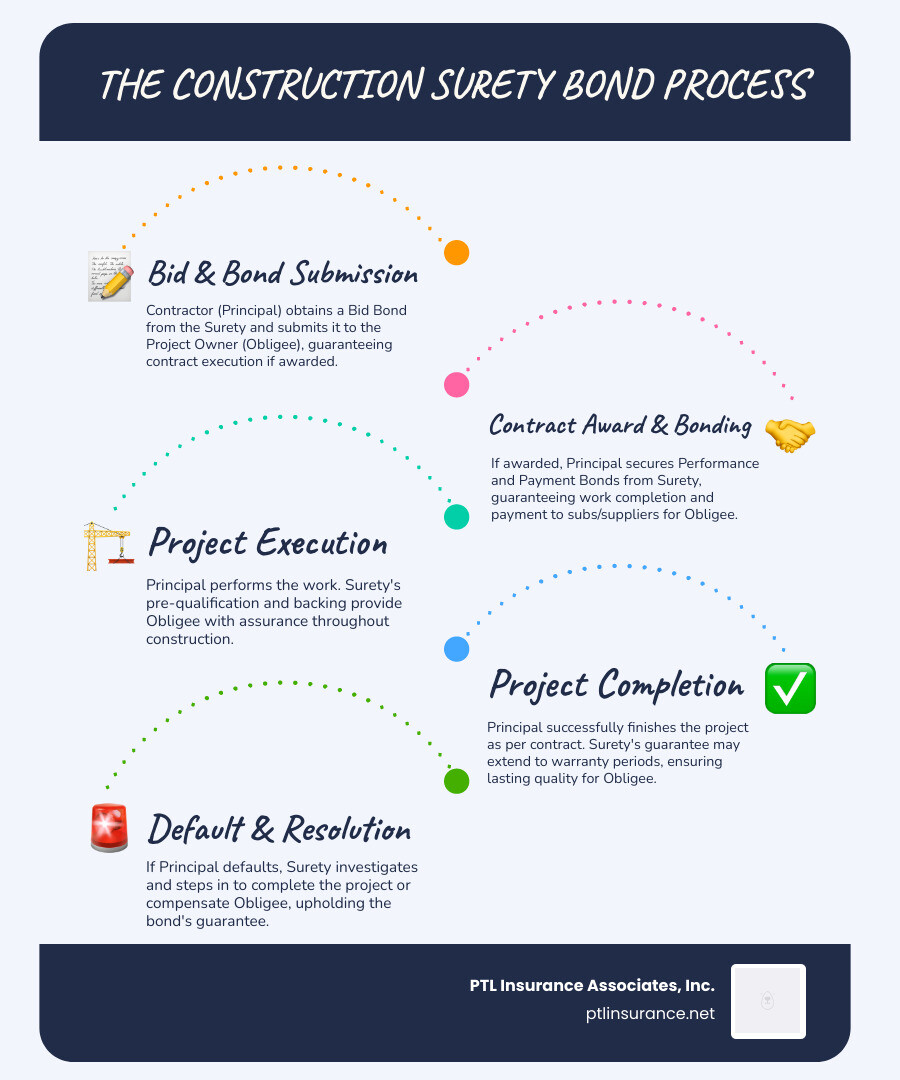
{title=”The Three-Party Relationship in Construction Surety Bonds” alt=”An infographic illustrating the three-party relationship in construction surety bonds, detailing the roles of the Principal, Obligee, and Surety, and the process from bid to project completion and default resolution.” caption=”Understanding the intricate connections and guarantees within a surety bond agreement.” source=”Internal”}
Crucially, the contractor signs an indemnity agreement with the surety. This means if the surety pays a claim, the contractor is legally required to reimburse the surety. This makes a surety bond more like a co-signed loan than a traditional insurance policy for the contractor.
Surety Bonds vs. Insurance: A Critical Distinction
Many people confuse surety bonds with insurance, but they operate very differently. Traditional insurance is a two-party contract that transfers risk and anticipates losses. Surety bonds are a three-party agreement designed to prevent loss through contractor prequalification.
| Feature | Surety Bond | Traditional Insurance |
|---|---|---|
| Purpose | Guarantees performance; prevents loss. | Compensates for unforeseen losses; assumes risk. |
| Parties | Three: Principal (contractor), Obligee (owner), Surety. | Two: Insured, Insurer. |
| Premium | Fee for prequalification and guarantee; no loss expected. | Fee for transferring risk; claims are expected. |
| Claims | Surety seeks reimbursement from Principal. | Insurer pays claim with no reimbursement expected. |
| Loss Expectation | Zero loss; contractor indemnifies surety. | Losses are expected as part of the business model. |
The surety’s goal is zero losses. The premium covers the cost of their rigorous vetting process. If a claim is paid, the surety will seek full reimbursement from the contractor. You can find more information about the difference between bonds and insurance here.
Another financial tool, a Letter of Credit (LOC), is sometimes used but lacks the comprehensive prequalification and performance guarantee of a surety bond. An LOC is a simple financial guarantee, whereas a surety bond guarantees a qualified contractor will complete the work.
Key Types of Surety Bonds for Construction
While surety bonds for construction typically refer to contract bonds for specific projects, contractors may also encounter commercial bonds. Contractor License Bonds, for example, are often required by states or cities to ensure compliance with local regulations. Subdivision Bonds guarantee that developers will complete public infrastructure like roads and sewers in new housing developments.
However, the core of construction bonding revolves around four main contract surety bonds that guide a project from bid to completion.
Bid, Performance, and Payment Bonds Explained
These three bonds work in sequence and are often required together, especially on public projects.
Bid Bonds: Submitted with a project bid, this bond guarantees that if you win the contract, you will sign it and provide the required performance and payment bonds. It protects the project owner from costs if you back out, forcing them to accept a higher bid. The AIA Bid Bond Form A310™-2010 is a common standard.
Performance Bonds: This is your promise to complete the project according to the contract’s terms, timeline, and quality standards. If you default for any reason, the surety steps in to ensure the project is finished, protecting the owner from financial loss.
Payment Bonds: This bond guarantees that your subcontractors, laborers, and material suppliers will be paid. It’s crucial on public projects where mechanic’s liens aren’t allowed, giving workers and suppliers a path to recourse if they aren’t paid. The AIA Performance and Payment Bond Form A312™-2010 often combines these two guarantees.
In short, a performance bond ensures the project gets built, while a payment bond ensures everyone who built it gets paid.
Ancillary and Post-Completion Bonds
Other bonds cover specific situations, often after a project is finished.
Maintenance Bonds (or Warranty Bonds): These guarantee you will fix defects in workmanship or materials for a specified period (usually 1-2 years) after project completion. The AIA Warranty Bond Form A313™-2020 is an industry-standard form for this.
Supply Bonds: These guarantee that a supplier will deliver materials and equipment as promised and at the quoted price. They are often required on federal projects to prevent supply chain disruptions.
Subcontractor Bonds: A general contractor may require their subcontractors to be bonded. This protects the general contractor if a sub defaults, preventing project delays and financial losses. It’s a smart risk management strategy that strengthens the entire project.
The Blueprint: Obtaining and Managing Your Bonding
Obtaining surety bonds for construction involves a detailed underwriting process where a surety company evaluates your ability to fulfill the contract. This evaluation centers on the “3 C’s”:
- Character: Your reputation, integrity, and track record of fulfilling commitments.
- Capacity: Your ability to perform the work, including your experience, equipment, and personnel.
- Capital: Your financial strength, including working capital, cash flow, and equity.
To assess this, sureties will request documents like CPA-prepared financial statements, a detailed work history, bank references, and information on your company’s structure. Your personal and business credit scores are also critical, as sureties view bonds as a form of credit. While minor credit issues may be overlooked for smaller bonds, significant problems can be a major hurdle for larger contracts.
Understanding and Building Your Bonding Capacity
Your bonding capacity is the maximum amount of bonded work a surety will extend to you. It’s expressed as a “single limit” (for one project) and an “aggregate limit” (for all projects combined). For example, a $500,000/$1,000,000 capacity means you can bond a single project up to $500,000, with a total of $1,000,000 in bonded work at one time.
To build your bonding capacity:
- Start small to build a successful track record.
- Maintain strong financials with the help of a construction-focused CPA.
- Build a strong relationship with your surety agent through open communication.
- Address any credit issues to reduce your perceived risk.
The Cost of Surety Bonds for Construction
The bond premium is a fee for the surety’s prequalification service and guarantee. It typically ranges from 0.5% to 3% of the total bond amount. The final rate depends on:
- The bond amount and type.
- Your company’s financial health and credit history (the biggest factor).
- The project’s size, complexity, and risk.
While the contractor pays the premium, the cost is usually included in the project bid, so it’s ultimately covered by the project owner.
Legal Mandates and Project Protection
The requirement for surety bonds for construction is often law, not just a best practice. These laws protect taxpayer money on public infrastructure projects.
The federal Miller Act of 1935 mandates that any federal construction project over $150,000 must have both performance and payment bonds. Following this standard, all 50 states have enacted their own “Little Miller Acts” that apply similar bonding requirements to state and local public works. Here in Florida, these laws ensure projects from schools to roads are financially secure.
How Bonds Protect Project Owners and Taxpayers
On public projects where the lowest responsible bid must be accepted, bonds are essential. They provide protection in several ways:
- Rigorous Prequalification: Before issuing a bond, sureties vet a contractor’s finances, experience, and capabilities. This weeds out unqualified bidders from the start.
- Financial Security: If a bonded contractor defaults, the surety steps in to complete the project. This is critical, as unbonded public projects are 10 times more likely to default, cost 85% more to complete, and take nearly twice as long to finish.
- Cost Savings: By ensuring a field of qualified bidders, bonding can lead to more competitive and realistic pricing. Sureties may also provide behind-the-scenes financial or technical help to a struggling contractor to prevent a default, a benefit known as “silent services.”
How Bonds Protect Subcontractors and Suppliers
Bonds also create a vital safety net for the subcontractors, laborers, and suppliers who perform the work.
Payment bonds guarantee that everyone who provides labor or materials will be paid, even if the prime contractor goes bankrupt. This is especially important on public projects, where it’s legally impossible to file a mechanic’s lien against government property. The payment bond provides the only recourse for unpaid parties, ensuring small businesses aren’t ruined by a single bad project. This protection strengthens the entire construction supply chain.
Frequently Asked Questions about Construction Bonds
Here are answers to some of the most common questions we hear about surety bonds for construction.
What happens if a contractor defaults on a bonded project?
If a contractor defaults, the surety company launches an investigation to verify the claim. Once confirmed, the surety has several options to resolve the situation, up to the bond’s value:
- Finance the original contractor to help them finish the job.
- Tender a new, qualified contractor to take over.
- Take over the project directly and manage its completion.
- Pay the project owner the bond amount, allowing them to arrange completion.
The project owner must notify the surety promptly to ensure a quick resolution.
Can a contractor get bonded with bad credit?
It’s challenging but not always impossible. Your credit history is a key factor, as sureties view bonds as a form of credit.
- For smaller contracts (under $350,000): You may still qualify with minor credit issues, though you’ll likely pay a higher premium.
- For larger projects: Serious credit problems like bankruptcies or large judgments make bonding very difficult. However, exceptionally strong financials and extensive, proven experience can sometimes overcome credit concerns.
Applications are also declined for weak business financials or a lack of relevant experience.
What is the claims process for a surety bond?
The claims process is designed to be thorough and fair.
- Claim Filed: The project owner notifies the surety that the contractor has defaulted on their obligations.
- Investigation: The surety conducts a comprehensive review of the contract, project status, and all related documents to validate the claim.
- Contractor’s Rights: The contractor has the right to dispute an unjustified claim. You should contact your surety immediately if you believe a claim is false, and they will help defend your position.
- Resolution: Based on the investigation, the surety determines the claim’s validity and chooses the best resolution to ensure the project is completed and the owner is protected.
At PTL Insurance Associates, we guide our clients through this process, ensuring they understand their rights and obligations.
Conclusion: Securing Your Success with the Right Partner
Surety bonds for construction are more than just a requirement; they are a strategic advantage. By obtaining a bond, you demonstrate your credibility, financial stability, and commitment to fulfilling your promises. This prequalification opens doors to larger public and private projects, setting you apart from competitors and giving clients the confidence to hire you.
For contractors aiming to grow, a strong bonding relationship is essential. It allows you to bid on projects that might otherwise be out of reach and builds a foundation for long-term success.
Here in Miami, PTL Insurance Associates, Inc. has spent over 35 years helping contractors steer the bonding landscape. As an independent broker, we work for you, not a single surety company. We find the right fit for your unique needs and goals. Whether you’re seeking your first performance bond or looking to increase your bonding capacity, our personalized approach means you get a partner invested in your success.
Ready to strengthen your business with the right bonding solution? Get expert help with your surety bond needs and let’s build your future on a foundation of trust and financial security.

