
Workers Comp for Small Business Owners: Secure in 2025

States vary in their workers’ comp requirements for small business owners.
Why Workers’ Comp for Small Business Owners Is Non-Negotiable
Workers comp for small business owners is more than an insurance line item—it’s a legal must-have that shields your team and your company from financial fallout. As the map above illustrates, requirements differ across the country, but whether you run a Miami café with two baristas or a construction firm with ten contractors, the right policy helps you avoid lawsuits, fines, and out-of-pocket medical costs.
Key Coverage Requirements:
- Legal mandate: Required in 49 states (Texas is the exception)
- Employee threshold: Many states require coverage from your first hire
- Coverage scope: Medical bills, lost wages, rehabilitation, and legal protection
- Financial protection: Average injury costs can reach $40,000+ per claim
- Penalty avoidance: Fines can exceed $100,000 in states like California
Workers’ comp is built on the “grand bargain”: employees receive guaranteed, no-fault benefits for work injuries; employers gain protection from costly lawsuits. From carpal tunnel in an office to slip-and-fall injuries in a restaurant, claims happen in every industry—coverage ensures one accident doesn’t threaten your business.
I’m Niki Perez. After years in real estate management services, I now work alongside my husband Erik at PTL Insurance to help small businesses steer workers comp for small business owners requirements. Our decades of experience show that the right coverage safeguards your team’s wellbeing and your business’s future.
What is Workers’ Comp and Why Is It Crucial?
Think of workers comp for small business owners as a safety net that catches both you and your employees when workplace accidents happen. It’s a state-mandated, no-fault system: benefits are provided regardless of who’s to blame, so injured workers get help fast and you gain protection from most lawsuits.
What it covers:
- Medical expenses (ER visits, surgery, therapy, prescriptions)
- Lost wages during recovery
- Rehabilitation services
- Death benefits for families
The infographic below illustrates the typical process, from the moment an injury occurs to the employee’s return to work.
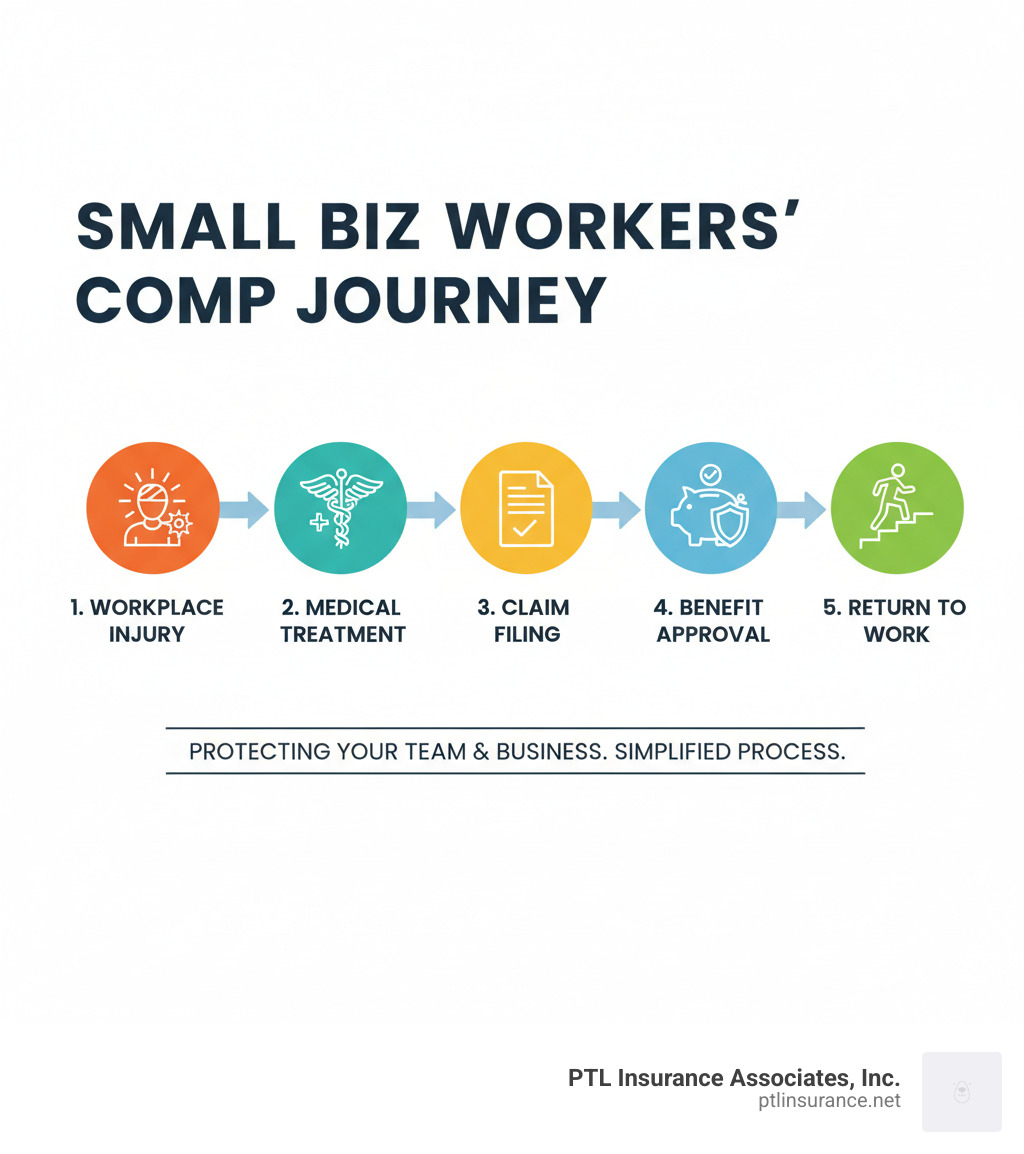
The “grand bargain” benefits both sides: employees get guaranteed benefits and quick care; employers gain a strong lawsuit shield. Without it, a single injury could result in six-figure costs. Learn how this works alongside other coverages: General Liability and Workers Comp Insurance.
The Dual-Benefit: Protecting Your Team and Your Business
- For employees: financial security and peace of mind—medical bills covered and a portion of wages replaced.
- For employers: legal protection and business continuity—predictable premiums instead of catastrophic expenses. See how this fits into broader protection: More info about Business Liability Insurance.
What’s Typically Covered (and What’s Not)
Generally covered when arising “out of and in the course of employment”:
- Slips, trips, and falls
- Repetitive stress injuries (e.g., carpal tunnel)
- Work-related illnesses (e.g., chemical exposure)
- Injuries from work equipment
Typically excluded:
- Injuries during the commute
- Self-inflicted harm
- Injuries from violating clear safety policies
- Incidents during a crime or fight
- Injuries while under the influence of drugs/alcohol
Navigating the Legal Maze: State Requirements
Understanding workers comp for small business owners can feel like solving a puzzle—each state sets its own rules. While coverage is required in 49 states (Texas is the exception), thresholds and penalties vary widely.
Some states mandate coverage from your very first hire; others set thresholds of three or four employees. Industries like construction often face stricter rules. For example, in Florida a general business needs coverage at four employees, but a construction business needs it with just one. For detailed guidance, you can view requirements by state.
Penalties for non-compliance can be severe: fines, stop-work orders, and even criminal charges in some jurisdictions.
Employee Classification: Full-Time, Part-Time, and Contractors
- Full-time and part-time employees generally must be covered.
- Temporary and seasonal staff usually require coverage too.
- Independent contractors are typically not covered by your policy, but misclassification can trigger back premiums, fines, and injury liability. When in doubt, get advice. See more: Business Insurance for Contractors.
State-by-State Nuances
- Florida: Coverage at four employees for most businesses; construction at one.
- California: Coverage from the first employee; penalties up to $100,000 and potential jail time.
- New York: Strict enforcement with fines and potential criminal charges.
- Texas: Optional for many private employers, but opting out removes lawsuit protections.
- Monopolistic States (OH, ND, WA, WY): Must buy from a state fund, not private insurers.
For a broader comparison, see this state-by-state comparison of workers’ comp laws.
The Financial Side of Workers’ Comp for Small Business Owners
Understanding costs helps you budget wisely. Workers’ comp premiums reflect your unique risk profile—industry, payroll, safety record, and state rates all matter. See typical expenses in our region: Business Insurance Florida Cost.
How Premiums Are Calculated
Your premium is shaped by four main factors:
| Factor | Description |
|---|---|
| Industry/Class Code | Each job has a risk-based code (see NCCI). Office work costs far less than roofing. |
| Total Payroll | Rates apply per $100 of wages. More payroll = higher base premium. |
| Claims History (E-mod) | Your safety record acts as a multiplier—good history lowers cost, bad history raises it. |
| State Regulations | Base rates and rules vary widely by state. |
Most policies are auditable. Year-end audits compare estimated to actual payroll and classifications. Keep accurate records to avoid surprises.
Smart Ways to Save on Your Premiums
- Implement a Safety Program to reduce injuries (and future premiums).
- Return-to-Work Program to bring employees back in light-duty roles sooner.
- Accurate Records & Proper Classification to prevent costly audit adjustments.
- Shop with an Independent Broker to compare carriers and pricing. Learn more: Insurance for Small Business Florida.
What is Workers’ Comp and Why Is It Crucial?
Workers comp for small business owners is the backbone of business resilience. It’s a no-fault, state-mandated system that pays for medical care and a portion of wages when employees are hurt on the job—while typically preventing employee lawsuits that could cripple your company.
Without coverage, a single claim (ER care, surgery, rehab, months off work) can exceed $50,000 and expose you to legal action. See how it complements other coverages: General Liability and Workers Comp Insurance.
The result is a win-win: your team gains peace of mind and financial support, and your business gains legal compliance, lawsuit protection, and predictable costs that support stability and growth. For broader risk protection, explore our Business Liability Insurance options.
Navigating the Legal Maze: State Requirements
Understanding workers comp for small business owners means recognizing that every state plays by different rules. Many require coverage from your first employee; others set thresholds at three or four. High-risk industries, like construction, often trigger coverage with just one worker.
The stakes are high: hefty fines, stop-work orders, and even criminal charges for non-compliance. Don’t guess—confirm your obligations here: view requirements by state.
Employee Classification: Full-Time, Part-Time, and Contractors
- If a worker is your employee, they usually must be covered—full-time, part-time, temporary, or seasonal.
- Independent contractors are generally not covered by your policy. Misclassification, however, can trigger back premiums, fines, and liability. Learn more: Business Insurance for Contractors.
State-by-State Nuances for Workers’ Comp for Small Business Owners
- Florida: Coverage for most businesses at four employees; construction at one.
- California: Mandatory from the first employee; penalties can reach $100,000 plus potential jail time.
- New York: Strict enforcement with fines and possible criminal charges.
- Texas: Optional for many private employers; opting out forfeits key lawsuit protections.
- Monopolistic States: Buy through state funds in OH, ND, WA, WY.
For details, review this state-by-state comparison of workers’ comp laws.
The Financial Side of Workers’ Comp for Small Business Owners
Workers’ comp pricing isn’t one-size-fits-all. Your premiums reflect industry risk, payroll, safety history, and state rules. Treated strategically, it’s an investment in stability. For Florida cost context, see: Business Insurance Florida Cost.
How Premiums Are Calculated
- Industry and Class Codes (via NCCI) set baseline risk by job.
- Total Payroll drives exposure (cost per $100 of wages).
- Experience Mod (Claims History) rewards safety, penalizes frequent or severe claims.
- State Regulations influence base rates and rules.
| Factor | Description |
|---|---|
| Industry/Class Code | Risk-based job codes; office roles cost far less than field trades. |
| Total Payroll | More payroll = higher exposure and premium. |
| Claims History (Experience Mod) | Good safety lowers cost; poor history increases it. |
| State Regulations | Rates/rules vary by state. |
Smart Ways to Save on Your Premiums
- Build a Safety Program with training, PPE, and maintenance.
- Use a Return-to-Work Program to reduce claim duration and cost.
- Keep accurate records and classify employees correctly to avoid audit surprises.
- Compare quotes via an independent broker for best value. More strategies: Insurance for Small Business Florida.
Frequently Asked Questions about Workers’ Comp
Do I need workers’ comp if I only have one part-time employee?
Often yes—many states require coverage from the first employee, regardless of hours. In Florida, most non-construction businesses need coverage at four employees, while construction requires it with just one. Always verify your local rule. Example: Florida requires coverage for most at four employees; construction at one.
Are business owners themselves covered by workers’ comp?
Generally, sole proprietors and partners are exempt but can opt-in. This can be smart in higher-risk fields since personal health plans often exclude work-related injuries.
Is workers’ comp the same as general liability insurance?
No. Workers’ comp protects your employees for job-related injuries/illnesses. Commercial General Liability Coverage protects you from third-party claims (e.g., a customer injury). Most small businesses need both.
Conclusion: Secure Your Business and Your Team
Workers comp for small business owners is essential: it keeps you compliant, converts unpredictable injury costs into budgetable premiums, protects you from most lawsuits, and demonstrates real care for your team.
From Miami to the rest of Florida, PTL Insurance Associates has helped entrepreneurs for over 35 years tailor coverage to their risks, employee classifications, and budgets. Whether you run a caf, boutique, or construction crew, we’ll help you get it right—without overpaying or leaving gaps.
Ready to protect your people and your business? Let us help you Find the right business insurance policy for your needs.