


Commercial excess umbrella insurance: Protect Your 2025
Why Your Business Needs Financial Protection Beyond Primary Coverage
Alt-text: A symbolic image of a large umbrella protecting a commercial building from a storm, representing commercial excess umbrella insurance.
Title: Protecting Your Business from Catastrophic Loss
Caption: Commercial umbrella insurance acts as a critical safety net when primary liability limits are exhausted.
Source: PTL Insurance Associates, Inc.
As the image above illustrates, commercial excess umbrella insurance provides an additional layer of liability protection that kicks in when your primary insurance policies reach their limits. In today’s litigious environment, where million-dollar lawsuits are increasingly common, this coverage is essential for protecting your business from a single catastrophic event.
For example, if a severe customer injury leads to a $2 million lawsuit and your general liability coverage is only $1 million, you would face $1 million in out-of-pocket costs. An umbrella policy is designed to cover that gap.
Key Coverage Benefits:
- Higher Protection Limits: Secure coverage from $1 million up to $100 million.
- Broader Coverage Scope: Protect against gaps in primary policies.
- Asset Protection: Shield business and personal assets from catastrophic claims.
- Contractual Requirements: Meet client and vendor insurance demands.
At PTL Insurance Associates, we’ve seen how businesses can underestimate their exposure. My experience helping Miami businesses has shown that this coverage is a critical tool for long-term survival and peace of mind.
Understanding Commercial Umbrella and Excess Liability
While often used interchangeably, “commercial umbrella” and “excess liability” policies have a key difference that could save your business millions. Both provide an extra layer of protection after your primary policies are exhausted, but they function in distinct ways.
What is Commercial Umbrella vs. Excess Liability?
Both policies activate when a claim exceeds the limit of an underlying policy, like Commercial General Liability Coverage.
Excess Liability (Follow-Form): This policy is straightforward. It provides higher limits but follows the exact same terms and conditions as your primary policy. It covers what your primary policy covers, just for a higher amount.
Commercial Umbrella (Broader Protection): A true umbrella policy also provides higher coverage limits to protect you in case of significant financial losses, but it can also offer drop-down coverage. This means it may cover claims that are excluded by your primary policies, filling critical gaps in your protection. For example, it might cover a libel claim that your general liability policy does not.
Primary vs. Umbrella/Excess Insurance
Your primary insurance is your first line of defense for common claims. Umbrella or excess insurance is the secondary layer for catastrophic events. The infographic below illustrates how this layered protection works.
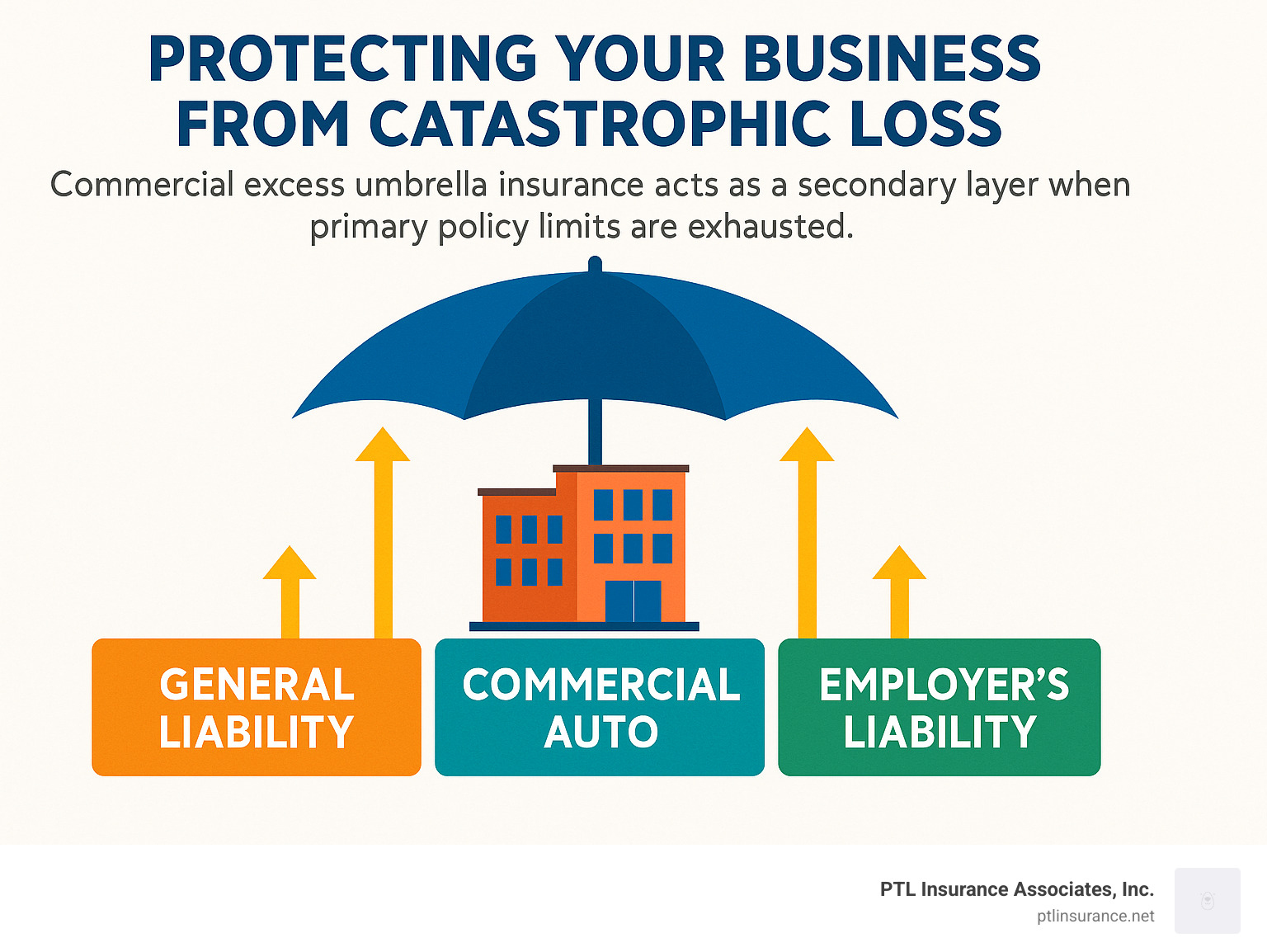
This structure allows you to have cost-effective primary coverage for everyday risks while securing high-limit protection for worst-case scenarios.
| Feature | Primary Liability Insurance | Umbrella/Excess Liability Insurance |
|---|---|---|
| Purpose | First line of defense against common business risks | Secondary layer of protection; covers claims exceeding primary limits |
| Coverage Scope | Specific types of liability (e.g., general liability, auto liability, employer’s liability) | Broadens (umbrella) or extends (excess) coverage across multiple underlying policies |
| Activation | Triggers immediately upon a covered incident | Triggers only after the underlying primary policy’s limit is exhausted |
| Typical Limits | Lower, designed for routine claims (e.g., $1M per occurrence) | Significantly higher, designed for catastrophic claims (e.g., $1M up to $100M+) |
An umbrella policy activates only after your primary policy limit is exhausted, bringing significantly higher limits to the table. While your general liability might max out at $1 million, your umbrella could provide an additional $5 million, $10 million, or more.
Who Needs This Coverage and What Risks Does It Cover?
It’s not just large corporations that need this protection. Any business can face a lawsuit that exhausts its primary insurance limits. Understanding your specific risk profile is key to determining your need for commercial excess umbrella insurance.
High-Risk Industries and Business Profiles
Certain businesses have a higher exposure to major liability claims and should consider this coverage essential.
- Businesses with public access: Restaurants, retail stores, and hotels face constant premises liability risk. A single serious slip-and-fall can easily exceed a standard Commercial General Liability Coverage policy.
- Companies with vehicle fleets: Delivery, construction, or transportation businesses have significant auto liability exposure. A major accident, especially in busy Miami traffic, can be financially devastating. Adding umbrella coverage to your Commercial Insurance for Trucks in Miami is a smart move.
- Businesses with contractual requirements: Many large clients and government contracts require liability limits of $2 million, $5 million, or more. An umbrella policy is the most efficient way to meet these demands.
Industries that benefit most include: Construction, Manufacturing, Hospitality, Retail, Trucking, and Real Estate.
Catastrophic Risks Covered by Commercial Excess Umbrella Insurance
This insurance is designed for business-altering events that your primary policies can’t fully cover. Key risks include:
- Severe Bodily Injury: Claims involving catastrophic injuries (e.g., spinal cord damage, traumatic brain injury) can result in multi-million-dollar settlements.
- Major Auto Accidents: A single accident with multiple injuries or fatalities can generate claims that far exceed commercial auto limits.
- Significant Property Damage: Your operations could cause extensive damage to another party’s valuable property, such as a neighboring building.
- Product Liability: A defect in your product could cause widespread harm, leading to class-action lawsuits.
- Libel and Slander: A negative review response or social media post could lead to a costly defamation lawsuit.
- Legal Defense Costs: Defending against a major lawsuit can cost hundreds of thousands. Many umbrella policies cover these costs in addition to the policy limit, preserving your coverage for the settlement itself.
How Commercial Excess Umbrella Insurance Policies are Structured
Understanding a policy’s key components is crucial for ensuring you have the right protection for your specific risks.
Key Benefits and Coverage Limits
Beyond just higher limits, this coverage offers strategic benefits that provide peace of mind.
- Asset Protection: Shields your business and personal assets from being seized to satisfy a large judgment.
- Meeting Contract Demands: Efficiently meets the high liability limits required by many large clients and contracts.
- Coverage for Defense Costs: Many policies cover expensive legal fees in addition to the policy limit, preserving your coverage for settlements.
- Broader Coverage: A true umbrella policy can fill gaps left by your primary policies.
Coverage limits typically start at $1 million and can go up to $100 million or more. Policies also include a Self-Insured Retention (SIR), which is like a deductible for claims covered by the umbrella but not by a primary policy.
Factors That Influence Your Premium
The cost of commercial excess umbrella insurance is surprisingly affordable relative to the protection it provides. Premiums are influenced by:
- Industry and Risk Profile: Higher-risk industries like construction or trucking generally have higher premiums.
- Desired Coverage Limit: Higher limits cost more, but the price per million of coverage often decreases as the limit increases.
- Underlying Policy Limits: Insurers require minimum limits on your primary policies.
- Claims History: A clean record can help keep costs down.
- Business Operations: Your number of employees, vehicle usage, and specific services all affect your risk.
- Location: Litigation trends in your area, like Miami, can impact rates.
To see what your premium might be, it’s best to Get a Commercial Insurance Quote custom to your business.
Common Exclusions in a Commercial Excess Umbrella Insurance Policy
Umbrella policies are broad but don’t cover everything. Common exclusions require separate, specialized policies.
- Professional Liability (E&O): Claims of professional negligence or mistakes.
- Workers’ Compensation: Injuries to your own employees on the job.
- Damage to Your Own Property: This is covered by commercial property insurance.
- Intentional or Criminal Acts: Deliberate wrongdoing is not covered.
- Pollution Liability: Environmental cleanup and contamination claims.
- Punitive Damages: Depending on state law (including in Florida), these may be uninsurable.
Always review your policy with an agent to understand what is and isn’t covered.
Navigating the Coverage and Claims Process
Knowing how to choose the right limit and what happens during a claim are practical steps to effectively managing your commercial excess umbrella insurance.
How to Determine Your Ideal Coverage Amount
Choosing the right coverage amount is a critical decision that requires a careful assessment of your business. Key factors to consider include:
- Risk Assessment: What is the worst-case scenario your business could realistically face?
- Asset Evaluation: What are the total assets you need to protect, including property, cash reserves, and future earnings?
- Contractual Obligations: Do your client contracts require specific, high liability limits?
- Industry Benchmarks: What level of coverage do similar businesses in your industry carry?
- Future Growth: Will your risk exposure increase as your business expands?
Working with an agent who understands the local market can help you select the right limit. Our expertise in Florida Business Insurance ensures your coverage is custom to the state’s unique legal and risk environment.
The Claims Process Explained
The claims process is designed to be a seamless transition from your primary to your umbrella coverage.
- Incident Occurs: A major event happens, like a severe customer injury or a multi-vehicle accident.
- Primary Claim is Filed: A claim is filed against your relevant primary policy (e.g., General Liability or Commercial Auto). Your primary insurer manages the initial investigation and defense.
- Primary Limit is Exhausted: The costs of the claim (settlement, judgment, and legal fees) exceed your primary policy’s limit.
- Umbrella Policy is Triggered: Upon notification, the umbrella policy activates to cover the remaining costs, up to its own limit.
Promptly notifying both your primary and umbrella insurers of any significant incident is crucial to ensure a smooth process. The insurers coordinate to provide the protection you need, giving you peace of mind during a stressful time.
Frequently Asked Questions
Here are answers to the most common questions we hear from Miami business owners about commercial excess umbrella insurance.
What is the main difference between a “true umbrella” and a “follow-form excess” policy?
This is a critical distinction. A follow-form excess policy simply provides higher limits for the exact same coverages and conditions as your underlying policy. It extends your coverage but doesn’t expand it.
A true umbrella policy also provides higher limits but can “drop down” to cover claims that are not included in your primary policies. This feature broadens your protection, covering gaps your other policies might have, after a self-insured retention (SIR) is met.
Can I get a commercial umbrella policy without having primary liability insurance?
No. Commercial excess umbrella insurance is designed to sit on top of a solid foundation of primary liability policies, like Commercial General Liability and Commercial Auto. Insurers require you to have and maintain specific minimum limits on these underlying policies before they will issue an umbrella. This layered approach is more cost-effective and ensures routine claims are handled by primary coverage, reserving the umbrella for catastrophic events.
Are legal defense costs typically included in the policy limit?
It depends on the policy, and it’s a crucial detail. Many commercial excess umbrella insurance policies provide defense costs in addition to the policy limit. This is the preferred structure, as it means your legal fees won’t deplete the funds available for a settlement. Some policies include defense costs within the limit, which reduces your total protection. We always recommend looking for policies where defense costs are covered outside the limit for more robust protection.
Secure Your Business’s Future Today
In a world of multi-million-dollar lawsuits, a single catastrophic claim can erase years of hard work. Commercial excess umbrella insurance is no longer an optional extra; it’s an essential shield for any serious business owner. This coverage is the ultimate safety net, changing a potentially business-ending event into a manageable one.
Protecting your assets provides more than just financial security—it provides peace of mind. At PTL Insurance Associates, Inc., we’ve spent over 35 years helping Miami businesses build robust risk management plans. We know that proactive protection is an investment in your company’s long-term stability and success.
Insurance can be complex, but you don’t have to steer it alone. As independent agents, we simplify the process, helping you find the right coverage with no surprises. Don’t wait for a disaster to find a gap in your protection.
Contact us to review your business insurance needs. We’re here to help you build a resilient foundation for your business.

