


Rental Insurance for Apartments: Essential 2025 Guide
Your First Line of Defense as a Renter
Rental insurance for apartments is a safety net that protects your belongings, covers liability if someone gets hurt in your home, and helps pay for temporary housing if your apartment becomes unlivable. While your landlord’s insurance covers the building, it won’t replace your TV, laptop, or clothes if they’re stolen or damaged. The image above captures the sense of home and security that a good policy helps protect.
Quick Answer for Apartment Renters:
- What it covers: Personal belongings, liability protection, temporary living expenses
- Average cost: $12-15 per month (less than $1 per day)
- Required by: Most landlords (not by law, but in lease agreements)
- Key benefit: Financial protection for incidents your landlord’s policy won’t cover
Think your stuff isn’t worth insuring? You might be surprised. As one insurance expert puts it: “The scenario of having to buy all your stuff all over again if it were lost” shows why even renters with modest belongings need coverage.
Many renters believe common myths like “renters insurance is expensive” or “the landlord’s policy covers me.” The truth is simpler: your landlord’s insurance protects the building, not your belongings or liability. A basic renters policy costs about the same as a fancy coffee each month but provides thousands of dollars in protection.
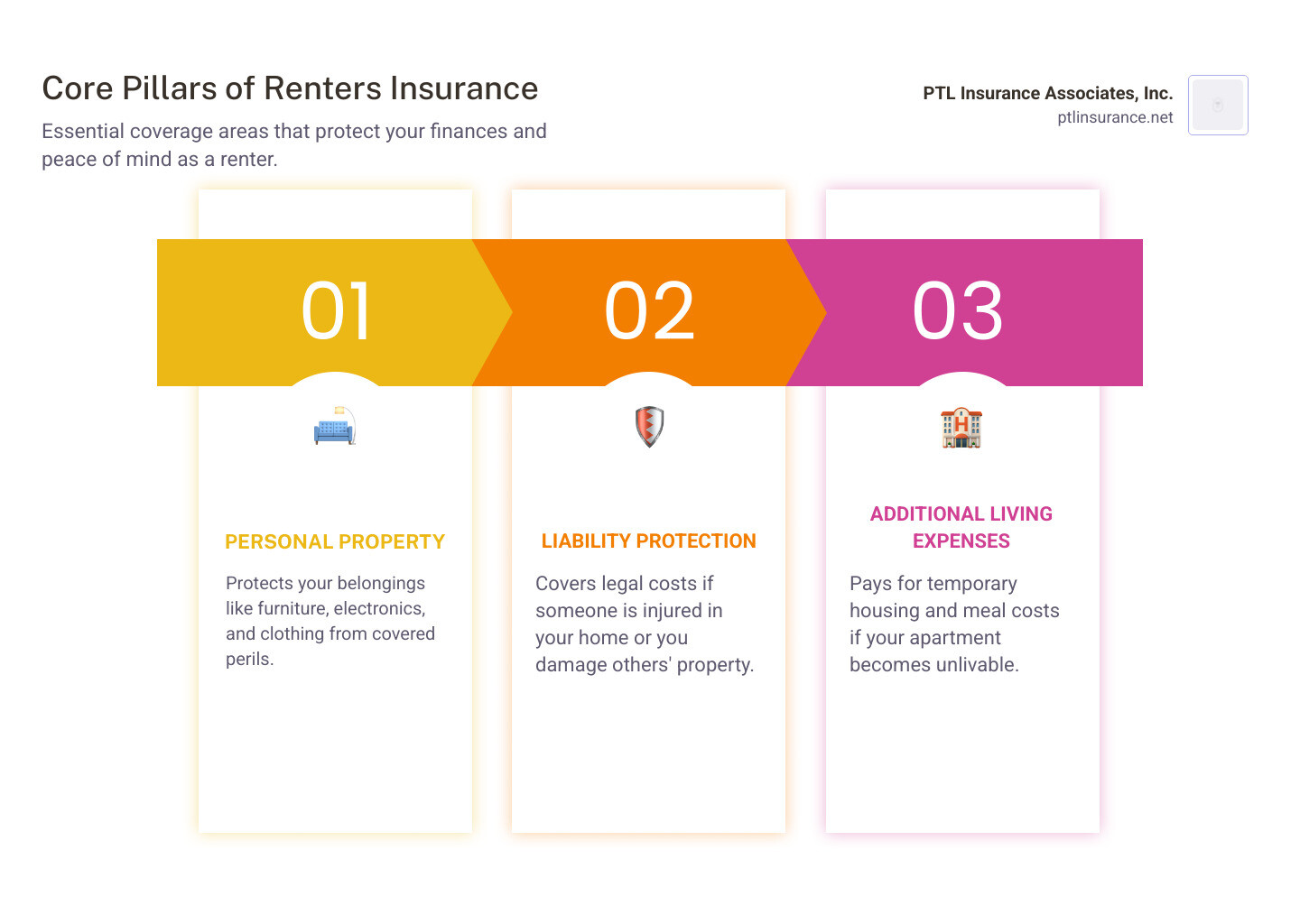
The three core areas renters insurance covers are:
- Personal Property – Your furniture, electronics, clothes, and other belongings
- Liability Protection – Legal costs if someone gets hurt in your apartment or you damage others’ property
- Additional Living Expenses – Hotel and meal costs if your apartment becomes temporarily unlivable
I’m Niki Perez, and with years in Real Estate Management, I’ve helped countless renters understand why rental insurance for apartments is essential, not optional. At PTL Insurance, we’ve seen how a simple policy saves renters thousands when the unexpected happens.
Decoding Your Coverage: What Renters Insurance Protects
Think of rental insurance for apartments as your personal safety net. The standard policy (called an HO-4) protects you from life’s unexpected curveballs – whether it’s a kitchen fire or someone breaking into your home while you’re at work.
A standard policy is built on three core pillars of protection, as visualized in the infographic below.
Personal Property Protection
Your personal belongings tell your story. That vintage guitar, your grandmother’s quilt, the laptop where you stored years of photos – these items have both financial and emotional value. Personal property coverage steps in when disaster strikes.
This protection covers your furniture, electronics, and clothing against covered perils. We’re talking about fire damage, water damage from internal sources (like a burst pipe), vandalism, and theft. What makes this coverage even better? It doesn’t stop at your front door.
Off-premises coverage means your belongings are protected even when they’re not at home. If someone breaks into your car and steals your work laptop, or your suitcase gets stolen while traveling, your renters policy can still help cover the loss. It’s like having a security blanket that follows you around.
For those living in condos, the coverage works similarly but with some key differences. More info about Condo Insurance Coverage can help you understand those nuances.
Liability and Medical Payments
Here’s where rental insurance for apartments really proves its worth. Life happens, and sometimes you’re accidentally responsible when it does.
Picture this: your friend trips over your yoga mat and breaks their wrist. Or your dog gets excited and knocks over your neighbor’s expensive pottery. Guest injuries and accidental damage to others’ property can lead to costly medical bills and repair costs – not to mention potential legal fees if things get complicated.
Your liability coverage handles these situations, including medical payments to others for minor injuries. This is completely different from liability-only policies that some landlords offer, which only protect the building owner. Your renters policy protects you from personal liability.
The peace of mind is invaluable, letting you host friends without worrying about “what if” scenarios. For property owners dealing with rental liability, More info about Business Liability Insurance for Rental Property provides additional insights.
Additional Living Expenses (Loss of Use)
When your apartment becomes uninhabitable due to a covered loss, where do you go? This coverage answers that question.
If a fire, burst pipe, or other covered event forces you out of your home, additional living expenses coverage kicks in. It helps pay for temporary housing like hotel bills, increased costs for restaurant meals (since you can’t cook at home), and other relocation costs you wouldn’t normally have.
The key word here is “additional.” This coverage pays for costs above your normal living expenses. So if you usually spend $400 monthly on groceries but now need to eat out, it covers that difference. It’s designed to maintain your standard of living while your apartment gets repaired.
What’s Typically Not Covered
Even the best rental insurance for apartments has its limits. Understanding what’s not covered helps you make informed decisions about additional protection.
Your policy won’t cover the building structure – that’s your landlord’s responsibility. Floods and earthquakes require separate policies, and standard renters insurance excludes these natural disasters. If you live in a flood-prone area, Learn about flood coverage from the National Flood Insurance Program (NFIP).
High-value items like expensive jewelry or art often have coverage limits. If your engagement ring is worth $10,000 but your policy only covers $2,500 for jewelry, you’ll need additional coverage. Pet damage to your property is another common exclusion – if your cat destroys your couch, you’re typically on your own for replacement costs.
The good news is that most of these gaps can be filled with additional coverage options, which we’ll discuss next.
The True Cost: Breaking Down Premiums for Rental Insurance for Apartments
Here’s something that might surprise you: rental insurance for apartments costs way less than most people think. We’ve had clients walk into our Miami office convinced they can’t afford coverage, only to find it costs less than their daily coffee habit.
How Much Does Renters Insurance Typically Cost?
Let’s put those “too expensive” worries to rest. The average rental insurance for apartments runs about $12-$15 per month – that’s less than a dollar a day for solid protection. Some of our clients pay as little as $5 monthly for basic coverage.
Think about it this way: you probably spend more on streaming services or that fancy coffee you grab on your way to work. Yet for the same amount, you’re getting thousands of dollars in coverage that could save you from financial disaster.
The numbers speak for themselves. According to national statistics, most renters get around $34,000 in coverage limits for about $13 monthly. When you consider the alternative – replacing everything you own out of pocket – the value becomes crystal clear.
If you’re curious about local pricing, we’ve put together detailed information about How Much Is Renters Insurance in Miami? that might help you understand what to expect in our area.
Key Factors That Influence Your Premium
Your exact premium won’t be identical to your neighbor’s for several reasons. Your ZIP code plays a big role, as areas with higher crime or weather risks typically see higher premiums.
How much coverage you choose matters too. Want to insure $50,000 worth of belongings instead of $25,000? Your premium will reflect that. The same goes for liability limits – higher protection costs a bit more.
Your deductible choice gives you some control over costs. Pick a higher deductible (what you pay before insurance kicks in), and you’ll see a lower monthly premium. Just make sure you can comfortably afford that deductible if you need to file a claim.
Building safety features can work in your favor. If your apartment complex has sprinkler systems, burglar alarms, or other protective measures, insurers often reward that with lower rates. Even simple things like deadbolts can earn you a discount.
Some insurers also consider your claims history and, in certain states, your credit score when calculating premiums. It’s their way of assessing risk, though these factors typically have less impact than location and coverage amounts.
Common Discounts to Lower Your Rate
Here’s where things get exciting for your wallet. The biggest money-saver we see is bundling with auto insurance. Many of our clients save significant amounts – sometimes hundreds per year – just by combining their renters and auto policies with the same company.
Security systems can trim your costs too. Whether it’s your building’s central alarm system or smoke detectors and fire alarms in your unit, insurers appreciate anything that reduces their risk. Sprinkler systems are especially valuable for discounts.
If you’ve been claims-free, some insurers will reward your careful living with lower rates. And here’s a simple one: paying your annual premium upfront instead of monthly often earns you a small discount while saving you from processing fees.
The key is to ask about every available discount. At PTL Insurance, we make sure our clients know about every money-saving opportunity. After 35 years in this business, we’ve learned that every dollar saved on premiums is a dollar you can spend on what matters most.
Your Step-by-Step Guide to Securing the Right Policy
Getting rental insurance for apartments doesn’t have to be complicated. Our goal at PTL Insurance is to make the process as straightforward as possible, guiding you to the perfect policy for your unique needs.
Step 1: Estimate the Value of Your Personal Property
This is a crucial step. Most people underestimate their belongings’ value until they have to replace everything at once. Take a few minutes to create a home inventory—it doesn’t have to be a chore.
- Make a List: Go room by room, listing your furniture, electronics (TVs, laptops, phones), clothing, kitchenware, and other valuables.
- Take Photos or Videos: Snap pictures or record a video of your items. This visual proof is invaluable if you ever need to file a claim.
- Use Apps or Spreadsheets: Many insurance companies offer personal property calculators or tools in their mobile apps to help you categorize and estimate values. A simple spreadsheet works wonders too.
- Keep Receipts: For high-value items, keep receipts, as they can help prove ownership and original cost.
Why is this so important? Underinsuring your property means you might not have enough coverage to replace everything after a major loss, leaving you to pay out of pocket.
Step 2: Gather Information for a Quote
Once you have a good grasp of your personal property’s value, getting a quote for rental insurance for apartments is quick and easy. You’ll typically need to provide:
- Your Personal Information: Your name, date of birth, and contact details.
- Rental Address: The full address of your apartment.
- Building Type: Information about the type of building (e.g., apartment complex, duplex, condo).
- Safety Features: Details on any safety measures in your building, like fire alarms, sprinkler systems, or security personnel.
- Desired Coverage Limits: Based on your personal property inventory, you’ll decide how much coverage you need for your belongings and for liability.
For a head start, you can always explore Home Rental Insurance Quotes to see what options are available.
Step 3: Understand Key Policy Choices for your rental insurance for apartments
As you compare quotes, you’ll encounter a couple of important terms:
- Replacement Cost (RC) vs. Actual Cash Value (ACV):
- Actual Cash Value (ACV): This coverage reimburses you for the depreciated value of your items. Think of it like buying a used item – it’s worth less than its original purchase price.
- Replacement Cost (RC): This is generally preferred. It pays the amount needed to replace your damaged or stolen items at current market prices, without deducting for depreciation. While it might have a slightly higher premium, it offers better financial protection.
| Feature | Replacement Cost (RC) | Actual Cash Value (ACV) |
|---|---|---|
| Payout Basis | Cost to replace with new, similar item | Original cost minus depreciation |
| Premium | Generally higher | Generally lower |
| Financial Benefit | Full replacement value, less out-of-pocket cost | Depreciated value, more out-of-pocket cost |
| Best For | Most renters who want to fully replace their items | Renters on a tight budget, or with older items |
- Choosing a Deductible: This is the amount you pay out of pocket before your insurance coverage begins. Common deductibles range from $500 to $2,500. A higher deductible usually means a lower premium, but be sure you can comfortably afford your chosen deductible if you need to file a claim.
- Endorsements for High-Value Items: If you have special items like expensive jewelry, fine art, or musical instruments that exceed standard policy limits, we can add an “Extra Coverage” or “Scheduled Personal Property” endorsement. This provides improved, often deductible-free, protection for those specific valuables.
Step 4: Adding Roommates and Interested Parties
Navigating renters insurance with roommates can be tricky, but we can simplify it:
- Roommate Coverage: Some providers allow roommates on a single policy, but it’s important to clarify coverage. A policy typically covers the named insured and their resident relatives. Non-related roommates usually need to be specifically listed or purchase their own separate policy. In many cases, it’s simpler for each non-related roommate to have their own policy to ensure their belongings are covered in all scenarios.
- Adding an “Interested Party”: Your landlord or property management company may require proof of insurance and ask to be listed as an “interested party” or “additional insured” on your policy. This means they’ll be notified if your policy is canceled or lapses, ensuring they always know you have coverage. Adding them is usually a straightforward process through your insurer’s app or website.
After You’re Covered: Managing Your Policy and Filing Claims
Getting your rental insurance for apartments is just the beginning. Its real value shows when you need it or when life changes require policy adjustments. At PTL Insurance, we’ve guided countless clients through both scenarios and are here to ensure you know what to expect.
How to File a Claim
Nobody wants to file a claim, but when disaster strikes, knowing the process can save you stress and time. Filing a claim for your rental insurance for apartments is more straightforward than most people think, especially when you’re prepared.
Contact your insurer immediately after finding damage or theft. Don’t wait – most insurers have 24/7 claim reporting through their mobile apps, online portals, or phone lines. The sooner you report, the faster the process begins.
Document everything thoroughly. This is where that home inventory we talked about earlier becomes your best friend. Take photos and videos of all damage from multiple angles. Create a detailed list of damaged or stolen items, including their approximate age and original cost. The more evidence you provide, the smoother your claim will go.
Gather receipts and proof of ownership for valuable items when possible. While you don’t need receipts for every single item, having them for electronics, furniture, or expensive clothing can speed up the valuation process significantly.
Cooperate fully with the adjuster your insurance company assigns. They’re not there to deny your claim; they’re there to help determine the extent of damage and appropriate compensation. Be honest, thorough, and responsive to their requests for information.
Understand what to expect during the process. Your insurer will review your claim, verify coverage, and calculate your payout based on your policy terms. If you chose replacement cost coverage, you’ll receive enough to buy new items. If you have actual cash value coverage, you’ll get the depreciated value. Either way, you’ll pay your deductible first.
Modern technology has revolutionized claims processing. Some insurers can now process simple claims in minutes rather than weeks, getting you back on your feet faster than ever.
Switching and Bundling Policies
Your insurance needs aren’t set in stone. As your life changes, your rental insurance for apartments should adapt too. Whether you’re moving, acquiring more valuable belongings, or finding better rates elsewhere, adjusting your coverage is easier than you might think.
Switching providers mid-term is surprisingly simple. If you find better coverage or rates with another company, your new insurer typically handles the transition. They’ll coordinate with your previous provider to cancel your old policy and ensure there’s no gap in coverage. Any unused premium from your cancelled policy usually gets refunded to you.
The benefits of bundling with auto insurance cannot be overstated. We’ve seen clients save hundreds of dollars annually by combining their renters and auto policies with the same provider. Beyond immediate savings, bundling creates streamlined management. You’ll have one company to deal with, one renewal date, and often one agent to call for all your insurance needs.
Bundling also tends to improve your overall customer experience. Insurance companies value multi-policy customers and often provide better service and more flexible payment options.
Life changes like getting married, moving, or acquiring expensive items might also trigger the need for policy adjustments. Regular reviews ensure your coverage keeps pace with your evolving needs.
If you’re ready to explore your options and compare what’s available, we encourage you to Find the Best Renters Insurance that fits your specific situation. At PTL Insurance, we’re here to help you steer these decisions with personalized guidance every step of the way.
Frequently Asked Questions About Rental Insurance for Apartments
After helping renters in Miami for over 35 years, we’ve heard just about every question imaginable about rental insurance for apartments. Let me share the answers to the ones that come up most often in our conversations.
Is renters insurance required by law or by landlords?
Here’s something that surprises many people: renters insurance isn’t required by any state law in the United States. You won’t get a ticket or face legal penalties for not having it. However, your landlord or property management company can absolutely require it as part of your lease agreement – and most do these days.
Why do landlords care so much about your insurance? It’s actually pretty smart business on their part. While their own insurance covers the building structure, they need protection from tenant-related incidents. If you accidentally start a kitchen fire that damages multiple units, or if your guest slips and falls in your apartment, your rental insurance for apartments steps in to handle those costs. This keeps landlords from having to chase you down for potentially thousands of dollars in damages.
Most landlords will ask you to provide proof of insurance – usually just a copy of your declarations page – before you get your keys. It’s become as standard as providing a security deposit.
Does renters insurance cover pets or pet-related damage?
This is where things get a bit nuanced, and the answer depends on what type of damage we’re talking about.
The good news is that most rental insurance for apartments policies do include liability coverage for your furry friends. If your dog bites someone or your cat somehow damages a neighbor’s expensive furniture, your liability coverage typically kicks in to handle medical bills and repair costs. However, some insurance companies exclude certain dog breeds they consider higher risk, so it’s worth checking your specific policy.
The not-so-good news? Your renters insurance generally won’t cover damage your pet causes to your own apartment or belongings. If your puppy decides to redecorate your couch with his teeth, or your cat uses your walls as a scratching post, that’s coming out of your own pocket. For your pet’s health issues or injuries, you’d need separate pet insurance.
Can renters insurance cover items stolen outside of my home?
This is one of my favorite features to explain because it often comes as such a pleasant surprise to renters. Yes, your rental insurance for apartments can absolutely cover items stolen outside your home through what’s called “off-premises coverage.”
Your belongings are protected whether they’re in your apartment, your car, a storage unit, or even halfway around the world. I’ve helped clients file successful claims for laptops stolen from their cars, cameras damaged while traveling, and even belongings lost in a hotel fire during vacation.
The coverage is quite broad, but there are some important details to understand. Policy limits may apply to off-premises theft, meaning you might have lower coverage limits for items outside your home compared to inside it. Also, the same covered perils apply – so while theft and fire damage are typically covered, flood damage to items in storage usually isn’t unless you have separate flood coverage.
This off-premises protection is just another reason why rental insurance for apartments offers such incredible value for such a small monthly cost.
Conclusion: Protect Your Peace of Mind Today
In the whirlwind of apartment living, it’s tempting to put off insurance. But rental insurance for apartments isn’t boring when you realize it’s your financial superhero in disguise.
For less than a weekly latte run, you’re protecting thousands of dollars worth of belongings and shielding yourself from liability claims that could seriously hurt your wallet. That’s not just smart—it’s essential.
Don’t wait for disaster to knock on your door. We’ve all heard the stories—the neighbor’s kitchen fire that spread, the burst pipe that flooded three units, or the break-in that happened in a “safe neighborhood.” These things don’t send a warning before they happen.
At PTL Insurance Associates, Inc., we’ve been helping Miami renters sleep better at night for over 35 years. We know every renter’s situation is unique—from a college student with basic furniture to a professional working from home with expensive equipment. That’s why we don’t believe in one-size-fits-all solutions.
Our team takes the time to understand your specific needs, walking you through coverage options that make sense for your lifestyle and budget. We’re not here to sell you the most expensive policy; we’re here to find the right one that gives you genuine peace of mind.
Ready to protect what matters most? Let’s have a conversation about your rental insurance for apartments needs. While our specialty includes comprehensive coverage solutions, we’re always here to help you understand your options and find the perfect fit.
Your future self will thank you for taking this step today.

