


College student renters insurance: Smart 2025 Protection
Your College Life Starter Pack: Essential Protection for Florida Students
Protecting your essential college gear, like the laptop and textbooks shown above, is easier and more affordable than you think.
College student renters insurance protects your belongings and finances while you’re away at school. Here’s what every college kid needs to know:
Key Benefits:
- Personal Property Coverage – Protects laptops, phones, textbooks, and furniture from theft or damage
- Personal Liability Protection – Covers accidents that happen in your apartment or dorm
- Additional Living Expenses – Pays for temporary housing if your place becomes uninhabitable
- Average Cost – Just $15-30 per month for comprehensive coverage
Heading off to college means packing up your life into boxes – your expensive laptop, new textbooks, gaming console, and all the furniture that’ll make your dorm or apartment feel like home. With all that new freedom comes unexpected risks you’ve never had to think about before.
College campuses are hotspots for theft. Burglaries and theft make up 44% of all criminal activities on college campuses, and students spend over $1,200 annually just on textbooks alone. When you factor in electronics, furniture, and personal items, you’re looking at thousands of dollars worth of belongings that could vanish in an instant.
Your parents’ homeowners policy might offer some protection, but it’s often limited to just 10% of their total coverage for items stored away from home. That means if they have $100,000 in personal property coverage, you might only get $10,000 – and that comes with their higher deductible, often $500 or more.
Florida college students face unique considerations too. From hurricane season to high crime rates in certain college towns, the Sunshine State presents specific risks that make proper coverage even more important.
I’m Niki Perez, and after years in real estate management and now working alongside my husband Erik at PTL Insurance, I’ve helped countless Florida families steer college student renters insurance decisions. Understanding your coverage options before you need them can save you thousands of dollars and significant stress down the road.
Quick look at college student renters insurance:
Why Every Florida College Student Needs Renters Insurance
Picture this: you’ve just finished a late-night study session at the library, and you return to your dorm to find your door ajar and your laptop missing. That $1,200 MacBook you saved up for all summer? Gone. Your textbooks worth $400? Also vanished. Without college student renters insurance, you’re looking at thousands of dollars in losses that you’ll have to replace out of your own pocket.
This scenario isn’t as rare as you might think. Burglaries and theft make up 44% of all criminal activities on college campuses, making students prime targets for criminals who know dorms and apartments are filled with expensive electronics. Your laptop, smartphone, gaming console, and even that pile of textbooks represent serious money – often more than many students realize.
Here’s what many students don’t understand: your landlord’s insurance policy only covers the building itself, not your stuff inside it. If a fire destroys your apartment or someone breaks in and steals your belongings, your landlord’s policy won’t pay you a dime. They’re protecting their investment in the property – you need to protect yours in your possessions.
The same goes for universities. While they provide security measures, they’re generally not responsible for replacing personal belongings stolen from dorm rooms. You sign agreements acknowledging this when you move in, but most students don’t think about what it really means until it’s too late.
The financial impact of being uninsured can be crushing. Recent surveys show that 36% of students cannot afford to replace their belongings without renters insurance. When you’re already juggling tuition, books, and living expenses, an unexpected loss of thousands of dollars worth of electronics and personal items can derail your entire semester.
Florida students face some unique challenges too. Hurricane season brings risks of wind and water damage that can destroy everything in your apartment. High crime rates in certain college towns mean theft risks vary significantly depending on whether you’re studying in Miami, Tallahassee, or Gainesville.
Some insurance companies offer specialized policies designed specifically for college students. These might include coverage for accidental damage to electronics (because let’s face it, coffee spills happen), worldwide coverage for study abroad programs, or lower deductibles that make sense for student budgets. These custom options recognize that student life comes with its own unique risks and financial realities.
What Renters Insurance Actually Covers
College student renters insurance gives you three main types of protection that work together to keep you financially safe. As the infographic below illustrates, these core coverages are Personal Property, Personal Liability, and Additional Living Expenses.
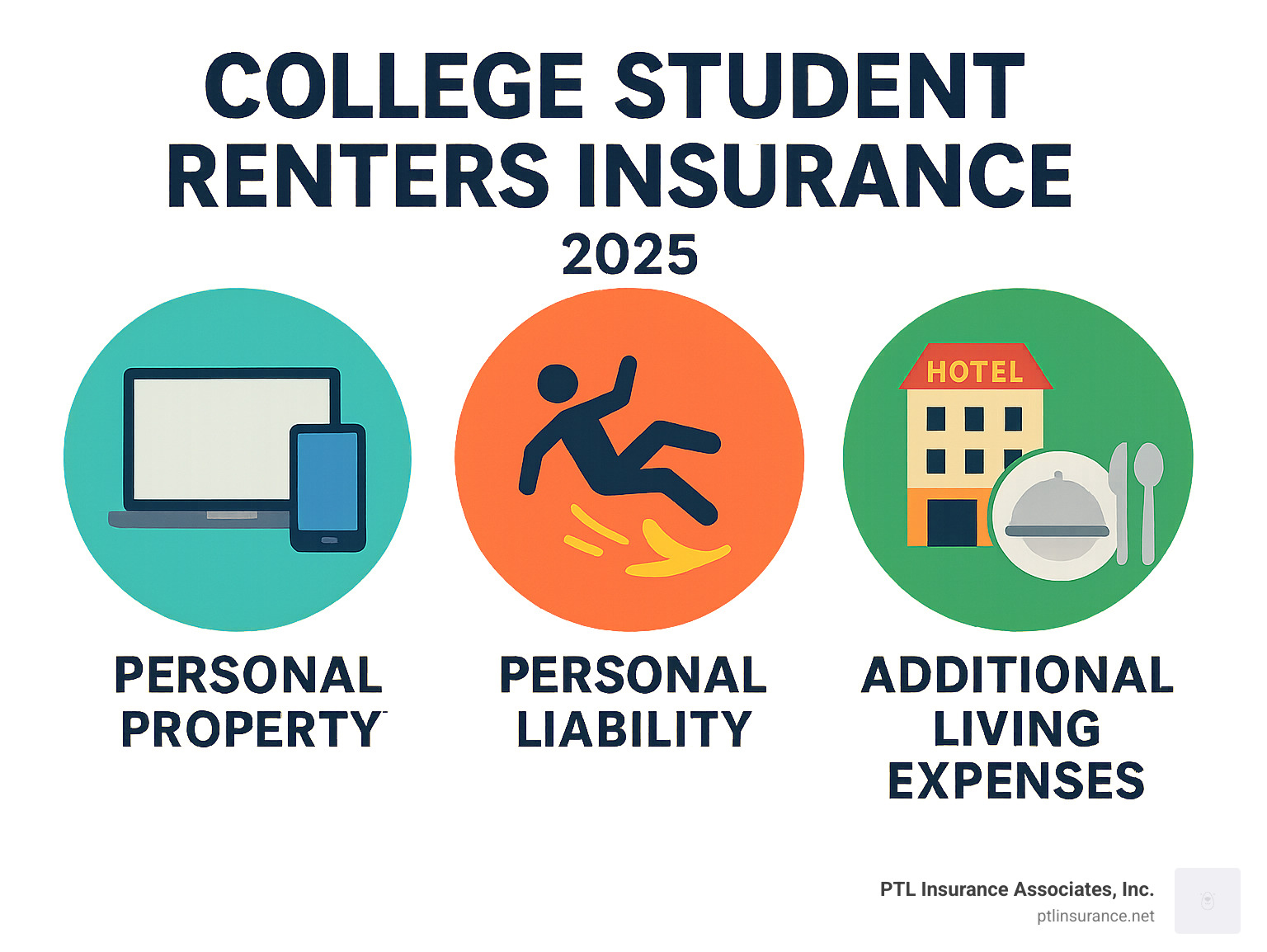
This infographic breaks down the three key protections of renters insurance: coverage for your belongings, liability for accidents, and funds for temporary housing.
Personal property coverage is your financial safety net when your belongings get damaged or stolen. This protection extends far beyond your dorm or apartment walls – if someone steals your backpack from a coffee shop or your bike from campus, you’re still covered. The most common covered items for students include laptops, smartphones, textbooks, bicycles, gaming systems, and furniture.
Fire damage from cooking accidents, water damage from burst pipes, and theft are the big ones students deal with most often. Florida students also get protection from windstorm damage – crucial during hurricane season when high winds can shatter windows and destroy everything inside.
Personal liability coverage protects you when accidents happen and someone gets hurt or their property gets damaged because of you. If your friend slips and falls in your apartment and breaks their wrist, or if you accidentally cause a kitchen fire that damages your neighbor’s unit, this coverage handles the legal and medical costs that could otherwise bankrupt you. More info about Florida liability coverage explains why this protection is especially important in our state.
Additional living expenses coverage kicks in when your place becomes unlivable due to covered damage. If a fire forces you out of your apartment for two weeks, this coverage pays for hotel stays, restaurant meals, and other extra costs while repairs are being made. For students who might not have family nearby to stay with, this coverage can be a lifesaver.
Your policy protects these commonly covered personal items for students: Laptops, Smartphones, Textbooks, Bicycles, Gaming Systems, and Furniture. The coverage follows you around campus and even off-campus, so you’re protected whether you’re studying in the library, at a coffee shop, or back home during breaks.
It’s important to know what’s typically not covered though. Your car needs separate auto insurance, flood damage requires special flood insurance, and expensive jewelry or cash might have low limits unless you add special coverage for them.
Parents’ Policy vs. Your Own: Decoding Your Coverage
The question of whether you need your own college student renters insurance or can rely on your parents’ homeowners policy is one of the most confusing aspects of college insurance planning.
If you’re living in on-campus dorms, your parents’ homeowners policy might provide some coverage through what’s called “off-premises coverage.” This typically covers about 10% of their total personal property limit. So if your parents have $100,000 in personal property coverage, you might get $10,000 for your dorm room belongings.
But here’s where it gets tricky. Most homeowners policies have high deductibles – often $500 to $1,000 or more. If your $800 laptop gets stolen, you’d pay the full deductible before seeing any money from the claim. Plus, any claim filed under your parents’ policy could affect their premiums and claims history, even though it was for your stuff.
Off-campus apartments change everything. The limited coverage from your parents’ policy rarely meets the requirements that most landlords have, and you’re typically responsible for much more property and liability risk. Many landlords actually require tenants to carry their own renters insurance as part of the lease agreement.
Roommate situations add another layer of complexity. Your renters insurance only covers your belongings and your liability – not your roommates’. Each roommate needs their own policy to be fully protected. Sharing a policy might seem cheaper, but it creates headaches when someone moves out or when you need to file a claim for shared items.
The comparison is pretty clear when you look at the numbers. A dedicated student policy gives you full coverage limits based on what you actually own, lower deductibles that make sense for smaller claims, and complete independence from your parents’ insurance record.
Do I Need Renters Insurance For College? provides additional guidance from insurance experts.
| Feature | Typical Parent’s Homeowners Policy (for student) | Dedicated Student Renters Insurance Policy |
|---|---|---|
| Personal Property Limit | Often 10% of total homeowner coverage (e.g., $10,000 for $100k policy) | Full coverage based on student’s inventory (e.g., $20,000 – $50,000+) |
| Deductible | Higher (e.g., $500 – $2,500+) | Lower (e.g., $250 – $1,000) |
| Liability Coverage | May extend, but details vary | Dedicated liability coverage for student’s living situation |
| Roommate Coverage | Generally NO (unless specifically added) | Generally NO (each roommate needs own policy) |
| Claims Impact | Can affect parent’s premium/claims history | Independent; only affects student’s record |
| Ease of Claim | May be more complex; involves parent | Simpler; student manages their own claim |
| Cost | “Free” (but hidden costs/limitations) | Affordable monthly premium |
The Real Cost of College Student Renters Insurance in Florida
Here’s the question that’s probably been on your mind: what’s this going to cost me? The good news is that college student renters insurance is surprisingly affordable – probably less than what you spend on coffee each month.
In Florida, you’re looking at an average of about $15 to $30 per month for comprehensive coverage. That’s roughly $180 to $360 per year to protect thousands of dollars worth of your belongings. When you consider that the average college student spends over $1,200 annually just on textbooks, this small monthly investment starts to look like a no-brainer.
To put this in perspective, replacing a stolen laptop could cost you $700 to $1,500. A new smartphone runs around $850. Your gaming console? Another $300 to $500. Just these three items alone could exceed $2,000 – and that’s before we even talk about your furniture, clothes, or those expensive textbooks. With 36% of students unable to afford replacing their belongings out-of-pocket, that monthly premium suddenly seems like the smartest money you’ll spend.
Several factors influence what you’ll actually pay for your college student renters insurance. Location plays a role – premiums might vary slightly between Miami and Tallahassee based on local crime rates and weather risks, though Florida generally offers some of the most affordable rates in the country.
Your coverage amount directly impacts your premium. Choosing $30,000 in personal property coverage instead of $15,000 will increase your monthly cost, but often by just a few dollars. Most students find the sweet spot between $20,000 and $50,000 in coverage.
Deductible choice is where you can really control your costs. This is the amount you’ll pay out-of-pocket before your insurance kicks in. A higher deductible means lower monthly premiums, but make sure you can comfortably afford whatever deductible you choose. For college students, deductibles typically range from $250 to $1,500, with $1,250 being the most common choice.
Here’s something many students don’t realize: you’ll want to choose between Actual Cash Value (ACV) and Replacement Cost Value (RCV) coverage. ACV pays you the depreciated value of your items – so that $1,000 laptop from two years ago might only get you $400. RCV pays what it costs to buy a brand new replacement item, which is almost always worth the slightly higher premium. Trust me, when you’re filing a claim, you’ll be grateful you chose RCV.
Don’t forget about discounts that can bring your costs down even further. If you have auto insurance, bundling it with your renters policy often saves money on both. Many insurers offer good student discounts for maintaining a solid GPA – finally, your parents’ nagging about grades pays off! Safety features like smoke detectors, deadbolt locks, or security systems can also lower your premium.
The bottom line? For the price of a couple of pizzas each month, you can protect everything you own and gain peace of mind that lets you focus on what really matters – your education.
More info about Renters Insurance Cost
More info about Car Insurance for Students with Good Grades
Calculating Your College Student Renters Insurance Needs
Figuring out how much college student renters insurance coverage you need doesn’t have to be complicated. Think of it like packing for college – you need to know what you’re bringing before you can protect it.
Creating a home inventory is your first step, and honestly, it’s easier than you might think. The simplest approach is to grab your phone and take a video inventory. Walk through your dorm room or apartment with your camera rolling, opening closets and drawers as you go. Narrate what you’re seeing – “Here’s my MacBook Pro, my PlayStation 5, my collection of textbooks.” This creates visual proof of everything you own and takes just a few minutes.
For your most valuable items, go a step further. Write down the make, model, and serial numbers of your electronics. Keep receipts for big purchases if you can – they make the claims process much smoother later on.
Estimating the value of your belongings is where many students get surprised. Your electronics alone – laptop, phone, tablet, gaming console, headphones, and chargers – can easily add up to $3,000 or more. Don’t forget about your furniture like that desk chair, mini-fridge, or coffee maker. Your clothing might seem less valuable individually, but replacing an entire wardrobe adds up quickly. And those textbooks? At $1,200 per year, they’re actually some of your most expensive possessions.
Add everything up, and most students find they need between $20,000 and $50,000 in personal property coverage. About 33% of college students choose coverage in the $20,000 to $29,000 range, but don’t just go with what’s popular – use your actual inventory to guide your decision.
For personal liability coverage, we recommend at least $100,000. This protects you if someone gets hurt in your place or if you accidentally damage someone else’s property. It might seem like a lot, but medical bills and property damage can add up fast.
When selecting your deductible, this is what you’ll pay out-of-pocket before insurance kicks in. Choose an amount you can comfortably handle – there’s no point in saving $5 a month on premiums if you can’t afford the $1,500 deductible when your laptop gets stolen.
How to Apply and File a Claim
Getting your college student renters insurance policy is refreshingly straightforward. When you’re ready to apply, you’ll need some basic information: your name and contact details, your rental address, details about your building’s age and security features, and information about any roommates.
The whole process can usually be completed online or over the phone in just a few minutes. Even if your parents are helping pay for the policy, you’ll typically be the one signing up since you’re the actual tenant.
Filing a claim, should you ever need to, is designed to be as stress-free as possible during what’s already a difficult time. Safety comes first – if there’s a fire or significant damage, follow emergency procedures before worrying about insurance.
Document everything as soon as it’s safe to do so. This is where that home inventory you created becomes invaluable. Take photos or videos of any damage. If items were stolen, make a list of what’s missing. The more documentation you have, the smoother your claim will go.
For theft, you’ll need to file a police report immediately. Your insurance company requires this documentation to process your claim. Don’t wait – do this as soon as you find the theft.
Then contact us at PTL Insurance Associates. We’ll walk you through the entire claims process, explain exactly what your coverage includes, and help you gather all the necessary paperwork. We’ve been helping Florida families steer insurance claims for over 35 years, so we know how to make this process as painless as possible.
An insurance adjuster may need to assess the damage or loss. Be cooperative and provide them with everything they request – your inventory, photos, police reports, and any receipts you have. The good news? About 56% of students who file claims have them accepted, so the system works when you need it.
Once your claim is approved, you’ll receive your payout minus your deductible. If you chose replacement cost coverage, you’ll get enough to actually replace your lost items with new ones – not just their depreciated value.
Frequently Asked Questions about Student Renters Insurance
When we talk to students and parents about college student renters insurance, we hear the same questions over and over. That tells us you’re thinking smart about protecting yourself – and we love that! Let me walk you through the answers to the most common concerns.
Does renters insurance cover my belongings if they’re stolen from my car or a coffee shop?
Here’s one of my favorite things about college student renters insurance – your stuff is protected wherever you go! Yes, your personal property coverage travels with you. Whether your laptop gets stolen from your dorm room, your backpack disappears from the library, or someone breaks into your car and takes your textbooks, you’re covered.
This “off-premises” protection means you don’t have to worry about where exactly you were when something bad happened. Your coverage follows your belongings whether you’re studying at a coffee shop, visiting friends across campus, or even traveling home for the holidays. Just remember, you’ll still need to pay your deductible, and the coverage is subject to your policy limits.
What happens if I live with roommates?
This is where things get a bit tricky, and I want to be crystal clear about this. Your college student renters insurance policy is like your personal bubble of protection – it only covers your stuff and your liability. It doesn’t automatically extend to your roommates or their belongings.
Think of it this way: if your roommate’s gaming console gets stolen, your policy won’t cover it. And if your roommate accidentally causes a kitchen fire, your policy won’t cover their liability for the damage. Each roommate needs their own individual policy to be properly protected.
I know it might seem like you could save money by sharing a policy, but trust me on this – separate policies prevent major headaches down the road. When it comes time to file a claim, you don’t want to be sorting out whose stuff is whose or dealing with complicated shared coverage. Plus, many landlords actually require each tenant to have their own policy anyway.
Are there common items that renters insurance doesn’t cover?
While college student renters insurance covers a lot more than most students realize, there are some important gaps to know about. The biggest ones that catch students off guard involve high-value jewelry and cash. Most policies have pretty low limits for expensive watches, rings, or large amounts of cash – sometimes just $200-500 total. If you brought grandma’s diamond earrings to college, you might need to add extra coverage.
Flood and earthquake damage require separate policies entirely. This is especially important here in Florida where heavy rains and hurricanes can cause serious flooding. Standard renters insurance covers water damage from things like burst pipes, but not rising floodwaters.
Your car isn’t covered either – that’s what your auto insurance is for. And just like your parents probably told you growing up, insurance doesn’t cover things that break from normal wear and tear or because you didn’t take care of them properly.
The building structure itself is also off-limits, but that’s actually good news – it means you’re not responsible if the roof leaks or the foundation cracks. That’s your landlord’s problem to fix and insure.
More info about Home and Boat Insurance
Get the Right Protection for Your College Journey
Starting college is one of life’s most exciting trips. Between choosing classes, making new friends, and adjusting to independence, it’s natural to focus on the fun stuff. But here’s the thing – taking a few minutes now to secure college student renters insurance can save you from a major financial headache later.
Think about it this way: you’re already investing thousands in your education. Why risk losing hundreds or even thousands more because your laptop got stolen or your apartment flooded? For less than what you’d spend on coffee each month, you can protect everything you own.
We’ve walked through the three essential coverages that make college student renters insurance so valuable. Personal property coverage protects your belongings whether they’re in your dorm, your car, or that coffee shop where you study. Personal liability protection has your back if someone gets hurt in your space or you accidentally damage someone else’s property. And additional living expenses coverage ensures you have somewhere to stay if your place becomes unlivable.
The numbers don’t lie – with burglaries making up 44% of campus crimes and students spending over $1,200 annually just on textbooks, you’re carrying more value than you might realize. When 36% of students can’t afford to replace their belongings out-of-pocket, that $15-30 monthly premium starts looking pretty smart.
At PTL Insurance Associates, Inc., we’ve been helping Florida families steer insurance decisions for over 35 years. As an independent broker right here in Miami, we understand the unique challenges college students face – from hurricane season to the specific risks of different campus areas.
We’re not here to sell you the most expensive policy. We’re here to find the coverage that fits your actual needs and budget. Whether you’re living in a dorm at UM, sharing an apartment near FSU, or anywhere in between, we’ll help you figure out exactly what protection makes sense for your situation.
Your college years should be about growth, learning, and making memories – not stressing about what happens if disaster strikes. Let us handle the insurance details so you can focus on acing that next exam.
Ready to protect your college investment? We’re just a phone call away, and we promise to make this as painless as possible.

