

Good student discount requirements: Unlock savings 2025
Why Good Student Discounts Matter for Miami Families

Good student discount requirements typically include maintaining at least a B average (3.0 GPA), being under 25 years old, and providing proof of enrollment as a full-time student. Most insurance companies also require students to be licensed for fewer than 6 years and unmarried to qualify for these savings.
Quick Reference – Common Good Student Discount Requirements:
- GPA: Minimum B average or 3.0 GPA
- Age: Usually 16-25 years old
- Status: Full-time high school or college student
- Documentation: Report card, transcript, or school administrator letter
- Savings: Typically 5-25% off auto insurance premiums
Teen drivers aged 15 to 19 have the highest accident rates of any age group, which explains why car insurance for young drivers can cost thousands more per year. But here’s the good news: insurance companies recognize that students who excel academically, like the one pictured above, tend to be more responsible behind the wheel too.
These discounts can save families $100-$200 annually on their auto insurance policies.
I’m Niki Perez, and after years in real estate management and now working alongside my husband at PTL Insurance, I’ve helped countless Miami families steer good student discount requirements to reduce their insurance costs. Understanding these requirements can make a significant difference in your family’s insurance budget, especially when dealing with the high costs of insuring teen drivers.
What is a Good Student Discount and Why is it Offered?
A good student discount is essentially your insurance company’s way of saying “congratulations” for keeping up those grades. It’s a special price reduction on car insurance premiums that rewards young drivers who maintain solid academic performance. Think of it as getting paid for studying hard – something that probably would have motivated me more in high school!
For families dealing with the sticker shock of insuring a teen driver, this discount provides genuine financial relief. Young drivers typically face much higher insurance costs, so every bit of savings helps stretch the family budget.
Insurance companies aren’t just being generous – there’s smart business logic behind these discounts. Insurers live and breathe risk assessment. They spend countless hours analyzing data to figure out which drivers are most likely to file claims. Unfortunately for young drivers, the statistics aren’t pretty.
According to teen driver accident statistics, drivers aged 15 to 19 have accident rates that make insurance companies nervous. This age group consistently shows the highest crash rates, which explains why insuring a teenager can feel like taking out a second mortgage.
Here’s where academic achievement comes into play. Insurance companies have finded something interesting: students who excel in the classroom often show the same responsibility behind the wheel. It’s not just coincidence – there’s a real correlation between good grades and safer driving habits.
Students who maintain strong GPAs typically demonstrate better decision-making skills, time management, and attention to detail. These same qualities translate to more cautious driving behaviors. A student disciplined enough to maintain a B average is often disciplined enough to follow traffic laws and avoid risky driving situations.
From the insurer’s perspective, this creates a win-win situation. They reward academic excellence with lower premiums, and in return, they often see fewer claims from these responsible student drivers. It’s their way of encouraging good behavior both in school and on the road.
The beauty of understanding good student discount requirements is that it helps families plan ahead. When students know their grades directly impact insurance costs, it adds another layer of motivation to academic success – and who couldn’t use a little extra incentive to hit the books?
Understanding the Core Good Student Discount Requirements
Every insurance company has its own take on good student discount requirements, but the good news is that most follow similar patterns. Think of it like a recipe – while each chef might add their own twist, the main ingredients stay pretty much the same. As your Miami neighbors at PTL Insurance Associates, we’ve helped families steer these requirements for over 35 years, and we know exactly what to look for to maximize your savings on Auto Insurance.
The infographic below visualizes the simple three-step process from meeting the requirements to getting your discount.
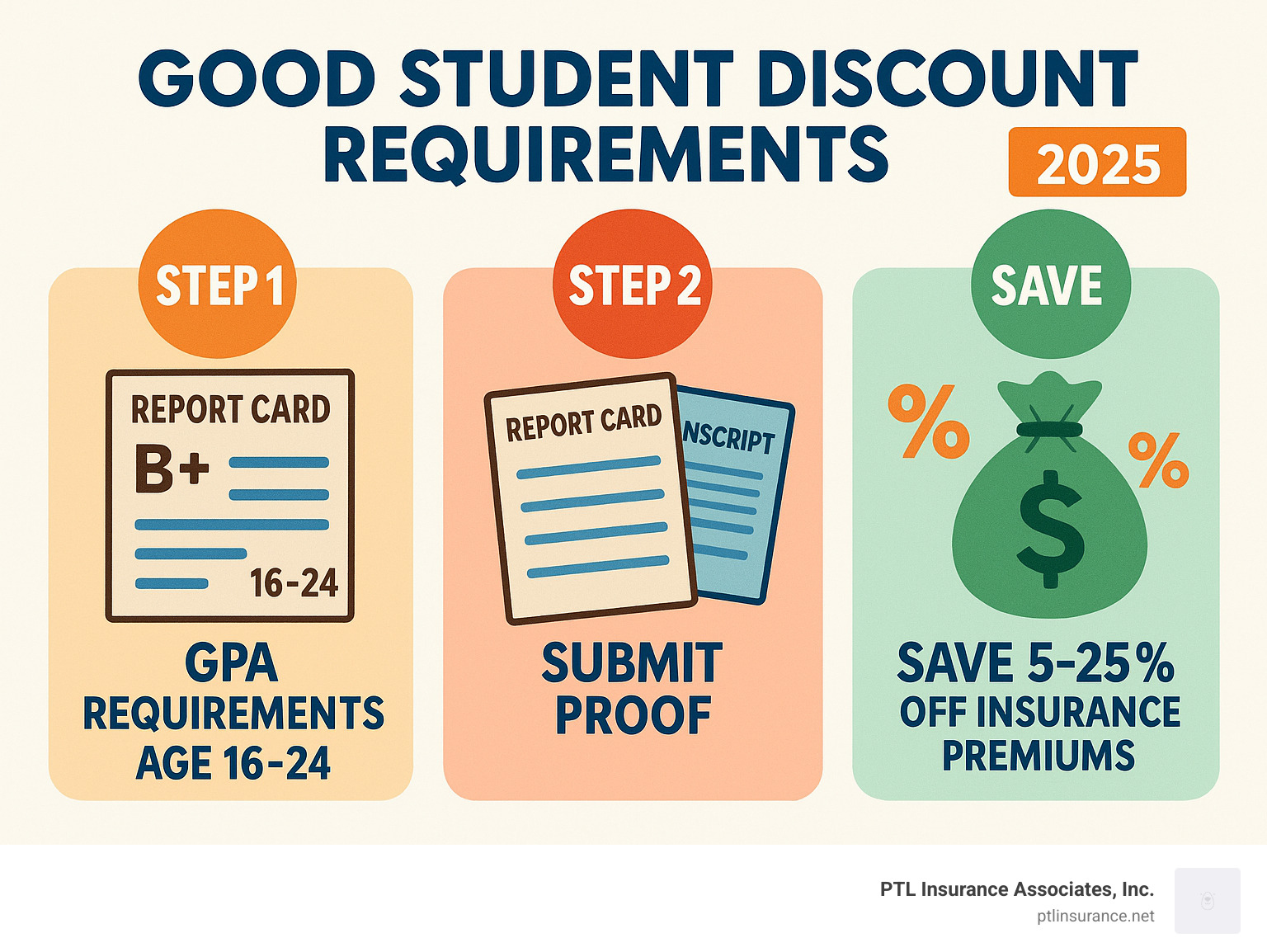
The beauty of working with an independent broker like us is that we can shop around and find which company’s requirements work best for your student’s situation. Let’s walk through what most insurers are looking for.
Common Good Student Discount Requirements for GPA
Here’s where your student’s hard work really pays off – literally. Most insurance companies want to see consistent academic performance, and they’ve made it pretty straightforward to qualify.
The magic number you’ll see everywhere is a B average or 3.0 GPA. This seems to be the sweet spot that insurers have settled on. Some companies will also accept being in the top 20% of your class if your school doesn’t use traditional grades. It’s like having a backup plan – if one way doesn’t work, there’s usually another path to savings.
For students who learn at home, things get a bit more creative. Many insurers will look at standardized test scores like the SAT or ACT instead. The key is showing that your homeschooled student is performing at the same high level as their traditionally-schooled peers.
What I love about these requirements is that they’re not asking for perfection – just consistent effort. A B average is achievable for most dedicated students, and it shows insurance companies that your teen takes responsibility seriously.
Age and Driver Status Restrictions
Insurance companies aren’t trying to be difficult with age limits – they’re just focusing their discounts where they’ll make the biggest difference. Most good student discount requirements target drivers who are dealing with those sky-high young driver premiums.
You’ll typically need to be between 16 and 25 years old to qualify, though some companies cut it off at 23 or 24. The reasoning makes sense – these are the years when car insurance costs the most, so that’s when families need the help most.
There’s usually an unmarried status requirement too. I know it might seem random, but insurance companies have found that married young drivers often have different risk profiles than single ones. And since most high school and college students aren’t married anyway, it rarely becomes an issue.
The licensing requirement is pretty straightforward – you need to be a licensed driver, obviously! Some companies also want you to have been licensed for fewer than six years, which keeps the discount focused on newer drivers who are still building their driving records.
School Enrollment Status
This is where we separate the serious students from the casual learners. Insurance companies want to see that your student is committed to their education, which usually means full-time enrollment.
Whether your student is finishing up at Miami High or just starting at a local college, full-time status at high school, college, or university is typically required. This makes sense – part-time students might have different schedules and responsibilities that could affect their driving patterns.
For families choosing homeschooling, don’t worry – you’re not left out! Most companies will accept homeschool certification or standardized test results showing your student is in the top 20% nationally. It’s just a different way of proving the same thing – that your student is dedicated to learning.
If your student is heading off to university, you might want to check out our guide on Car Insurance for University Students for additional money-saving tips that go beyond just the good student discount.
The bottom line? These requirements aren’t meant to be obstacles – they’re meant to reward students who are already doing what they should be doing anyway. And we’re here to help you steer every detail to make sure you’re getting every discount you deserve.
How to Prove Your Eligibility and Get the Discount
Once you understand the good student discount requirements, the next crucial step is gathering and submitting the right paperwork to your insurance provider. I know, I know – more paperwork feels like getting assigned extra homework when you’re already juggling finals! But trust me, when you see those premium savings, you’ll agree it’s some of the most profitable “homework” you’ll ever do.
The documentation process involves proving two key things: that you’re actually enrolled as a full-time student and that your grades meet the required standards. Think of it as showing your “academic ID card” to open up those savings.
Navigating Good Student Discount Requirements for Documentation
Getting your good student discount requirements documentation together doesn’t have to be complicated. Most insurance companies accept similar types of proof, and the good news is you probably already have most of what you need sitting in your backpack or email inbox.
Report cards are often the easiest option – just grab a copy of your most recent one that clearly shows your grades and the grading period. If you’re in college, an official or unofficial transcript from your registrar’s office works perfectly and gives a more comprehensive view of your academic performance.
Sometimes a letter from a school administrator can work wonders, especially if your school uses an unusual grading system. This needs to be on official school letterhead from someone like your principal, dean, or registrar, confirming both your full-time enrollment and that you’re maintaining the required GPA.
Made the Dean’s List or Honor Roll? Congratulations! That certificate or official notification can serve as excellent proof of academic excellence. For our homeschooled students, standardized test results showing performance in the top 20% (like PSAT, SAT, or ACT scores) are typically accepted, along with a certification from a recognized homeschool certifying body.
The submission process is usually straightforward. Most insurance companies accept documents via email, mail, or through their online portals. At PTL Insurance Associates, we make this process as painless as possible for our Miami clients, walking you through exactly what you need and helping you submit everything correctly the first time.
Here’s something important that catches many families off guard: this isn’t a one-time thing. To keep enjoying your good student discount, you’ll need to provide updated proof regularly – typically every policy period (which could be every six months or annually) or every 6-12 months depending on your insurer’s requirements.
This regular check-in ensures you’re consistently maintaining those good grades. If your grades slip below the threshold temporarily, you might lose the discount until you bring them back up – but the good news is it can usually be reinstated once you’re back on track.
The key to avoiding any lapses in your discount is staying proactive. When policy renewal time approaches or when you receive new grades, reach out to your agent. We can tell you exactly what documents are needed and when to submit them, making sure you never miss out on those valuable savings because of a paperwork mix-up.
How Much Can You Save with a Good Student Discount?
Here’s where things get exciting! After jumping through all those good student discount requirements hoops, you’re probably wondering what’s actually in it for you. The good news? The savings can be pretty impressive, especially when you consider how expensive car insurance can be for young drivers.
Most insurance companies offer savings that range from 5% to 25% off your premiums when you qualify for their good student discount. Now, I know percentages can feel a bit abstract, so let’s talk real money.
The discount percentage varies quite a bit depending on your insurance company and your specific policy coverage. Some insurers start their good student discounts at around 5%, which might seem modest but still puts money back in your pocket. Others are more generous, offering discounts that can reach up to 25% off your premiums.
What does this look like in actual dollars? Students could save anywhere from $100 to $200 annually on their auto insurance policy. For Miami families dealing with already high insurance costs, that’s real money that can go toward textbooks, gas, or maybe even a spring break trip.
Think about it this way: if your annual premium is $2,000 (which isn’t unusual for teen drivers), a 10% good student discount saves you $200 per year. That’s like getting a month and a half of coverage for free, just for keeping your grades up!
The savings become even more meaningful when you consider that teen drivers typically face much higher insurance costs than older, more experienced drivers. Car insurance for young drivers can cost thousands more per year due to their higher accident rates. The good student discount helps offset some of that financial sting.
Every dollar counts when you’re managing the costs of insuring a young driver. That’s why we always encourage our Miami clients to explore every available discount opportunity. Finding Affordable Car Insurance for Students often means stacking multiple discounts together, and the good student discount is usually one of the most substantial ones available.
The exact amount you’ll save depends on factors like your driving record, the type of coverage you choose, and your insurance company’s specific discount structure. But one thing’s for sure: maintaining good grades pays off in more ways than just making your parents proud!
Beyond Good Grades: Other Car Insurance Discounts for Students
While meeting the good student discount requirements is an excellent way to save, it’s just one piece of the puzzle when it comes to reducing your car insurance costs. Think of it like building a savings sandwich – the good student discount might be your main ingredient, but adding other discounts creates something much more substantial for your wallet!
At PTL Insurance Associates, we’ve spent over 35 years helping Miami families find every possible way to save on their insurance. We know that young drivers face some of the highest premiums, so we make it our mission to find every discount you qualify for. It’s like being a detective, but instead of solving mysteries, we’re solving high insurance bills.
The beauty of insurance discounts is that many can be combined. So while you’re already saving with good grades, you might be able to stack additional savings on top. Let’s explore some other opportunities that could put even more money back in your pocket.
| Discount Type | Primary Requirement | Typical Age Range | How it Helps Save |
|---|---|---|---|
| Good Student Discount | Maintain B average (3.0 GPA) or equivalent | Under 25 | Rewards academic responsibility, indicating lower driving risk |
| Distant Student Discount | Attend school 100+ miles from home, car stays home | Under 23 | Reduces exposure to risk by limiting vehicle usage while away |
| Driver Training Discount | Complete approved driver’s education/training | Young drivers (often under 21) | Demonstrates improved driving skills and commitment to safety |
Distant Student Discount
Here’s a discount that might seem counterintuitive at first – you can actually save money when your student isn’t driving! The distant student discount is perfect for families whose college-bound kids are heading off to universities far from home.
The basic idea is simple: if your student is attending school more than 100 miles away from home and doesn’t have access to the family car, they’re not putting miles on it or creating risk. Insurance companies recognize this reduced exposure and reward you with lower premiums.
Most insurers require that the student be 22 years old or younger to qualify for this discount. The car must stay at the family home while the student is away at school. This makes perfect sense when you think about it – a car sitting in your Miami driveway while your child studies in Tallahassee presents much less risk than if they were driving it daily around campus.
This discount can be particularly valuable for families with multiple children. You might have one child benefiting from the good student discount while driving locally, and another benefiting from the distant student discount while away at college.
Driver Training and Safety Program Discounts
Insurance companies love proactive safety measures, and they’re willing to pay for them through discounts. Completing approved driver’s education courses beyond the basic requirements shows insurers that you’re serious about safe driving.
Defensive driving courses can provide additional savings even after your initial driver’s education. These courses teach advanced techniques for avoiding accidents and handling challenging driving situations. In a city like Miami, where traffic can be intense, these skills are invaluable.
Some insurers offer specific programs like the TeenSMART program, which focuses on reducing risky behaviors in young drivers. These specialized courses often come with their own discount opportunities.
The implementation of Graduated Driver Licensing (GDL) systems across all states has also created opportunities for savings. While not always a direct discount, following GDL requirements demonstrates lower risk behavior, which can influence your overall rates.
A growing trend we’re seeing is the use of safe driving apps and telematics programs. These monitor your actual driving habits through your smartphone or a device in your car. If you consistently demonstrate safe driving behaviors – smooth braking, appropriate speeds, limited night driving – you can earn ongoing discounts.
The key to maximizing your savings is understanding that these discounts often work together. You might qualify for a good student discount, complete a defensive driving course, and bundle your auto insurance with your family’s home insurance policy. Each discount builds on the others, creating substantial savings that can make car insurance much more affordable for student drivers and their families.
Conclusion
Understanding good student discount requirements might seem like just another item on your already lengthy to-do list, but trust me—it’s one homework assignment that actually pays you back. We’ve walked through everything from maintaining that all-important B average to gathering the right paperwork, and I hope you can see how these requirements aren’t just hoops to jump through. They’re your ticket to meaningful savings on what can be one of your family’s biggest insurance expenses.
The beauty of the good student discount lies in its simplicity: reward responsibility with real financial benefits. When your teenager brings home that report card with solid grades, you’re not just celebrating their academic achievement—you’re looking at potential savings of 5% to 25% on your auto insurance premiums. That can translate to $100-$200 back in your pocket annually.
But here’s where it gets even better. The good student discount is just the beginning. Remember those distant student discounts for college kids who leave their car at home? Or the driver training program discounts that reward safe driving education? These savings can stack up, creating a comprehensive approach to affordable coverage for your student driver.
At PTL Insurance Associates, we’ve been helping Miami families steer these waters for over 35 years. Our personalized approach means we don’t just sell you a policy and disappear. We actively look for every discount opportunity available to you because we know how much these savings matter to real families dealing with real budgets.
My advice? Take a proactive approach. Don’t wait for your agent to mention these discounts—ask about them directly. Every insurance company has different offerings, and what you don’t know really can cost you. We’re here to make sure you know about every penny you can save.
Ready to put your student’s hard work to good use? Let’s find all the discounts you’re eligible for and make sure your coverage works as hard for your family as your student works for their grades. Get a personalized auto insurance quote with us today, and let’s turn those good grades into great savings.

