
Student Car Insurance: Quick Savings 2025
Why Student Car Insurance Costs Are Higher Than You Think
Title: Student Driver Ready for the Road. Caption: The journey to college often involves a car, but the insurance costs can be a shock. Source: Unsplash.
Student car insurance can be a major shock for families preparing for college. Research shows that student drivers face premiums that are 142% higher than average rates, with some cases reaching up to 210% more expensive than standard coverage.
Quick Answer: What You Need to Know About Student Car Insurance
- Average Cost: Students over 20 pay approximately $4,000 annually
- Why It’s Expensive: Drivers under 25 are statistically higher risk
- Best Savings Strategy: Stay on parent’s policy (usually cheapest option)
- Top Discounts: Good student (10-25% off), distant student (up to 50% off)
- Required Coverage: Liability insurance is mandatory in all states
The reality is simple: insurance companies view young drivers as higher risk because statistics show they’re more likely to be involved in accidents. The good news is there are proven strategies to significantly reduce these costs.
Whether you take your car to campus or leave it at home, understanding your options can save you thousands. From academic discounts to smart policy decisions, this guide will show you how to steer student auto insurance.
I’m Niki Perez, and after years in real estate management, I now work alongside my husband at PTL Insurance Associates, where we help families find the most affordable student car insurance solutions. We’ve seen how the right approach can cut student premiums dramatically while maintaining excellent coverage.
Basic student car insurance vocab:
Understanding the Cost & Coverage of Student Car Insurance
Navigating student car insurance can feel tricky, but we’re here to help. Let’s break down the costs and the coverage you need to protect yourself and your ride.
Why Are Premiums Higher for Students?
Why is student car insurance so pricey? It all comes down to risk. Insurance companies rely on statistics, and for drivers under 25, the numbers indicate a higher likelihood of accidents.
First, the statistics aren’t in your favor (yet!). Studies show that drivers under 25 are involved in more accidents than older, more experienced drivers. This higher risk means insurance companies charge more. In fact, student car insurance can be 142% higher than average rates, sometimes jumping up to 210% more. You can see some of the teen driver accident data for yourself.
Then there’s the lack of driving experience. Most students are new to the road and haven’t had years to build a clean driving record, which is a key factor in lowering insurance costs.
Finally, there’s your limited credit history. In many states, insurers use credit scores to help set rates. Since students are often just starting to build credit, a limited credit history can lead to higher premiums.
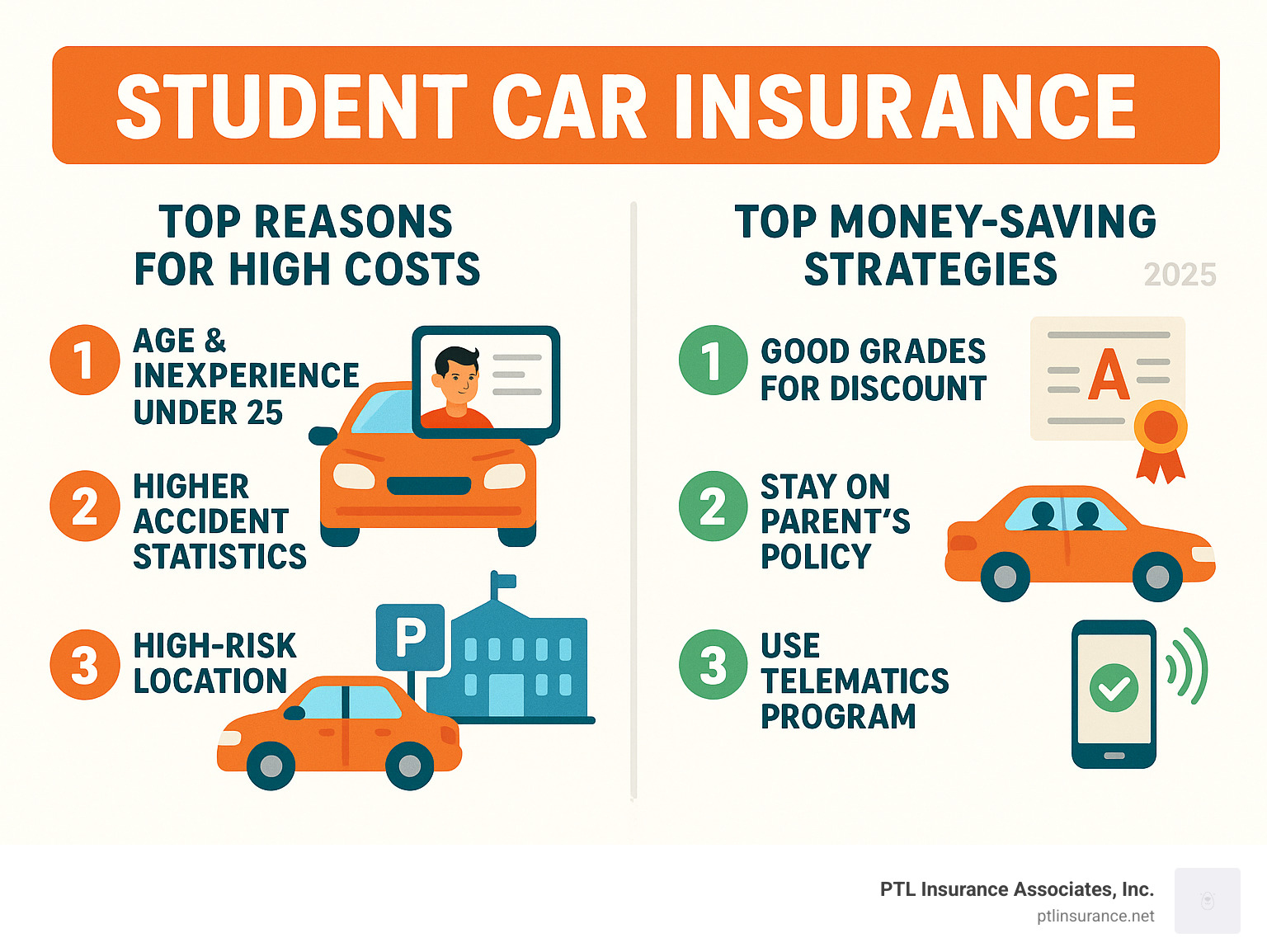
Even if you’re a safe driver, these factors mean your rates will likely be higher than those for more experienced drivers. As the infographic below illustrates, these risk factors are the primary drivers of cost, but there are also clear strategies to save.
Mandatory vs. Optional Coverage
Let’s review the types of coverage you’ll need. Car insurance is divided into mandatory and optional coverages. Every state has minimum requirements; here in Florida, where PTL Insurance Associates is located, this includes Personal Injury Protection (PIP) and Property Damage Liability (PDL).
When it comes to mandatory coverage, the main one is Liability Insurance. This protects you financially if you’re at fault in an accident that causes injuries or property damage. While states have minimums, we always suggest higher limits to protect your future assets. In Florida, you’re also required to have Personal Injury Protection (PIP), which covers your medical bills and lost wages regardless of fault, and Property Damage Liability (PDL), which covers damage you cause to someone else’s property.
Now for the optional coverage – these smart extras can prevent huge financial headaches, even though they add to your premium.
Collision coverage helps pay for damage to your own car if you hit another vehicle or an object, regardless of who is at fault. If you have a car loan or lease, your lender will almost certainly require it.
Comprehensive coverage protects you from non-collision events like theft, vandalism, fire, natural disasters (especially important in Florida), or hitting an animal.
When should you consider these optional coverages? If your car is newer, has significant value, or if you want extra peace of mind, Collision and Comprehensive are a wise investment. Without them, you’d have to pay to replace a totaled car yourself. For a deeper dive into coverage options, check out our guide on More info about Cheap Car Insurance Florida.
The Ultimate Guide to Student Car Insurance Discounts
While student car insurance can be expensive, numerous discounts are available for young drivers. Think of them as a financial reward for being responsible.
Academic and Location-Based Discounts
Your academic performance and living situation can directly lower your insurance premiums.
- Good Student Discount: This directly rewards academic achievement. If a student under 25 has an 80% (A) average or a minimum 3.0 GPA, they could qualify. This discount can lower car insurance rates by a significant 10-25%.
- Student-Away-at-School Discount: This is for families with students attending college far from home without their car. If the school is 100 km (or 100 miles) or more from home and the student is listed as an occasional driver, you could qualify. Some insurers offer up to a 50% discount for this, which is ideal for students who only drive when home for breaks.
Driving and Vehicle-Based Discounts
How you drive and what you drive can also lead to savings.
- Driver’s Training Discount: Completing an accredited driver’s training course can qualify new drivers for a discount. This can apply for up to three years after passing the course and signals to insurers that you’ve received professional instruction.
- Multi-Vehicle Discount: Insuring more than one vehicle with the same company can lead to a discount of 5% to 15%. This is a common strategy for families with a student on their policy.
- Usage-Based Insurance (Telematics): Many insurers offer programs that monitor driving habits like speed, braking, and mileage. Demonstrating safe driving can lead to savings of up to 30%. This allows safe student drivers to prove their low-risk behavior and earn significant savings.
- Safe Vehicle Features: Cars with anti-theft devices, advanced safety features, or a good alarm system can earn discounts because they reduce the risk of theft or accidents.
Ready to explore how these discounts can work for you? Take a look at our insights on Auto Insurance with Student Discounts.
Strategic Moves: How to Lower Your Premiums Beyond Discounts
Beyond discounts, certain strategic decisions can have a huge impact on your student car insurance rates.
To Share or Not to Share: Your Policy Options
One of the biggest questions is whether a student should get their own policy or be added to a parent’s. The answer is almost always to share.
For most students, being added to a parent’s policy is the most cost-effective option. You benefit from your parents’ established driving history, lower rates, and multi-car discounts. This is especially true if the student is an “occasional driver.”
While most policies have “permissive use” coverage for occasional drivers, any student living in the household with a license must be listed on the policy if they drive regularly. Failing to disclose a regular driver can lead to denied claims or policy cancellation, as insurers can detect unlisted drivers.
There are times when an individual policy is necessary, such as if the student owns their car, lives independently, or has a different permanent address. An individual policy also allows a student to build their own insurance history, which can lead to lower rates later on.
Here’s a quick comparison to help you decide:
| Feature | Staying on Parent’s Policy | Getting an Individual Policy |
|---|---|---|
| Cost | Generally much lower, leveraging family discounts and history | Significantly higher for young drivers; no family discounts |
| Coverage | Benefits from established family coverage limits | Student chooses coverage limits, potentially lower |
| Convenience | Simpler; one bill, one point of contact | More administrative work; separate billing and management |
| History Build | Benefits from family history, less direct impact on personal history | Builds personal insurance history from scratch |
How Your Living Situation Impacts Your Student Car Insurance
Where you live and park your car significantly impacts your premiums, as insurers assess risks like local crime rates and traffic density.
If you’re living at home and commuting, you’ll likely remain on your parents’ policy as a secondary driver, which is usually the cheapest option.
If you’re living in a dorm without a vehicle, you might qualify for the “away-at-school” discount on your parents’ plan. If you take your car, the university’s ZIP code and parking safety will affect your rates.
If you’re living off-campus, your situation is more complex. You may need your own policy, or you might stay on your parents’ policy with the new address listed. The ZIP code of your off-campus housing can dramatically affect rates, with urban areas often being more expensive. Your parking location also matters; a private garage is less risky than street parking. Always inform your insurer where the car is primarily kept.
Other Smart Choices for Savings
Here are some additional tips we share with our clients.
First, choosing a sensible, safe car makes a big difference. Sports cars or luxury vehicles are more expensive to insure than reliable sedans or compact SUVs with high safety ratings.
Next, consider your deductible, the amount you pay out-of-pocket before insurance kicks in. Choosing a higher deductible (e.g., $1,000 instead of $500) will lower your premium. Just be sure you can afford it if you need to make a claim.
Perhaps the most vital long-term strategy is to maintain a clean driving record. An accident- and ticket-free driver will save significantly. Drive safely, avoid distractions, and follow traffic laws.
Building a good credit score also plays a role. In many states, your credit score can influence your insurance rates. Responsible financial habits like paying bills on time can eventually lead to lower premiums.
Finally, always shop around. Rates vary widely between providers. As an independent broker, we can help you compare options to find the best value.
For more ways to keep costs down, explore our comprehensive guide on Find Affordable Car Insurance for Students.
Special Scenarios for Student Drivers
College life rarely follows a straight path, and neither does student car insurance. Moving away for college presents unique insurance challenges, but with a little planning, you can avoid common pitfalls.
Out-of-State and International Students
Coverage across state lines is generally straightforward if you’re on your parents’ policy. Your family’s insurance will typically follow you to your new college town. However, you must inform your insurer of the move.
This is essential for valid coverage. Your premium is based on where your car is primarily located. A vehicle on a busy campus faces different risks than one in a quiet suburban driveway.
Failing to update your address is considered misrepresentation and can lead to a denied claim or policy cancellation.
For international students, the timeline is important. Your international driving permit or foreign license is typically valid for 60 to 90 days after arriving in the U.S., depending on the state.
After that initial period, you’ll need to obtain a U.S. driver’s license to maintain legal coverage. Insurance companies will require this local license once your international permit expires. It’s wise to start this process early.
Your insurance costs as an international student will be similar to other students your age, based on factors like driving experience, car type, and location.
For more detailed guidance, our guide on car insurance for university students covers the specific challenges college students face.
Temporary Student Car Insurance: Is It an Option?
Many students ask about getting student car insurance for just a few months, such as for summer break. It’s a logical question, but the answer isn’t straightforward.
Short-term policies are rare in the U.S. market. Unlike in some countries, standalone temporary policies for a few weeks or months are not common. Standard policies are written for 6- or 12-month terms.
However, there are practical alternatives.
When temporary coverage makes sense, it’s for specific situations like borrowing a car for a weekend or a summer job. These are typically handled through existing policies.
The best solution for summer driving is to be added to your parent’s policy for the months you’re home. Families can often adjust their policy twice a year, adding the student for the summer and removing them when they return to school without the car.
Being listed as an occasional driver on a standard 6-month policy often works better than finding temporary coverage. This ensures you’re covered whenever you drive during breaks and is typically more affordable than a separate policy.
The key is working with your insurance provider to find the arrangement that matches your driving patterns. At PTL Insurance Associates, we help families structure their policies to accommodate the changing needs of student life.
Frequently Asked Questions about Student Car Insurance
We get a lot of questions about student car insurance, and we’re happy to answer the most common ones to help clear up any confusion.
Is it cheaper to stay on my parents’ car insurance policy?
Yes, in almost all cases, it is significantly cheaper for a student to stay on their parents’ car insurance policy.
When added to a family plan, you benefit from your parents’ established driving history and potential multi-car discounts. An individual policy for a young driver is almost always more expensive due to the higher perceived risk.
Do my grades really affect my car insurance rates?
Yes, they do. Insurers recognize that students with good grades are often more responsible drivers.
That’s why they offer a “Good Student Discount.” If you’re a full-time student under the age of 25 with a B average (3.0 GPA) or higher, you could qualify. This can lower your student car insurance premium by as much as 25%!
Do I have to tell my insurer that I’m taking my car to college?
Yes, you absolutely must inform your insurance company if you’re taking your car to college.
Your premium is calculated based on where the car is primarily kept. Factors like ZIP code, traffic, and crime rates all play a role in determining your rate.
If you don’t update your address, it could be considered misrepresentation, which could lead to a denied claim or your policy being voided. A quick call to your provider can prevent this.
Conclusion
While student car insurance can seem overwhelming, this guide shows it’s manageable. Young drivers often face higher rates, but you’re not stuck paying a fortune.
You have many ways to control your premiums. Leveraging discounts for good grades, completing a driver training course, and choosing to stay on a family policy can dramatically cut costs. Simple habits like maintaining a clean driving record and choosing a sensible car also make a huge difference.
The key is finding a plan that’s right for your unique situation, whether you’re living at home, in a dorm, or heading out of state.
That’s where an independent insurance broker like PTL Insurance Associates, Inc. really shines. We’re here to help you steer all those options, compare quotes from multiple carriers, and secure the best protection without breaking the bank. Our goal is to make sure you get exactly what you need at a price that fits your student budget.
Ready to find your perfect fit and drive confidently into your college years? Let’s get started! Explore your options for Auto Insurance today.